


Forget about Nvidia! These US stocks are expected to emerge as the big winners in AI.

Goldman Sachs has different views on AI trading: Forget about today and focus on the long term.
In the midst of the artificial intelligence (AI) boom, the stock price of NVIDIA (NVDA.US) has risen over 200% this year. The prosperity of AI has led investors to eagerly search for the next hot stock, but Goldman Sachs has a different view on AI trading: forget about today and focus on the long term.
According to the Zhitong Finance APP, Goldman Sachs analysts Ryan Hammond and David Kostin have designed an index (code: GSTHLTAI) that includes long-term AI beneficiaries. These component stocks are companies that utilize AI to create more efficient labor, lower labor costs, or both, with the potential for significant long-term earnings growth per share. The team stated that based on the consensus earnings forecast for 2024, the median earnings per share of stocks in their index could increase by approximately 72% through AI-related productivity improvements.
Productivity is just one AI-related factor that investors consider when evaluating stocks, but in a market obsessed with ChatGPT, Goldman Sachs' index provides another tool for picking winners from the losers.
Gregor Schubert, an economist at the University of California, Los Angeles, said, "For stock researchers and investment managers, this could be a useful tool as they consider how to filter out exaggerated statements in media channels and transform the overwhelming technology news into more actionable investment decisions based on their own assumptions."
Any such predictions come with a lot of caveats. First, it is still unclear when each company will see earnings growth and when the market will react. Goldman Sachs analysts expect AI to have a "meaningful macro impact" at some point between 2025 and 2030, but considering that valuations are often forward-looking, individual stock prices may soar before AI changes the operations of specific companies.
Currently, many of the companies in this index are not Wall Street darlings. Occidental Petroleum (OXY.US), despite struggling to achieve breakeven this year, is still included in the list. The index also includes Walgreens Boots Alliance (WBA.US), one of the worst-performing components of the S&P 500 index this year. Overall, the performance of the GSTHLTAI index has lagged behind the broader market this year, reflecting to some extent the stock selection strategy focused on the future performance of AI.
Goldman Sachs' AI long-term beneficiary index lags behind the broader market
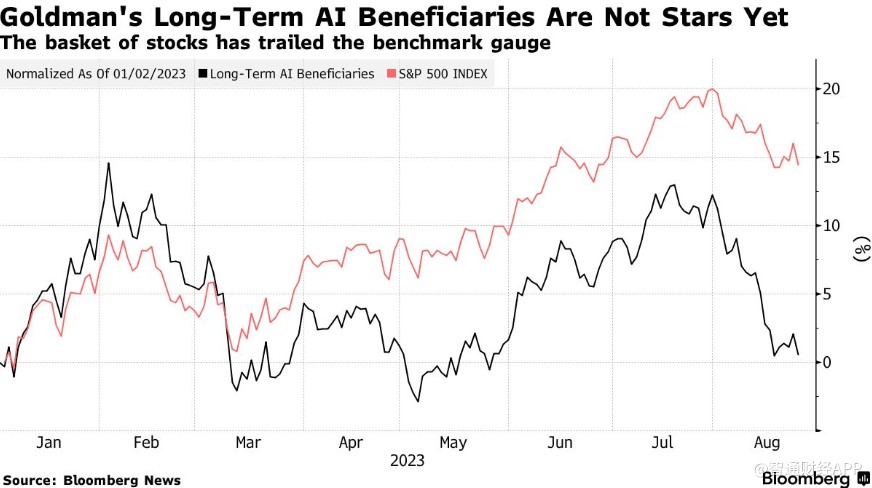
Hammond said, "There is still a lot of uncertainty around AI and the adoption timeline." "This is part of the reason why I believe the index has not performed well so far." This is in stark contrast to the star AI stocks this year - large tech stocks have driven the Nasdaq 100 index up 37% year-to-date. It is worth noting that, apart from Amazon (AMZN.US), the so-called "FAANG" stocks (Meta, Amazon, Apple, Netflix, and Google) are mostly not among the long-term beneficiaries. Hammond said that these stocks may still perform well in the coming years, but the gains may not be driven by productivity improvements related to AI.
The extent to which AI will completely change the workforce depends on the tasks at hand. For example, a recent study found that customer service representatives using generative AI tools had a 14% higher productivity than those who did not use such tools. Other researchers have found that companies in the finance, professional services, and technology sectors are expected to increase productivity through tools like ChatGPT. While this may raise concerns about job displacement, it could also mean that smart chatbots can handle heavy workloads, allowing humans to focus on other tasks.
When compiling this index, Goldman Sachs analysts first assessed the difficulty of AI completing various tasks. Taking into account the implied labor costs of companies, the team calculated productivity improvements based on two scenarios: revenue growth with stable profits, or stable revenue with profit growth. By averaging the two, they calculated the average earnings per share growth for each company.
Boosted by AI, earnings per share of Goldman Sachs index constituents
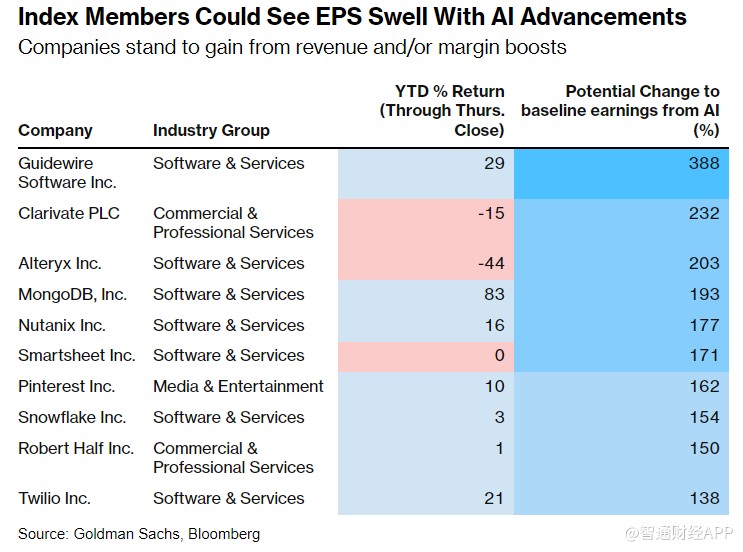
Based on this productivity analysis, Goldman Sachs analysts found that the median earnings per share of stocks in the Russell 1000 index will increase by about 19%. However, some companies will gain more than others, thus occupying a place in the long-term AI beneficiary stock index. For example, the Goldman Sachs team estimates that Guidewire Software (GWRE.US) could see a roughly 388% increase in earnings per share due to productivity improvements.
However, these high estimates are just estimates. Sanford C. Bernstein analyst Nikhil Devnani said, "In theory, this potential is interesting, especially in terms of improving productivity." However, "this is still largely in experimental mode."
