Is there an excess of GPUs? Sequoia Capital: AI cannot earn 200 billion, A16Z "refutes word by word": AI is going to disrupt everything

Appenzeller believes that the fundamental problem with Redwood is underestimating the impact of the historic AI revolution.
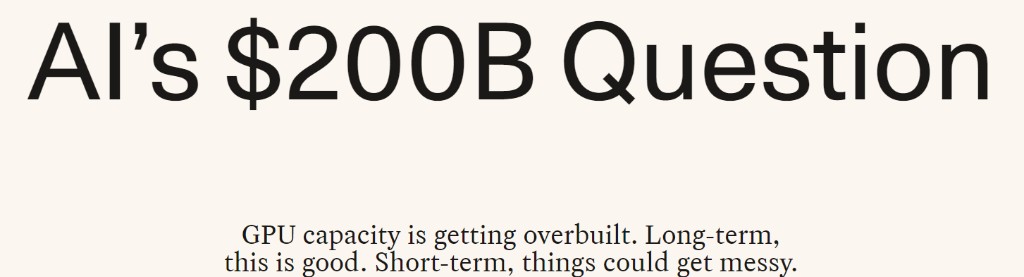
On September 20th, VC giant Sequoia Capital stirred up the entire AI industry with an article about NVIDIA.
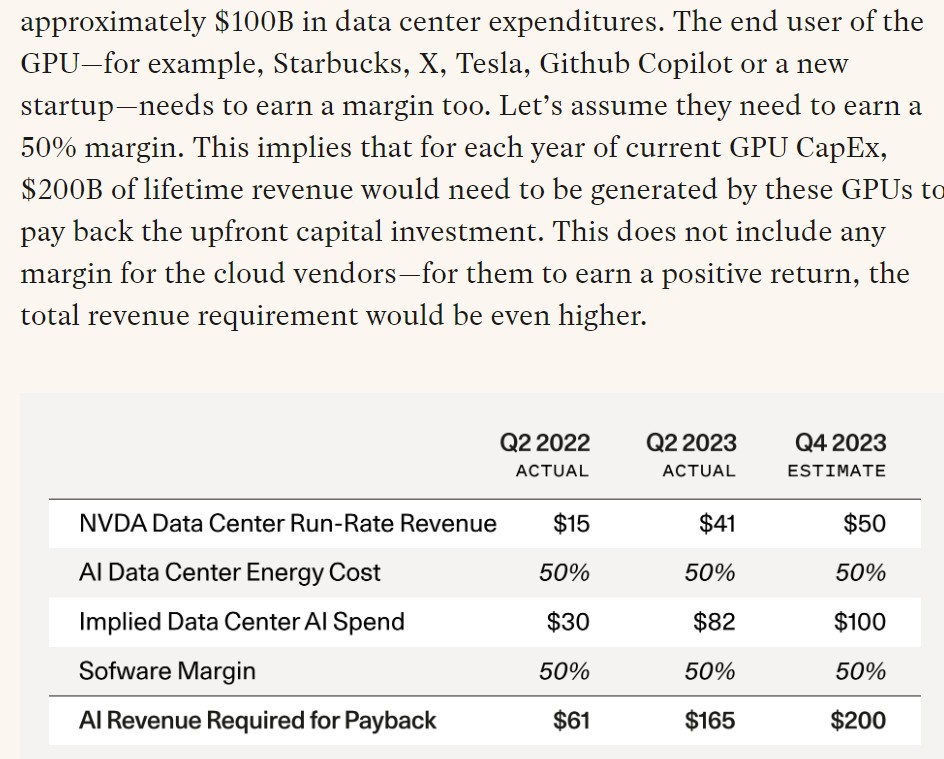
According to David Cahn, a partner at Sequoia Capital, conservatively estimating, NVIDIA's $50 billion GPU sales correspond to $100 billion in data center expenditures for other companies. Assuming a profit margin of 50%, the AI industry would need $200 billion in revenue to offset this expenditure. However, currently, the annual revenue is only $75 billion, resulting in a shortfall of $125 billion. Link
Cahn pointed out that there is an oversupply of GPU production capacity, and he predicts a "money-burning furnace" scenario will reoccur in the AI field.
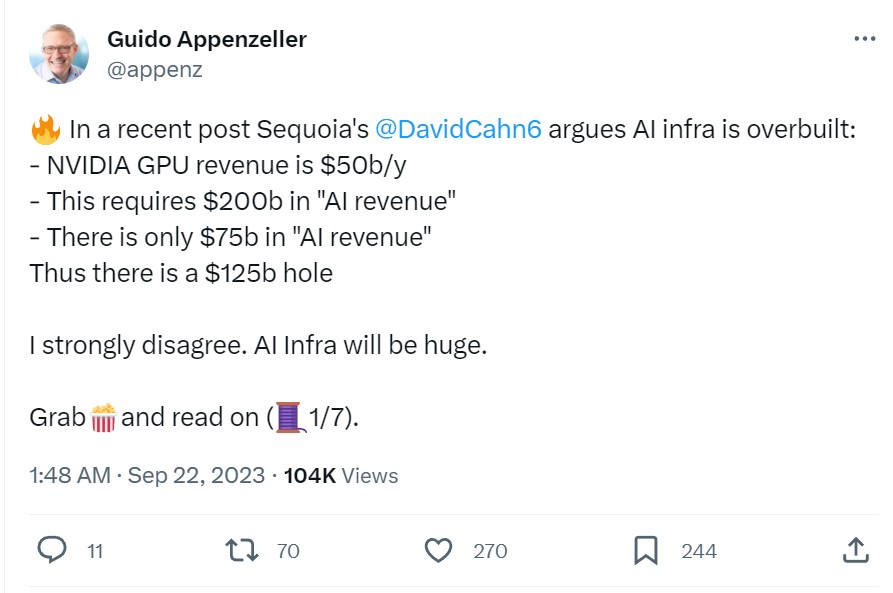
Three days after the incident, Guido Appenzeller, a special advisor at Silicon Valley venture capital giant A16Z and co-founder of AI startup 2X, tweeted nearly 10 times, not only refuting Sequoia Capital's estimation of AI's profitability but also pointing out that the fundamental problem with Sequoia Capital's analysis is underestimating the impact of the historic AI revolution.

Appenzeller: AI will disrupt all software, and there is no revenue shortfall
In a series of tweets, Appenzeller pointed out three major errors in Cahn's article.
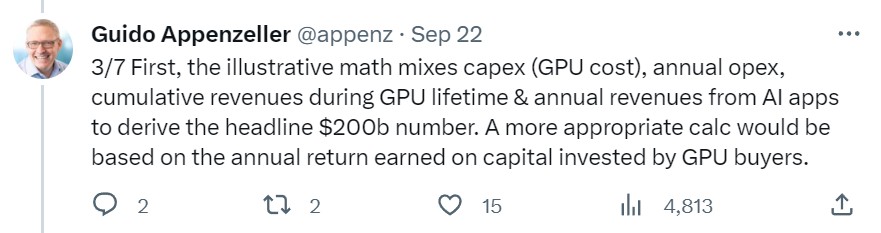
Firstly, Cahn used a $200 billion figure at the beginning of the article to attract attention, but Appenzeller believes that there are issues with the calculation process of this number.

Appenzeller pointed out that Cahn added the purchase cost of GPUs (capital expenditure), annual operating costs, cumulative revenue within the GPU usage cycle, and annual revenue generated by AI applications together to obtain the exaggerated figure of $200 billion.

However, a more appropriate calculation method should be based on the return on investment that GPU buyers can obtain after investing capital. In other words, the return on investment for GPU buyers should be calculated, rather than simply adding up various costs and revenues from different time periods and natures.
Secondly, Appenzeller argues that the cost of electricity for GPUs has been exaggerated. Cahn assumes a 1:1 ratio between electricity consumption and hardware costs for GPUs, but in reality, it's not that extreme.
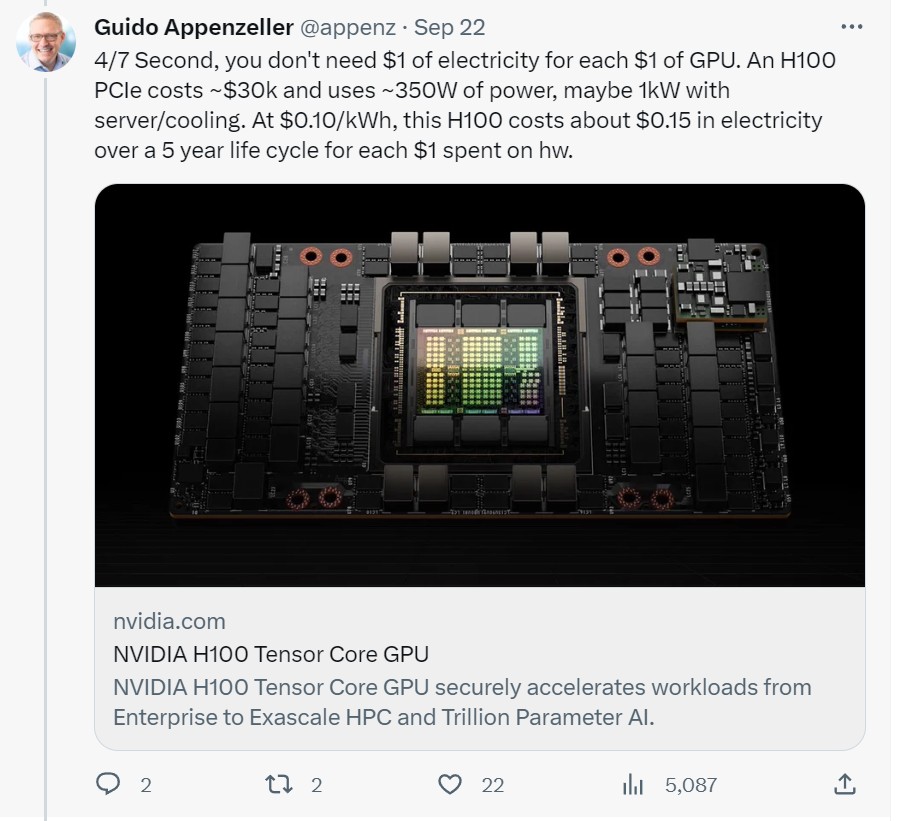
According to Appenzeller, the cost of an H100 PCIe GPU is approximately $30,000, with a power consumption of around 350 watts. Taking into account the server and cooling, the total power consumption may be around 1 kilowatt.
If the electricity price is $0.1 per kilowatt-hour, then over the 5-year lifespan of this H100 GPU, for every $1 spent on GPU hardware, the electricity cost would only be $0.15, far below Cahn's estimated $1.
These two estimates are not the most fatal. Appenzeller believes that the fundamental problem with the article is that it underestimates the impact of the AI revolution.
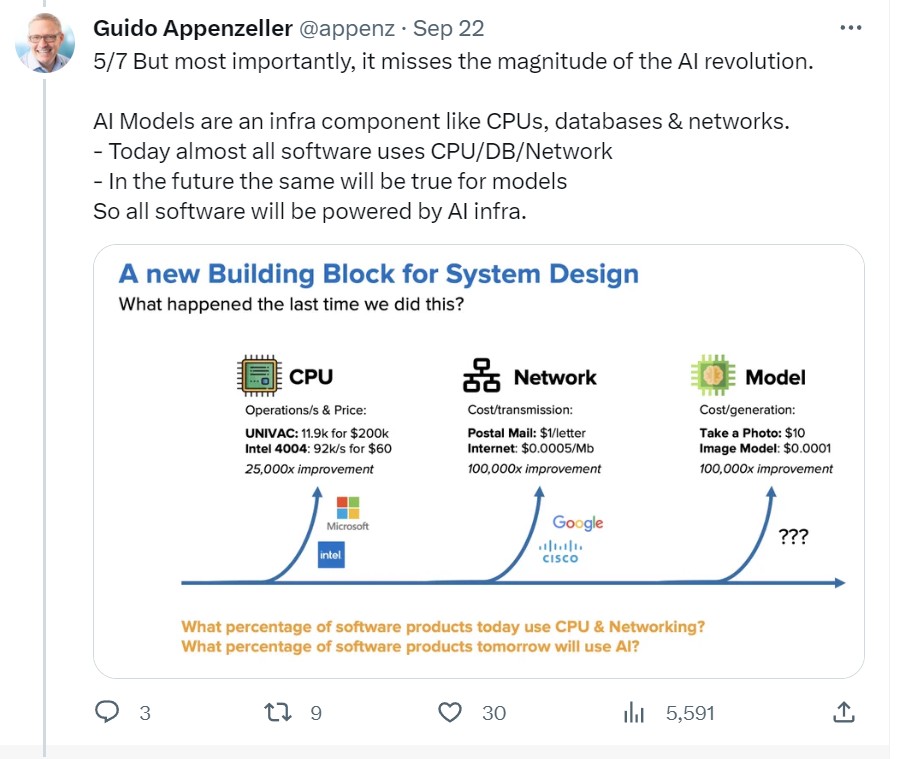
Appenzeller states that AI models, like CPUs, databases, and networks, are infrastructure components. Currently, almost all AI software uses CPUs, databases, and networks, and this will continue in the future.
Therefore, AI models will profoundly impact all software and IT systems, far beyond the narrow domains analyzed in the article. The article overlooks the position of AI models as the future software infrastructure, thus underestimating the true significance of the AI revolution.
Can startups fill this gap? Cahn believes there is a "great opportunity." The technological leap in the AI field and the unprecedented GPU buying frenzy are undoubtedly good news for humanity, but:
In the historical cycles of technology, excessive construction of infrastructure often burns capital, but it also releases future innovation by reducing the marginal cost of developing new products. We expect this pattern to repeat in the AI field.
So, the question arises: can the AI industry really earn $200 billion? Appenzeller gives a definite answer, and not only that, as a network infrastructure, the revenue it generates will exist in every sector in different forms.
Appenzeller states:
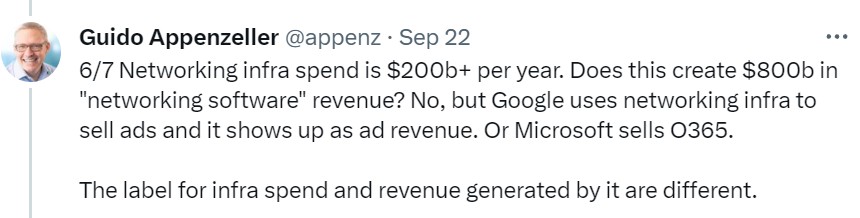
Spending over $200 billion annually on network infrastructure, can it create $800 billion in "network software" revenue?
No, but when Google uses network infrastructure to sell ads, the revenue generated is shown as advertising revenue, not "network software" revenue. Similarly, the revenue achieved by Microsoft Office 365 is not labeled as "network software" revenue. Also, it means that the revenue generated by infrastructure will be categorized differently depending on the department.
In conclusion, Appenzeller argues that the "AI revenue gap" described by Cahn does not actually exist:
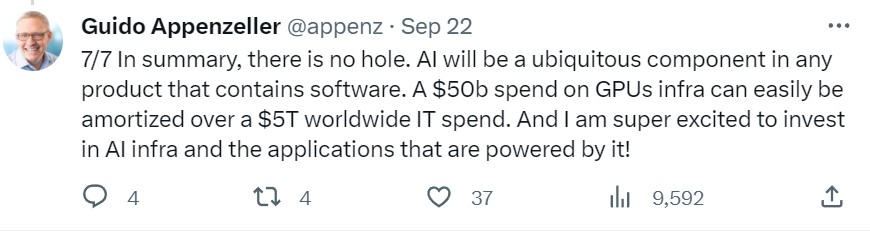
The assumed "AI revenue gap" in the article does not exist. AI and the infrastructure it supports will ultimately be reflected in software expenses and revenue across various industries.
AI will profoundly impact all software, not just narrow AI software. Therefore, we don't need to worry about any "revenue gap" and can confidently embrace the far-reaching effects of the AI revolution on the entire IT industry.
Nvidia's Customers are Slow to Make Profits, Capital's Patience is Running Out
It is worth noting that Sequoia's concerns about the monetization of AI are not unfounded.
A previous article by Wallstreetcn mentioned that the substantial investment in each GPU must eventually translate into value for end customers for the industry to thrive in the long term.
Currently, Nvidia has had impressive performance in the first two quarters of this year as the core beneficiary of the "mining for gold" logic. However, in the downstream application layer, we have only seen an increase in AI investment without any improvement in performance.
Benefiting from the significant demand brought by large-scale model training, orders and performance of AI infrastructure manufacturers have been consistently validated. However, most AI application manufacturers in the B-end are still in the early stages and have yet to enter the commercialization phase. Based on the time required for realization, it is expected to be 2-3 quarters later than the infrastructure layer.
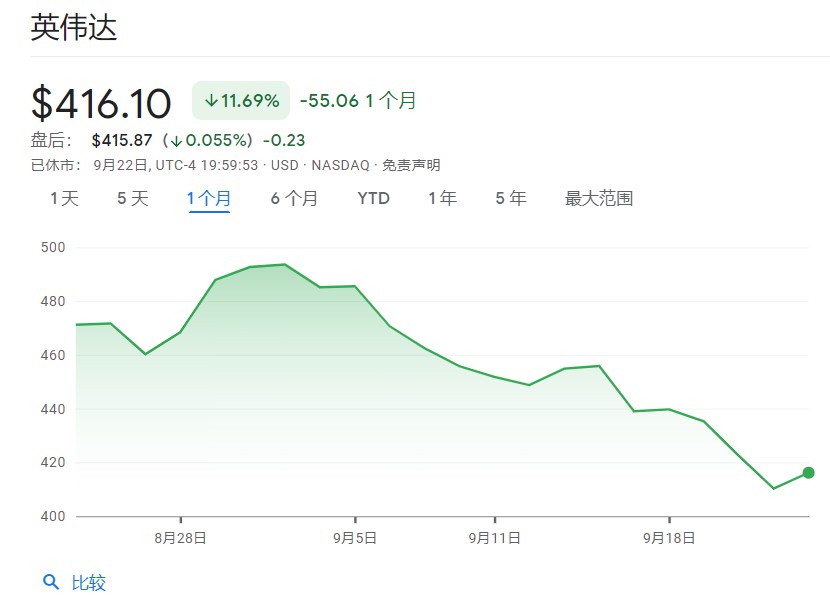
If the gold miners cannot make money, it is also impossible for the shovel sellers to thrive in the long run. In the past month, Nvidia's stock price has fallen by more than 11%, returning to the level of June this year.

With cost reduction and efficiency enhancement still being the main theme of global technology stocks, the patience of the capital market is running thin.