Benefiting from the high popularity of the tourism industry, can the leading luggage brand Samsonite "regain its youth"?

Zhitong
2023.09.24 10:56
portai
I'm PortAI, I can summarize articles.

Stock price and performance soaring, Samsonite returns to growth "fast lane"?

Against the backdrop of a consumer recovery and an unexpectedly strong rebound in the tourism industry, the luggage company Samsonite (01910) seems to be emerging from the "shadow" of previous short-selling and the pandemic.

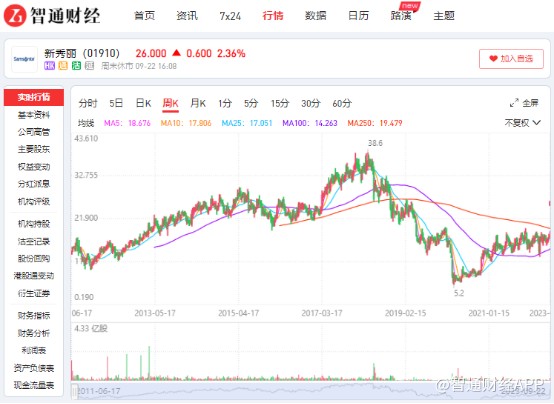
On September 22nd, Samsonite's stock price closed at HK$26, a nearly 500% rebound from its lowest point of HK$5.2 in 2020. It has also recovered nearly 70% from its highest point of HK$37.32 before the short-selling attack in 2018. With the ongoing boom in the tourism industry, the company's stock price may have even more room for growth in the future.

Looking back at the company's experiences in the secondary market in recent years, it can be said that it has encountered numerous "twists and turns". In 2018, short-selling institution Blue Orca Capital released a report accusing Samsonite of six major issues, including financial statement manipulation, CEO resume fraud, lack of internal control in South Asian companies, and related-party transactions. Subsequently, the company's stock price and performance declined, and it suffered losses in 2020 due to the pandemic.

However, according to the latest interim report, the company's performance has rebounded beyond pre-pandemic levels, and the growth rate of net profit is also quite optimistic. The upward trend in the stock price reflects the market's confidence in the company's future prospects. Research reports from institutions such as UBS and Citigroup point out that the company's sales momentum is strong and is expected to maintain good growth in the second half of the year. Overall, whether in terms of performance or stock price, Samsonite seems to have returned to a high-growth trajectory.

Strong rebound in performance indicators, net profit surpasses pre-pandemic levels

Public information shows that Samsonite is the world's most famous and largest luggage company with a history of over 110 years. Before 2012, the company's main business focused on the Samsonite brand, mainly in the distribution of travel luggage through wholesale channels. In recent years, the company has strategically diversified its business and now owns major brands such as Samsonite, Tumi, American Tourister, Gregory, High Sierra, Kamiliant, ebags, Lipault, and Hartmann, as well as other proprietary and licensed brands.

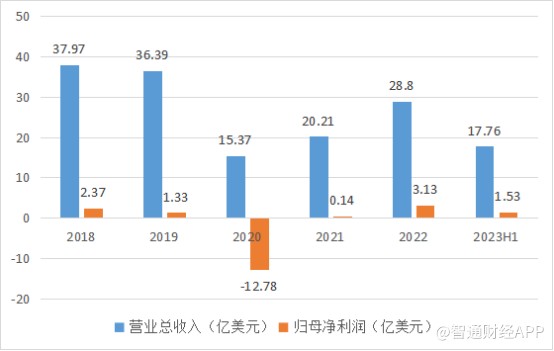
Looking at the performance in recent years, Samsonite's performance fluctuations are closely related to the pressure on the tourism industry during the pandemic. The company recorded a loss of approximately $1.2 billion in 2020, followed by a gradual recovery in profitability. In 2022, although the revenue still lags behind pre-pandemic levels, the profitability has already exceeded the pre-pandemic levels.

In the first half of 2023, the company's performance continued to grow rapidly. According to the mid-year financial report of 2023, the company's sales net amount in the first half of the year was approximately $1.776 billion, a year-on-year increase of 39.8%; the attributable profit to equity holders was $152.5 million, a year-on-year increase of 171.5%; and the basic earnings per share was $0.106. The announcement stated that the strong recovery in leisure and business travel and the resulting increase in demand for the group's products have driven the improvement in the group's sales net amount.

Benefiting from the recovery of tourism demand in Asia and changes in the sales channel mix, the company's gross profit margin increased by 310 basis points to 58.8% compared to the same period in 2022, reflecting a rapid recovery in profitability.

According to the Zhitong Finance APP, the company's performance recovery is mainly driven by the Asian market. Samsonite stated that in the first half of 2023, the company's total sales net amount increased by 16.2% compared to the first half of 2019, and the sales net amount in all regions exceeded the level before the outbreak of the COVID-19 pandemic in 2019. Among them, sales in Asia reached $694 million, a significant year-on-year increase of 76.4%, making it the company's largest revenue market again after three and a half years; sales in North America, Europe, and Latin America increased by 24.8%, 21.4%, and 23.2% respectively; sales in India, Japan, and South Korea all achieved double-digit growth in the first half of the year; sales in Hong Kong and Singapore increased by over 100% and over 200% respectively compared to the same period last year.

In terms of costs, the company's expense control efficiency has improved, and the leverage level is expected to be further optimized in the future. In the first half of the year, the company's marketing expense ratio increased by 1.9 percentage points to 6.4% year-on-year, while the management expense ratio decreased by 1.1 percentage points to 7.2%. The company revealed at the performance meeting that the full-year gross profit margin and adjusted EBITDA profit margin targets are 59% and 19% respectively, and the net leverage ratio target is expected to decrease to about 2 times by the end of the year.

With the high growth of the tourism industry, the upward trend is expected to continue in the second half of the year.

After the comprehensive relaxation of epidemic prevention and control measures, the global tourism industry is experiencing a retaliatory recovery. Data released by the International Air Transport Association shows that global air passenger traffic in the first half of 2023 increased by 47.2% year-on-year, and the global air passenger traffic in June has recovered to 94.2% of the level in 2019. The Asia-Pacific region has the highest year-on-year growth rate in global air passenger traffic (90.1%), followed by Africa (31.8%) and the Middle East (28.3%), while Latin America, Europe, and North America have weaker growth.

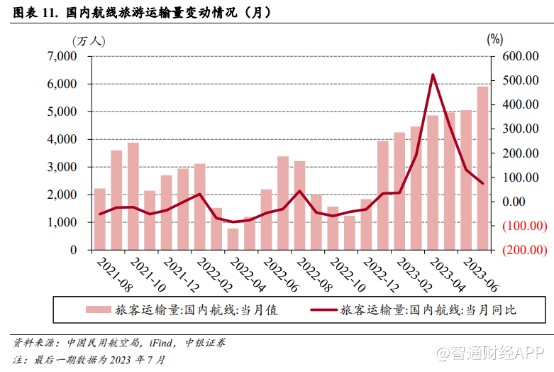
In China, the domestic civil aviation industry has also entered a period of rapid recovery after a trough, and the flight volume of major airlines is rapidly increasing. According to data from the Civil Aviation Administration of China, from January to June 2023, the passenger transportation volume of China's civil aviation completed 283.769 million, a significant year-on-year increase of 140.2%. From July 1st to August 31st, benefiting from the unexpected recovery in travel demand during the summer vacation, the civil aviation industry as a whole has guaranteed more than 17,200 flights per day, an increase of 0.54% compared to the same period of the summer season in 2019. Transported 130 million passengers, an increase of 7.4% compared to the same period during the summer of 2019, with an average daily passenger volume of 2.106 million, an increase of 7.4% compared to the same period during the summer of 2019.

Looking at the trend in the second half of the year, with the approaching of the National Day and Mid-Autumn Festival holidays, the popularity of domestic and outbound tourism continues to rise, which is expected to further boost domestic long-haul tourism and outbound tourism. According to Ctrip data, the booking volume of domestic tourism products during the "Golden Week" holiday increased by 88% compared to the previous week, and it increased more than four times compared to the same period last year. Among them, Hangzhou's overall order volume during the "Golden Week" holiday increased more than five times due to the hosting of the Asian Games. The outbound travel orders during the "Golden Week" holiday increased nearly 20 times compared to last year, with popular destinations including Thailand, South Korea, Malaysia, Singapore, Australia, and the United Kingdom.

According to the Zhitong Finance APP, at the company level, Samsonite's revenue in July continued the strong trend of the second quarter, with overall, North America, Asia, and Europe revenues increasing by 18%, 8%, 22%, and 26% respectively compared to July 2019.

Since August, there have been frequent positive news in the tourism industry. On August 10th, the Ministry of Culture and Tourism released the third batch of outbound group tour lists, adding 78 countries including Japan, South Korea, the United Kingdom, and the United States to the outbound group tour business. On August 11th, the U.S. Department of Transportation announced an increase in passenger flights between China and the United States. According to data from the Civil Aviation Administration of China, the passenger volume of China's international routes in the first half of the year was only about 30% of the same period in 2019, and it recovered to about 40% of the same period in 2019 in June, still with a large room for recovery.

According to Euromonitor, in 2022, Samsonite still ranks first in the global travel luggage market with a market share of 15.9% (Samsonite 10.5%, American Tourister 3.3%, Tumi 2.2%), followed by LVMH Group with 12.6% (LV 9.0%, Rimowa 3.1%); Delsey, ranking third, only has a market share of 2.2%.

Driven by the retaliatory growth in tourism and related consumption and the release of suppressed consumer demand during the previous epidemic, it is expected that Samsonite will continue to benefit from the recovery of domestic and international travel and tourism demand in the coming quarters, further improving its profitability.

Diversified brand layout and progress in high-end development

As a global leader in luggage and bags, Samsonite has formed a series of luggage and bag product portfolios covering the middle and low-end, young fashion, and high-end business through self-built brands and multiple external acquisitions in recent years.

According to the Zhitong Finance APP, the company's brand matrix is centered around three major brands: Samsonite, American Tourister, and Tumi. In the first quarter of 2023, the net sales of the top three brands accounted for 90.35%, with Samsonite/American Tourister/Tumi accounting for 50.2%, 18.0%, and 22.7% respectively. In terms of brand positioning, Samsonite focuses on the mid-to-high-end market, Americam Tourister targets the mass market, and Tumi focuses on the high-end business segment. Additionally, there are also brands like High Sierra, which specializes in outdoor backpacks, and Lipault, which focuses on youth fashion and creativity.

Compared to the United States, Western Europe, and other regions, the competition in the Chinese luggage market is fierce, and the concentration is more dispersed. According to Euromonitor, in 2022, the CR10 of companies in the Chinese luggage market accounted for 24.9%, and the CR10 of brands accounted for 23.2%, with a concentration difference of about 10 percentage points compared to the global market. In a more "competitive" market, most domestic brands focus on cost-effectiveness. However, as the industry continues to develop, the trend towards high-end products has become the main driving force for future profitability.

It is not difficult to observe that the net sales of the core brands of Samsonite in the first half of the year have shown strong year-on-year growth compared to the same period in 2022. Among them, the net sales of Samsonite brand increased by 42.0% (or 47.1% based on constant exchange rates) year-on-year. The net sales of Tumi brand increased by 48.5% (or 51.7% based on constant exchange rates) year-on-year. The net sales of American Tourister brand increased by 36.8% (or 42.5% based on constant exchange rates) year-on-year as of June 30, 2023.

However, it is worth noting that although Tumi, positioned as a high-end brand, became the fastest-growing segment in the first half of the year, its revenue contribution to the overall company is still relatively low. In the first quarter of this year, Tumi brand accounted for 22.8% of total revenue. Looking at the data from 2022, Tumi has the highest proportion in total sales in North America (36.7%), while it still has room for development in Asia (18.4%), Europe (10.3%), and Latin America (3.9%), where the proportions are relatively low.

Summary

Overall, benefiting from the improved external environment, the company's performance has shown a recovery growth trend, and it has also demonstrated optimism in terms of cost and expense indicators. However, from a market perspective, considering that the company's stock price is already at a historically high level, it is necessary to be cautious about the risks of the industry's short-term recovery falling short of expectations, a potential decline in consumer demand after concentrated release, and a short-term correction in the company's stock price. Institutions have given an overall optimistic outlook for the company's performance in the second half of the year, but in the longer term, attention needs to be paid to the progress of the company's high-end brand building.