


This week's (3.25-3.31) stock investment clues summary

This week's investment leads (industries or stocks with positive evaluations in interviews, please cross-validate independently, not stock recommendations) are summarized as follows:
Industry leads (A-shares and Hong Kong stocks): solid-state batteries, GB200 copper cable high-speed connectors, flexible DC converter valves
U.S. stocks: Credo(CRDO.US), Globant(GLOB.US), Snowflake(SNOW.US)
Before detailing the investment leads, let's first introduce the role of AI research navigation in the investment process with a diagram:

This week, 210 interview minutes were updated on the platform, with AI-summarized key conclusions and data on the first page of each minute. You can review the main conclusions and data of dozens of minutes in just one hour.
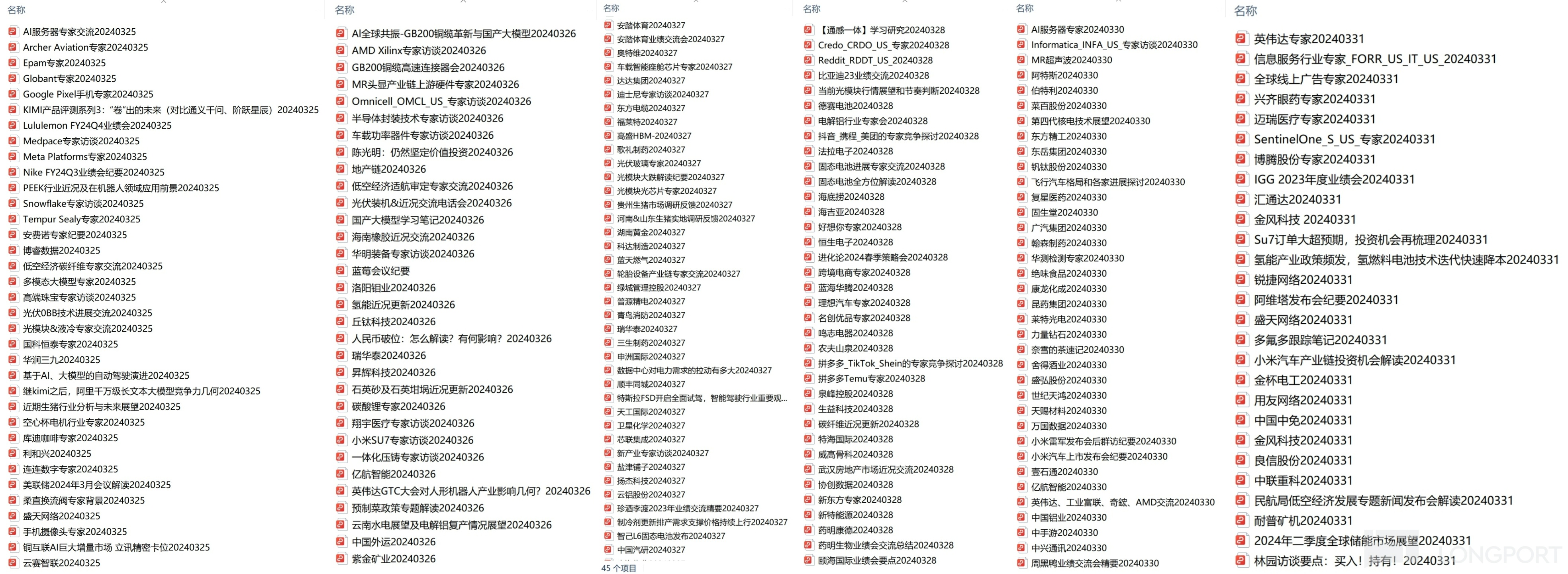
Expert interviews and research reports related to investment leads have been uploaded to the knowledge platform. Those who need to join the platform to access them can do so independently.
1. Industry Investment Leads:
1) Solid-state batteries:
The technical challenges of solid-state batteries include ion conductivity and anode expansion issues, but solutions have been successfully validated in labs and small-scale production.
The main challenge for all-solid-state batteries lies in preventing cracks and defects during thin-film manufacturing, with no mass production achieved yet.
Solid-state batteries are expected to increase the range of electric vehicles to over 1,000 km, with energy density rising to 280-320Wh/kg.
Solid-state battery technology has already been applied in consumer electronics, such as vivo smartphones, indicating accelerated technological maturity and commercialization.
Despite technical and cost challenges, solid-state batteries are expected to see broader applications as technology advances and production scales up.
The technological focus and talent recruitment by companies like CATL highlight the industry's emphasis on solid-state batteries, suggesting potential breakthroughs and large-scale applications by around 2027.
2) GB200 copper cable high-speed connectors:
Event: NVIDIA's GTC conference showcased achievements in AI computing hardware, software ecosystems, edge intelligence, and more. The highlight was the release of the new Blackwell architecture, including the Blackwell GPU chip, which offers about 5x AI performance improvement over the previous H100, and the GB200 superchip, consisting of one Grace CPU and two B200 GPUs. The GB200 superchip uses high-speed copper cable interconnects (requiring high-speed backplane connectors) between GPUs and NVSwitch.
Currently, Amphenol is the sole supplier of GB200 copper cables and connectors, handling both production and connector design without OEM outsourcing.
The copper material for GB200NB1732 comes from Ningbo Boway Alloy, with about 5,000 cables produced by Amphenol, paired with specially designed connectors. The value of these cables and connectors accounts for roughly 6%-7% of the entire server, estimated at 1-2 million RMB per GB200 server.
Amphenol is unlikely to outsource cable production soon, as its profit margin exceeds 50%. With a dedicated cable factory in Shanghai, Amphenol will continue in-house production unless demand exceeds capacity.
Each GB200 server's copper alloy generates over 100,000 RMB in profit for suppliers, with copper cables priced around 900,000 RMB (cost: ~600,000 RMB). Connectors, estimated at 2,500 units per server (5-6 USD each), add ~100,000 RMB, bringing total connection costs to 1-1.2 million RMB per server.
3) Flexible DC converter valves:
Flexible DC (FDC) and conventional DC (CDC) are two mainstream HVDC transmission methods. CDC is mature and cost-effective but faces commutation failure risks and relies on reactive power compensation. FDC is newer, enables independent active/reactive power control, and requires less compensation, but depends on imported core components and is more expensive.
CDC converter valves cost ~1.2 billion RMB, while FDC valves range from 5-6 billion RMB, depending on voltage level, capacity, and components.
FDC core components like IGBTs and capacitors are mainly imported, driving high costs. However, localization efforts are expected to reduce costs over time.
Over the next 5-10 years, FDC valves are projected to reach a market size of 100 billion RMB, driven by renewable energy bases and offshore wind projects, potentially replacing some CDC applications.
Key players in FDC valves include NARI Technology, Rongxin Huiko, and XJ Electric. NARI is expected to maintain leadership despite increasing competition.
2. U.S. Stock Investment Leads:
1) Credo(CRDO.US):
In AI infrastructure, InfiniBand and AEC technologies are widely discussed. InfiniBand is bundled with NVIDIA's H100, while AEC is promoted by Credo. Standards like 400G/800G vary, with some still using DAC.
A Microsoft executive noted AEC's deployment on active-passive servers, with support for both Credo and Broadcom solutions.
Credo is favored for high-performance solutions, while Broadcom and Marvell attract buyers with comprehensive offerings and discounts.
AI infrastructure demand primarily comes from hyperscalers (e.g., Microsoft, Google, Azure), second-tier providers (e.g., CoreWeave, Lambda Labs, Jarvis), and general clients, with hyperscalers leading.
2) Globant(GLOB.US):
Globant's 2023 revenue hit a record $2.1 billion, up ~18% YoY.
Its GlobantX platform offers innovative products to reduce delivery costs and accelerate goals.
North America contributes ~60% of revenue, with LATAM and EMEA growing steadily.
2023 operating margin was 15.2%, expected to expand 30 bps to 15-16% in 2024.
Experts project 15-17% growth for 2024, calling it conservative.
3) Snowflake(SNOW.US):
The data warehouse market will likely consolidate around six players (three hyperscalers, Snowflake, Databricks, Oracle) and niche players. Snowflake's edge lies in multi-cloud compatibility and flexible data storage.
Snowflake started as a data warehouse platform, while Databricks focused on AI/ML. Snowflake targets mass-market products, whereas Databricks specializes in AI/ML use cases.
AI/ML contributions to Snowflake's revenue remain unclear but may grow as enterprises deploy AI solutions.
Experts see ample growth potential, with Snowflake and Databricks poised to expand over the next 5-8 years.
$Snowflake(SNOW.US) $CATL(300750.SZ) $Amphenol(APH.US) $NARI-TECH(600406.SH) $XJEC(000400.SZ) $Credo Tech(CRDO.US) $Globant SA(GLOB.US) $Snowflake(SNOW.US)
The copyright of this article belongs to the original author/organization.
The views expressed herein are solely those of the author and do not reflect the stance of the platform. The content is intended for investment reference purposes only and shall not be considered as investment advice. Please contact us if you have any questions or suggestions regarding the content services provided by the platform.
