


 Posts
PostsThe "Runes" are coming, is a war of Ordinals about to begin?

Yesterday, the Ordinals protocol version v.017.0 was officially released, which includes the long-awaited final implementation of the "Runes" protocol.
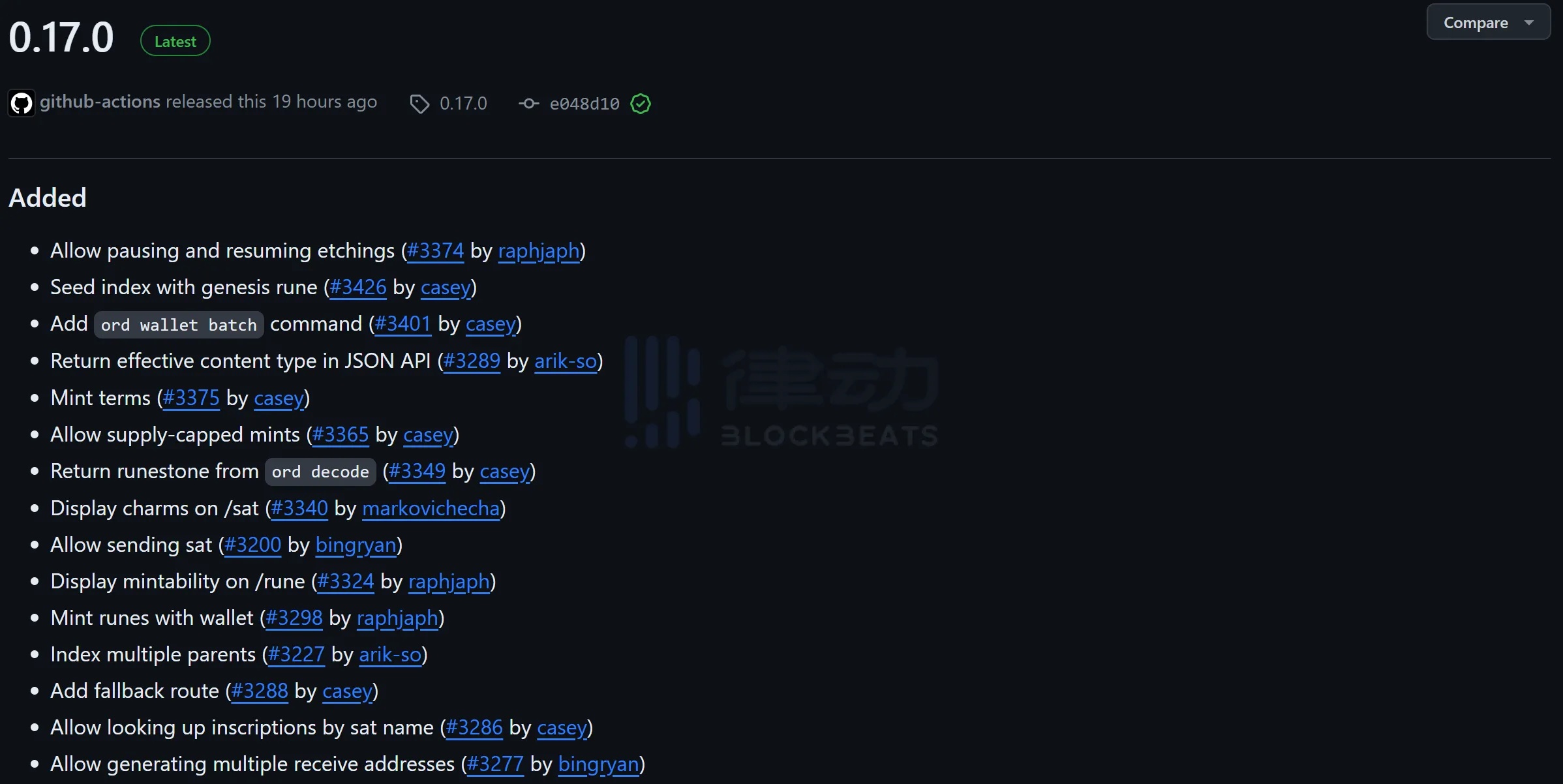
Here’s a quick Q&A about "Runes" compiled for you:
Can we start minting "Runes" now? Not yet. "Runes" will officially activate at Bitcoin block height 840,000, which is expected to be in about 19 days.
What will the first "Rune" be? The first "Rune" is "UNCOMMON•GOODS," hardcoded (i.e., directly written into the code) by Ordinals protocol founder Casey Rodarmor. We can start minting this "Genesis Rune" from Bitcoin block height 840,000. However, note that the "Genesis Rune" is time-limited but not quantity-limited—it can be minted from the upcoming 2024 halving block to the next halving block, with one mint per transaction. Casey is still considering whether to proceed with the earlier plan to hardcode the first 10 "Runes" (0-9).
Will "Runes" be fair-minted like BRC-20 after deployment? It depends on the deployer’s settings. It supports both one-time minting upon deployment (for centralized distribution by projects) and fair minting post-deployment like BRC-20. In this regard, "Runes" are much more flexible than BRC-20, also supporting public minting with project reservations (such "Rune" tokens will be marked) and the aforementioned "time-limited but quantity-unlimited" model.
Why is the first officially unlocked "Rune" ticker "ZZZZZZZZZZZZ"? The maximum length of a "Rune" ticker is 26 characters (Casey’s hardcoded "UNCOMMON•GOODS" is an exception; also, the separator "•" is not counted within the 12-character limit to enhance recognizability, e.g., "WO•YAO•DISS•YOU"). However, it’s a reverse-unlocking process over time (blocks), gradually unlocking from longer to shorter tickers. Simply put, after "Runes" activate at block height 840,000, all 13-26 character tickers can be deployed immediately, but "ZZZZZZZZZZZZ" is the first 12-character ticker to be deployable. The 12-character tickers will fully unlock between blocks 840,000 and 857,500—every 17,500 blocks, a shorter (by 1 character) ticker will unlock. So for familiar 4-character tickers like $PEPE, we’ll need to wait about 3 years.
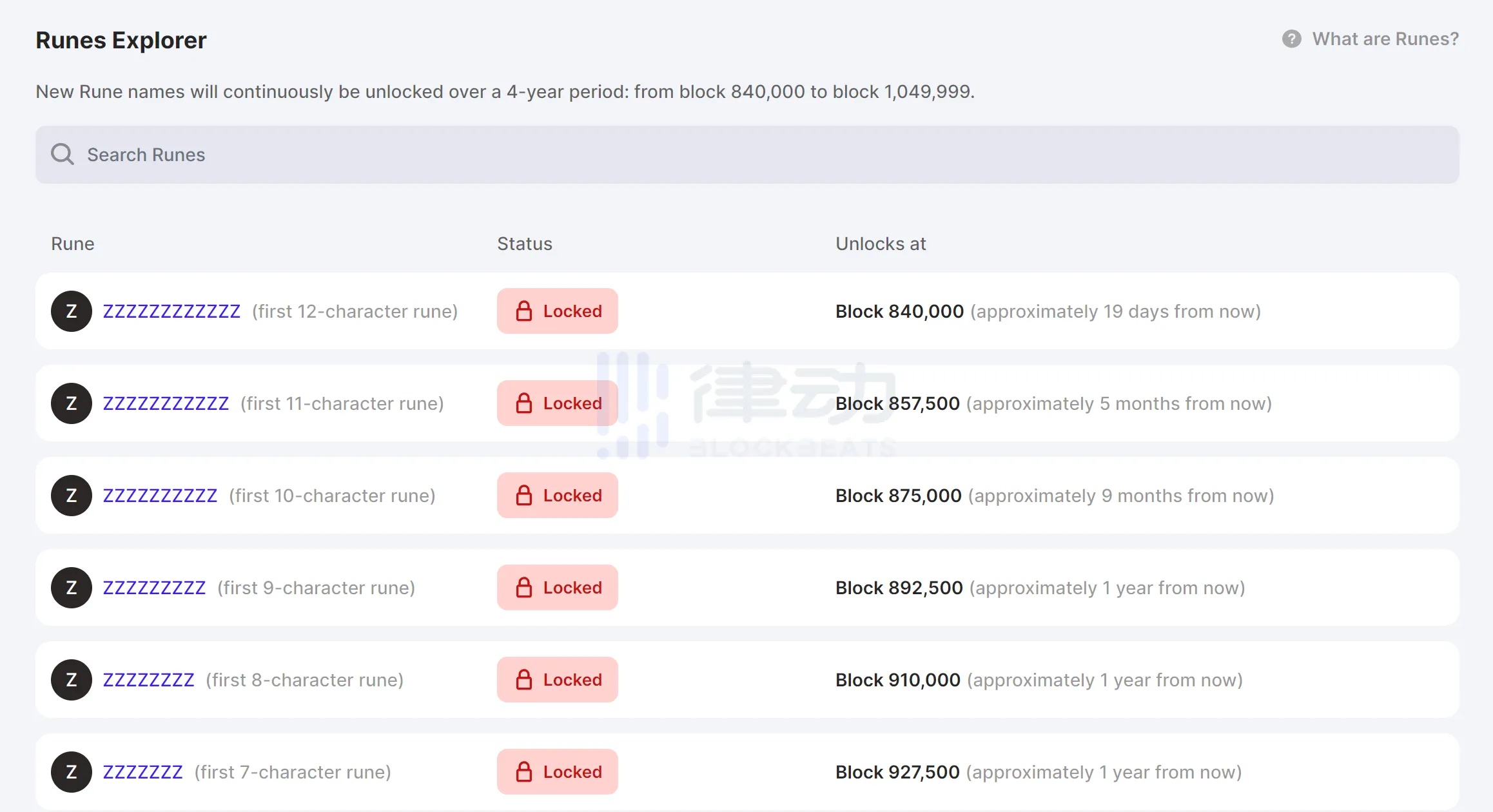
This ticker unlocking method is the complete opposite of BRC-20. BRC-20 recently opened 5-character tickers. If BRC-20 continues to allow longer ticker deployments in the coming years, will the two protocols collide at some point? That’s quite interesting.
In BRC-20’s recent updates, besides supporting 5-character tickers, it also introduced "self-issuance" (projects minting all at once) and a burn mechanism. Short-term, these updates make BRC-20 more conducive to hype than Runes, facilitating centralized distribution by projects and enabling older projects to introduce deflationary tactics to boost market performance—this is BRC-20’s current advantage.
Runes’ advantages, however, lie in being an Ordinals protocol-level standard. To draw an imperfect analogy, it’s like ERC404 and DN404 on Ethereum—the former sparked the "tokenized NFT" trend, while the latter is cheaper and fully compliant with Ethereum standards, aiming to become an official EIP. As Ordinals’ "first-party" solution, Runes won’t face stability issues from protocol changes like BRC-20 and can immediately leverage new Ordinals features for potential improvements. It’s also UTXO-based, eliminating the need for users to inscribe transfer inscriptions before sending transactions, significantly reducing costs.
More importantly, while Runes is an Ordinals protocol-level standard, its implementation doesn’t depend on the Ordinals protocol—it’s independent, like Taproot Assets and RGB. BRC-20, however, relies on the Ordinals protocol, making its long-term development more passive.
In past articles, we’ve mentioned Casey’s dissatisfaction with BRC-20—it generates excessive "junk" UTXOs. In September 2023, Casey proposed the "Runes" concept, natively leveraging Bitcoin’s Unspent Transaction Output (UTXO) model to minimize "junk" UTXOs, enabling more responsible UTXO management and a smaller on-chain footprint.
Now, "Runes" are coming. People often joke that Ordinals is an ecosystem of "endless debates," and the imminent launch of "Runes" means these ideological clashes will turn into real warfare—the competition between Runes and BRC-20 is about to begin.
The copyright of this article belongs to the original author/organization.
The views expressed herein are solely those of the author and do not reflect the stance of the platform. The content is intended for investment reference purposes only and shall not be considered as investment advice. Please contact us if you have any questions or suggestions regarding the content services provided by the platform.
