


Hedge against sharp declines by buying Put options

This is the third article in the options series, introducing hedging with put options, also known as buying insurance. If you're new to options, it's recommended to read the first two articles first.
What is a put option?
A put option is a contract that grants the buyer the right to sell the underlying asset at a predetermined price within a specific timeframe.
Example: On March 31, TSMC's stock price is 130 yuan. You buy a put option for TSMC with a strike price of 120 yuan expiring on April 30 for 3 yuan. The buyer has the right to sell TSMC at 120 yuan anytime before April 30, even if TSMC drops to 100 yuan. The buyer can also choose to abandon this right, such as if TSMC rises to 140 yuan.
There's a saying in the market: the Fed put, meaning people believe that whenever the U.S. stock market crashes badly, the Fed will step in to rescue it.
Hedging with Buy Put
The most common scenario for buying puts is hedging. If you hold long-term bullish positions but face short-term uncertainty, buying puts can hedge against a potential sharp decline in stock prices. It's colloquially called buying insurance.
Common scenarios include:
<1>Before key macroeconomic data releases: Next Wednesday's CPI release is highly sensitive for the market, with U.S. stocks at historical highs. If you're worried about a potential adjustment due to CPI exceeding expectations, you can buy puts on SPY or QQQ for hedging.
<2>When anticipating a black swan event: For example, during the 2023 Silicon Valley Bank crisis, the market faced significant uncertainty.
<3>Before earnings reports: For instance, before NVDA's Q1 earnings, if guidance is critical but uncertain, and you don’t want to sell NVDA, buying NVDA puts can hedge against earnings risk.
<4>When technical indicators are at extreme highs: For example, if RSI exceeds 90 or even 100, and a correction seems likely, but you remain long-term bullish and don’t want to sell, buying puts can hedge.
Note that hedging comes at a cost—use it only when uncertain during critical moments. If a major decline seems highly probable, reducing positions directly is better than hedging.
P&L Chart for Hedging with Buy Put While Holding Stocks
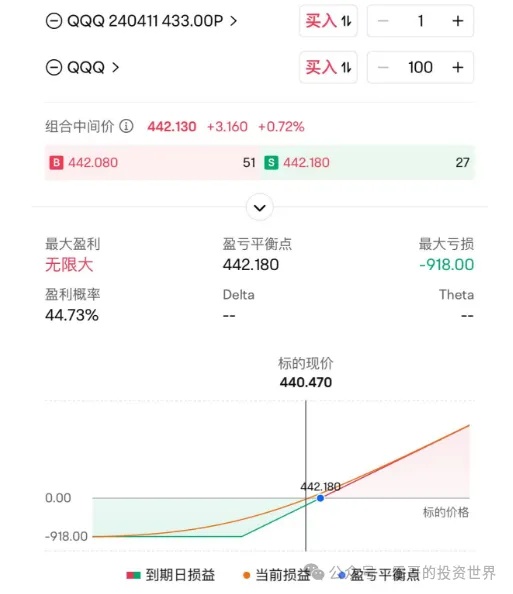
Assume the current date is April 7, 2024, with QQQ priced at 440.47. Holding QQQ and anticipating risks from the April 10 CPI release, you buy a put expiring April 11, 2024, with a strike price of 433 for 1.71 yuan.
P&L chart below
<1>Premium
The cost of buying a put is called the premium. In this example, buying the put at 1.71 for 100 shares requires a premium payment of 171 yuan. Buying puts offers limited loss and unlimited profit potential.
Why choose the 433 put? Because the goal of hedging is to prevent significant declines—here, a drop of 1.5% or more, corresponding to around 433. Additionally, consider the hedging cost: the 433 hedge costs 0.38%, resulting in a maximum loss of about 2%.
<2>Break-even Point at Expiry
Break-even point = stock price + put premium.
In this example: 440.47 + 1.71 = 442.18. The insurance cost requires some stock appreciation to offset.
<3>Maximum Loss
Loss increases as the stock price falls until it hits 433. Maximum loss = current price - put strike price + put premium.
Here: 440.47 – 433 + 1.71 = 9.18. The max loss per share is 9.18 yuan, or 918 for 100 shares.
<4>Maximum Profit
As the stock price rises, maximum profit is unlimited—buying puts doesn’t cap upside.
Summary: Buying insurance locks in maximum loss at a cost while preserving unlimited profit potential.
Settlement at Expiry
Holding both Buy Put and the underlying stock:
<1>If the stock price at expiry is 0.1 or more below the strike price: The system automatically delivers the stock to the put seller. This scenario limits losses.
<2>If the stock price at expiry is equal to or above (strike price - 0.1): The put expires worthless, and you keep the stock. Here, the premium is wasted, but insurance is about peace of mind—no claim is still a win.
FAQs
<1>Should long-term investors hedge?
First, consider whether to avoid risk—enduring volatility is part of investing if the asset is sound.
If hedging, time it for moments when a major decline seems likely. Hedging costs ~1% monthly for SPY at-the-money options with 14 volatility.
<2>Should hedges be closed early?
No one-size-fits-all answer. It depends on the targeted hedge level—close when the expected decline occurs. For example, if you view a 5% S&P 500 drop as a buying opportunity, close the hedge at that point.
<3>Must hedges be held to expiry?
Hedging aims to avoid selling stocks while mitigating short-term risk. Personally, I close before expiry to prevent stock liquidation. If further declines are expected, hold to expiry and rebuy later at lower prices.
<4>How to choose hedge duration?
Shorter durations cost less. Cover the critical period + 1 day.
<5>How to select strike prices for hedging?
Hedging targets major drops—ignore sub-1% moves. Choose strikes for 1%–1.5%+ declines.
<6>Must hedge ratios be 1:1?
No. 1:1 is common and simpler, but customize ratios based on break-even and max loss analysis.
The copyright of this article belongs to the original author/organization.
The views expressed herein are solely those of the author and do not reflect the stance of the platform. The content is intended for investment reference purposes only and shall not be considered as investment advice. Please contact us if you have any questions or suggestions regarding the content services provided by the platform.
