


Warren Buffett and Duan Yongping are both playing this way - Sell Put

This is the fourth article in the options series: introducing selling put options, also known as writing insurance. If you're new to options, it's recommended to read the first three articles first.
What is selling a put option (sell put)
A put option is a contract that grants the buyer the right to sell the underlying asset at a predetermined price within a specific time frame. The seller of the put option is obligated to buy at the agreed price. Simply put, selling a put is like running an insurance company: collect premiums if there's no claim, but pay out if there is
Many big names use selling put options: Warren Buffett, Duan Yongping
In 1993, when Coca-Cola's stock price kept falling, Buffett firmly believed it was a good stock. At the time, Coca-Cola was priced at $40, and Buffett found it acceptable to buy 3 million shares at $35 per share. He sold Coca-Cola puts with a strike price of $35. If the price didn't drop below $35 by expiration, he would earn the premium; if it did, he would add to his position at $35
December 2023: Duan Yongping sold Alibaba puts expiring on January 17, 2025, with a strike price of $70, priced at $8.65
Why sell put options?
<1>Position building: When you want to buy but don't think it's cheap enough
For example, SPY is currently at a historical high of 520, and you want to buy but fear buying at the peak. Historical data suggests a 5% pullback would be a good entry point, so you could sell puts at a price 5% below the peak, i.e., 500.
On May 10, 2024, the 500 Put was priced at $2.14. Assuming you sell 1 contract (100 shares) with full cash collateral (ready to buy if assigned), excluding transaction fees.
The potential returns for this trade are as follows:
--Premium received: $214, with $49,786 reserved for potential assignment ($50,000 - $214)
--Annualized premium yield: 214/49,786 = 5.15%
--USD cash yields an annualized 5%
--Total return: 5.15% + 5% = 10.15%
If not assigned, this trade yields an annualized 10.15%; if SPY drops below 500, it's a perfect entry point
<2>Pure premium income: A game of probabilities, selecting suitable underlying assets based on annualized targets
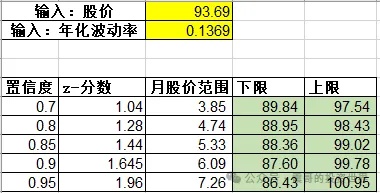
The probability calculation tools for Covered Calls also apply here. Input the stock price and volatility to calculate the probable price range weekly or monthly. For example, the chart below shows a 70% probability of the monthly price being between 89.84 and 97.54, allowing you to sell puts at corresponding prices.
Profit and loss diagram for selling insurance
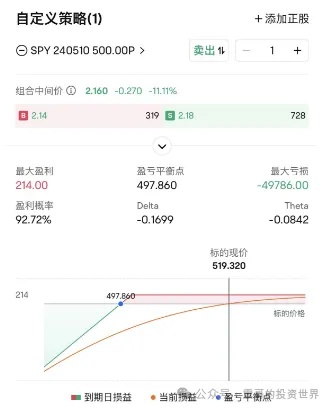
Assume the current date is April 10, with SPY at 519.32. Selling the May 10, 2024, 500 Put at $2.14.
The P&L diagram is as follows:
<1>Premium
The money received from selling a put is called the premium. In this example, selling the put at $2.14 for 100 shares yields a premium of $214. Selling puts has limited profit potential (the premium) and unlimited loss potential.
<2>Breakeven point at expiration
Breakeven = Strike price - Premium received. For this example: 500 - 2.14 = 497.86.
<3>Maximum loss
Losses increase as the stock price falls, theoretically unlimited (until the stock hits zero). In this example, the maximum loss is $49,786
<4>Maximum profit
If the stock price is above the strike price at expiration, the maximum profit is the premium received. Here: $214
Key points for selling put options
<1>Underlying selection
Adopt a value-investing mindset when selling puts—only sell puts on stocks you'd want to own. Indexes like QQQ or SPY carry relatively lower risk.
<2>Leverage
Selling puts is a margin trade, allowing 3x or higher leverage. Leverage magnifies the risk of forced liquidation during sharp declines.
There are many cautionary tales, such as:
On December 1, 2004, Singapore-listed China Aviation Oil lost $550 million from oil derivative put selling, despite having a net worth of only $145 million
Always consider the worst-case scenario before using leverage
<3>Return targets
Set acceptable return targets and choose appropriate timing/strike prices. Be aggressive when you believe the stock is undervalued to lock in long-term returns.
For example, the author sold Tencent 280 puts expiring December 30, 2024, at 28.1 on December 27, 2023, with an assignment price of 251.9. The author found 251.9 highly attractive, locking in a 15% annualized return
<4>Psychology
During crashes, floating losses far exceed the premium received. During rallies, you face opportunity costs (small gains vs. missing bigger moves). It tests human nature
The author advises sticking to the original plan: Have the initial conditions changed? If not, follow the strategy.
Settlement at expiration
<1> If strike price - expiration price > 0.1: The put seller must buy the stock at the strike price. Insufficient margin may trigger liquidation of other positions
<2> If strike price - expiration price <= 0.1: The put seller keeps the full premium
Frequently asked questions
<1> Should you close a sold put early?
The author often closes early when the remaining option value's annualized yield drops below 4%, as full cash collateral offers better opportunity costs
<2>Margin requirements for selling puts?
Brokerage policies vary. For Interactive Brokers, a simple rule is 20%: selling 100 shares of a $10 strike requires $200 margin
--Equity options: Put price + max[(20% × underlying price - out-of-money amount), (10% × strike price)]
--Index options: Put price + max[(15% × underlying price - out-of-money amount), (10% × strike price)]
<3>Can selling puts blow up your account?
Yes. The author uses full cash collateral. High leverage carries liquidation risks—many painful lessons exist; beginners should avoid leverage.
Example: Selling 100 shares of a $10 strike put with $200 margin. If the stock drops to $8, the margin is wiped out.
<4>What expiration timeframe is ideal?
For attractive prices, go long-dated (e.g., selling long-dated AAPL puts at $170 if you believe it's cheap). For unattractive prices, avoid selling or opt for short-term puts. Balance your target returns
<5>When is selling puts appropriate?
When you want to buy but find the price unattractive—sell puts at your desired entry point. The market always offers opportunities; missing some is fine—profits are what matter.
Another scenario is when implied volatility is high, profiting from its eventual decline.
<6>How do dividends affect sold puts?
Put sellers don't receive dividends. If the strike price adjusts downward, no impact; if not, it negatively affects the put position
The copyright of this article belongs to the original author/organization.
The views expressed herein are solely those of the author and do not reflect the stance of the platform. The content is intended for investment reference purposes only and shall not be considered as investment advice. Please contact us if you have any questions or suggestions regarding the content services provided by the platform.
