


 Likes Received
 Posts
PostsChaPanda: Market cap equals to 6.3 NAYUKI, a gold-plated tea beverage stock!

The longer you stay in the secondary market, the more you understand one truth
To judge whether an industry is good or bad, it's not about how fast demand is growing, but whether the supply side is orderly.
This leads to the number one rule for analyzing companies: Does this industry have barriers to entry?
For example, suppose an industry grows 100% annually, doubling every year—a surefire star sector, right? Such an industry would inevitably become highly recommended by major institutions.
But upon closer inspection, since this industry has no barriers to entry, anyone with money and capital can come and go as they please.
The result? Even though the industry's growth rate doubles annually, there are too many players, and the supply side grows by 200% each year.
This creates a situation of oversupply, causing product prices to plummet. In the end, only the end consumers benefit, while shareholders and naive investors suffer the most.
Currently, Brother Cai believes the tea beverage industry is exactly like this—no barriers to entry, with countless mom-and-pop shops, independent stores, and chain brands flooding the market.
As a result, companies in this industry are bound to end up in a dire situation.
Take Nayuki Tea $NAYUKI(02150.HK), the "first listed tea beverage stock," for example. It went public in Hong Kong in 2021 at a price of 19.8 HKD, but as of this writing, its stock price has plummeted to a pitiful 2.39 HKD.
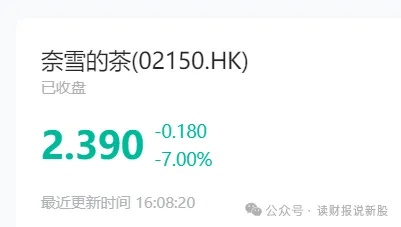
In three years, the stock price has dropped by a staggering 88%, effectively halving three times—now down to the toes.
This shows how terrifying it is for an industry to lack barriers to entry.
Now, another tea beverage company, Chabaidao $CHABAIDAO(02555.HK), is preparing to go public.
Originally, Brother Cai thought Nayuki wasn't being fair, but after looking at Chabaidao, he now believes Nayuki is at least a somewhat ethical company. Here's the analysis:
1. A market cap equivalent to 6.3 Nayukis—is your milk tea made of gold?
If an industry has no barriers to entry, a company can still have a chance if its valuation is low enough—below the cost of replacement (everyone should learn the replacement cost method—many American masters use it).
As the third-largest player in the industry, Chabaidao's IPO valuation is 25.86 billion HKD, equal to 6.3 Nayukis. For an industry with no barriers to entry, this valuation is absurdly high.
Is your milk tea literally made of gold?
Some might argue that Chabaidao's current P/E ratio is 21x, while Nayuki's is 265x, so Chabaidao isn't expensive.
But Brother Cai disagrees. First, Nayuki operates direct stores, which are costlier.
Chabaidao has only 6 direct stores, with nearly 8,000 being franchises. Nayuki is asset-heavy, while Chabaidao is asset-light.
Moreover, asset-heavy companies are judged by P/B ratios. Nayuki's current P/B is 0.77x, below book value, so it's actually not expensive. Nayuki could easily improve profitability by opening fewer stores and hiring fewer workers, drastically reducing its seemingly high P/E.
From any angle, Chabaidao is clearly overpriced!
More importantly, Chabaidao's so-called performance is highly questionable. Here's the analysis:
2. Full of red flags—a raw materials company disguised as a tea beverage brand
Didn't we just say Chabaidao's P/E of 21x isn't expensive?
Now, let's analyze its performance. First, the surface data:
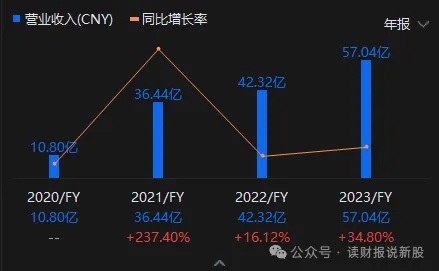
Revenue-wise, from 2021 to 2023, Chabaidao's revenue was 3.644 billion, 4.232 billion, and 5.704 billion HKD, with year-on-year growth of 16.1% and 38.4% in the latter two years.
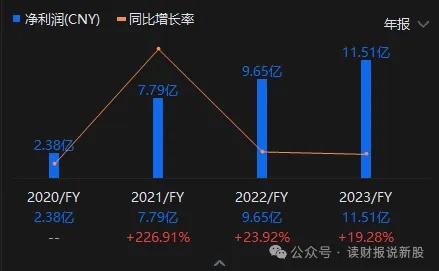
Net profit also maintained double-digit growth, with 779 million, 965 million, and 1.151 billion HKD from 2021 to 2023, a compound annual growth rate of 21.6%.
On the surface, the performance looks amazing.
But careful observers will notice one problem: 2022 was a year of widespread pandemic restrictions, when most F&B and consumer companies struggled. Nayuki, also in the tea beverage sector, saw a 0.12% decline in revenue in 2022.
Why, among all F&B and consumer stocks, was Chabaidao the only one to grow 16% in 2022?
The following chart reveals the secret:
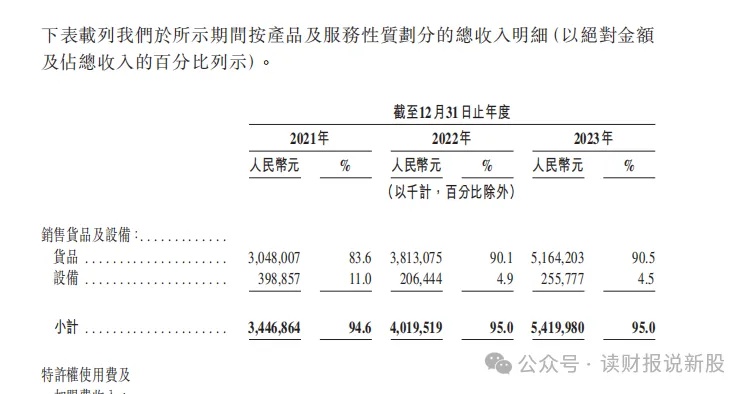
95% of Chabaidao's revenue comes from selling raw materials and equipment.
It has only 6 direct stores and nearly 8,000 franchise stores—it makes money by exploiting franchisees.
Nayuki, on the other hand, genuinely sells milk tea and products, driven by average customer spending and foot traffic.
Chabaidao is essentially a wholesale company. How does it make its performance look good? By recruiting more franchisees and selling them goods and equipment.
Whether franchisees make money or not is irrelevant—as long as the headcount keeps growing.
Additionally, to prepare for its IPO, Chabaidao needs to inflate its performance and polish its prospectus.
How? By offering more discounts than usual to attract even more franchisees.
For example, gross margins dropped from 37% to 34%.
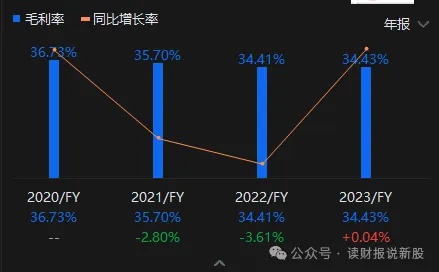
Brother Cai believes this strategy of inflating numbers is unsustainable, especially in such a competitive industry. Heytea, Shanghai Auntie, Mixue Bingcheng, and Gucha are all preparing to go public.
To stand out, companies must focus on product innovation, not aggressively expanding franchises to inflate numbers. The consequence? The prospectus looks good, but within a year or two of listing, performance will inevitably bomb!
3. No cornerstone investors—so expensive even institutions can't stomach it!
With a market cap of 26 billion HKD, this is a large-cap stock, but strangely, there are no cornerstone investors.
Historically, when large-cap stocks can't secure cornerstone investors, it's usually because they're too expensive.
If it were just slightly overpriced, institutions might still participate as a courtesy.
But when it's so expensive that even institutions can't justify it, you get a large-cap stock with no cornerstone investors.
4. Conclusion
Chabaidao is clearly here to exploit naive investors. Brother Cai's articles focus on logical analysis—if you're only interested in whether the stock will rise or fall on its first trading day, this isn't for you.
After all, a stock's debut performance depends on many factors. Brother Cai doesn't favor Chabaidao logically, but that doesn't mean it will drop on its first day—readers should decide for themselves!
Everyone should weigh their risk appetite before deciding whether to subscribe!
$TJCD(02515.HK) $MOBVOI(02438.HK)
That's all for today's analysis. Did you find it helpful? I'm Read Financials & Discuss IPOs, an ordinary investor who loves reading financial statements, specializes in HK and US IPOs, and invests with a long-term focus and short-term supplements. See you next time!
The copyright of this article belongs to the original author/organization.
The views expressed herein are solely those of the author and do not reflect the stance of the platform. The content is intended for investment reference purposes only and shall not be considered as investment advice. Please contact us if you have any questions or suggestions regarding the content services provided by the platform.
