



TSMC's AI "advance consumption"

After lithography giant $ASML(ASML.US) reported weaker-than-expected results the previous day, the market had higher expectations for the performance of foundry leader $Taiwan Semiconductor(TSM.US).
TSMC did not disappoint, with its Q1 2024 results exceeding expectations. This was somewhat anticipated, as the company had already released its March operating data a few days earlier, giving the market a rough idea of its revenue scale.
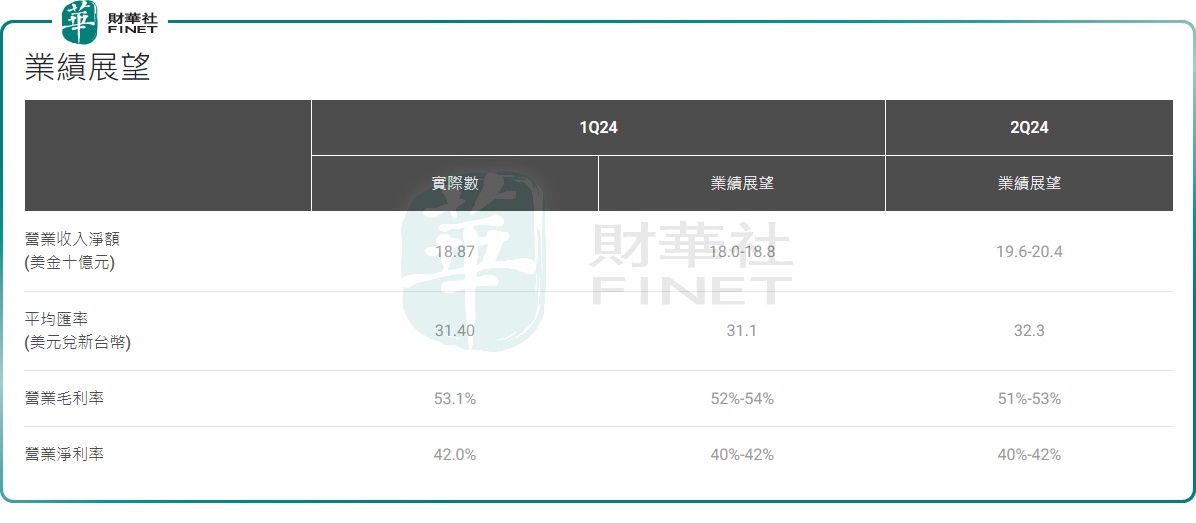
In Q1 2024, TSMC's wafer shipments fell 6.10% YoY to 3.03 million units, while total revenue rose 16.5% YoY but declined 5.3% QoQ to NT$5.92644 trillion (~$18.873 billion), mainly due to cyclical weakness in smartphone demand offsetting the continued rise in high-performance computing (HPC) demand.
Gross margin for Q1 was 53.1%, up 0.1 percentage points QoQ but down 3.2 percentage points YoY, landing in the middle of the company's guidance range of 52%-54%. The margin decline was primarily due to product mix changes (weaker high-margin smartphone demand offsetting forex gains).
Operating margin improved 0.4 percentage points QoQ but fell 3.5 percentage points YoY to 42.0%, at the high end of the company's 40%-42% guidance range. EPS was NT$8.70, up 8.9% YoY but down 5.5% QoQ, equivalent to ~$1.38 per ADR unit, beating Wall Street's $1.29 estimate.
Advanced Node Share Holds at 65%
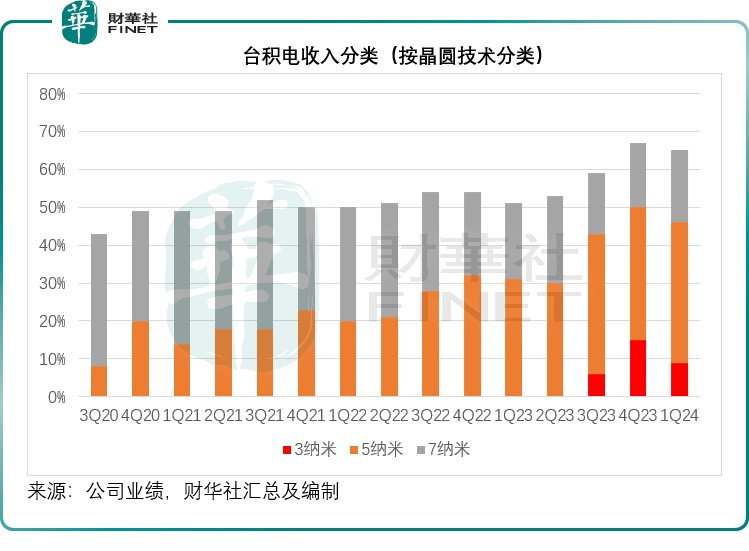
In Q1 2024, 3nm accounted for 9% of total wafer revenue, 5nm for 37%, and 7nm for 19%. Combined, advanced nodes (7nm and below) represented 65% of total revenue, up from 51% YoY but slightly below Q4's 67% (see chart below).
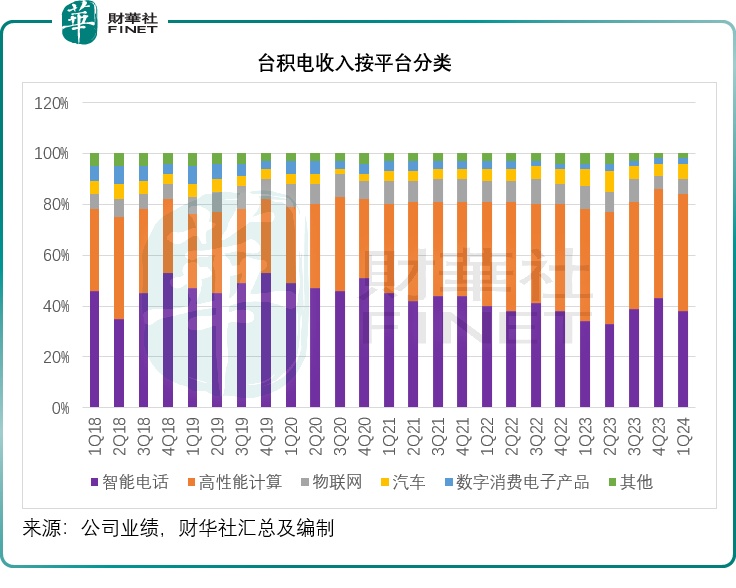
By platform, HPC revenue grew 3% QoQ, increasing its share to 46%, while smartphone revenue fell 16% QoQ, dropping from 43% to 38% of total revenue (see chart below).
As of March 2024, TSMC held NT$1.9 trillion (~$60 billion) in cash and marketable securities, sufficient to fund future capacity expansion.
Dolphin Research notes that as of March 2024, TSMC's accounts receivable days remained at 31, but inventory days rose by 5 to 90. Management attributed the inventory increase to 3nm yield ramp-up.
For cash flow and capex, TSMC generated NT$436.3 billion in operating cash flow in Q1, spent NT$181 billion (~$5.77 billion) on capex, and distributed NT$78 billion in dividends.
TSMC Outlook
Guidance: TSMC expects Q2 2024 revenue between $19.6-$20.4 billion, with gross margin of 51%-53% and operating margin of 40%-42%.
Management noted that the April 3 earthquake impacted some facilities, but 70%+ of wafer fabs resumed within 10 hours, with full recovery by day three. While some production was affected, most output is expected to be recovered in Q2, minimizing revenue impact. The earthquake is estimated to have a ~50bps gross margin impact.
Additionally, after a 17% electricity price hike in April 2023, TSMC's Taiwan plants face another 25% increase effective April 2024, expected to negatively impact Q2 gross margin by 70-80bps.
Revenue-wise, management expects growing 3nm contributions in coming quarters, likely pressuring H2 2024 gross margin by 3-4 percentage points. As previously explained, advanced nodes like 3nm require massive upfront R&D, with capitalized costs amortized as depreciation, initially weighing on margins before scale benefits emerge.
Given strong 3nm demand, TSMC may convert some 5nm capacity to 3nm, potentially impacting H2 gross margin by 1-2 percentage points.
TSMC reiterated 2024 capex of $28-$32 billion, with 70%-80% for advanced nodes, 10%-20% for specialty technologies, and ~10% for advanced packaging/testing/masks.
CEO C.C. Wei projected a "moderate recovery" for 2024 semiconductor markets (ex-memory), lowering overall growth forecasts to ~10%, with foundry industry growth at 15%-20% as inventory corrections ease. He reaffirmed TSMC's 2024 dollar revenue growth target of 20%-25% with sequential quarterly growth.
Wei highlighted booming AI demand, stating "virtually all AI innovators" are working with TSMC. AI accelerator revenue is expected to more than double in 2024, reaching ~10% of total revenue, with 50% CAGR projected through 2028 (>20% share).
TSMC's Arizona fabs: Fab 1 (4nm, H1 2025 production), Fab 2 (2nm, 2028), and planned Fab 3 (2nm+, by 2030) will total >$65 billion investment. Japan's specialty fab (12/16nm & 22/28nm) will mass-produce in Q4 2024, with a second fab (6/7nm & 14-15nm) starting construction in H2 2024 for 2027 production. Germany's Dresden specialty fab (auto/industrial) begins construction in Q4 2024.
TSMC is expanding 3nm capacity in Tainan and preparing for 2nm mass production in 2025, with multiple 2nm fabs planned in Hsinchu/Kaohsiung. Taichung expansion approvals are pending.
Wei expressed confidence in maintaining >53% gross margins long-term and delivering ≥25% ROE. He noted strong 2nm customer engagement, expecting higher initial adoption than 3nm/5nm. 2nm development is on track for 2025 production with a ramp similar to 3nm.
Conclusion
In summary, TSMC represents the pinnacle of foundry technology. Its expansion plans reflect strong demand from clients like AI leader $NVIDIA(NVDA.US) $NVIDIA(NVDA.US) NVIDIA (NVDA.US), suggesting robust end-market demand. The AI momentum appears set to continue.
Author: Dolphin Research
The copyright of this article belongs to the original author/organization.
The views expressed herein are solely those of the author and do not reflect the stance of the platform. The content is intended for investment reference purposes only and shall not be considered as investment advice. Please contact us if you have any questions or suggestions regarding the content services provided by the platform.
