


 Likes Received
 Posts
PostsSelling over 1 billion cups annually with more than 100 million members! CHABAIDAO is going public!

The giant of new-style tea beverages is about to enter the capital market.
Recently, Sichuan Baicha Baidao Industrial Co., Ltd. (hereinafter referred to as "Baicha Baidao") $CHABAIDAO(02555.HK) has launched its IPO and will be listed on the main board of the Hong Kong Stock Exchange on April 23 with the stock code "2555". It will become the "second stock of new-style tea beverages" and the first new tea beverage company to successfully list on the Hong Kong Stock Exchange in nearly three years.
It is reported that Baicha Baidao's IPO price is HKD 17.5 per share, with an expected fundraising scale of HKD 2.586 billion, which may become the largest IPO in the Hong Kong market this year.
According to the prospectus, Baicha Baidao sold a total of 1.016 billion cups of milk tea in 2023, with total retail sales reaching RMB 16.9 billion. According to a report by Frost & Sullivan, based on 2023 retail sales, Baicha Baidao ranks third in China's freshly made tea beverage market, with a market share of 6.8%.
A High-Growth, High-Profit Tea Beverage Giant
Combining the prospectus and its IPO pricing, it is not difficult to see that Baicha Baidao, which is about to enter the capital market, basically possesses several key investment attributes that investors value most: high growth, high profitability, and low valuation.
First, from the financial data, Baicha Baidao is still in a stage of rapid growth.
According to the latest disclosed prospectus, from 2021 to 2023, Baicha Baidao's operating income was RMB 3.644 billion, RMB 4.232 billion, and RMB 5.704 billion, respectively, with revenue growth rates of 16.1% and 34.8% in 2022 and 2023, and a compound annual growth rate of 25.1%.
More importantly, Baicha Baidao's profitability is among the best in the industry. According to the prospectus, from 2021 to 2023, Baicha Baidao's gross profit margins were 35.7%, 34.4%, and 34.4%, respectively.
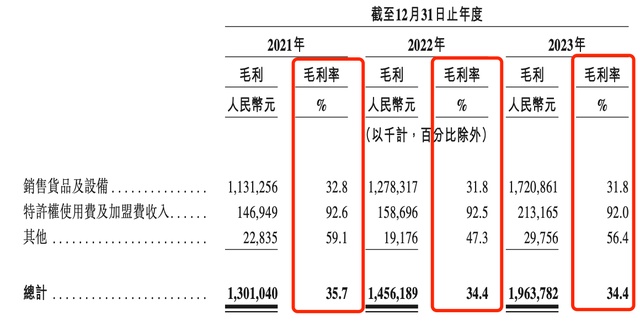
This has enabled Baicha Baidao to achieve profitability early, with net profit continuing to grow, demonstrating strong growth attributes.
According to the prospectus, from 2021 to 2023, Baicha Baidao's adjusted net profit was RMB 900 million, RMB 967 million, and RMB 1.258 billion, respectively, with net profit margins of 24.7%, 22.8%, and 20.2%, and a compound annual growth rate of net profit of 21.6%.
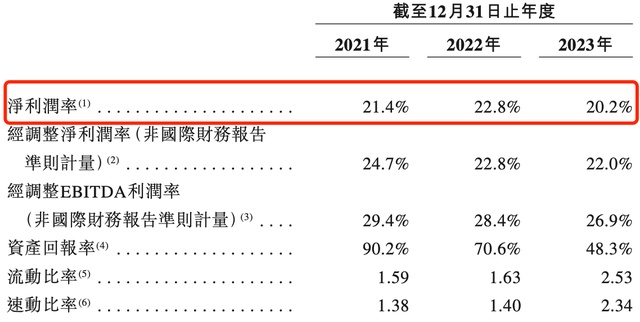
Based on this growth rate, it is conservatively estimated that Baicha Baidao's net profit in 2024 will reach RMB 1.53 billion. Calculated based on the post-IPO market capitalization (RMB 23.7 billion), its post-IPO price-to-earnings ratio is only 15 times. According to institutional estimates, the expected price-to-earnings ratio for 2025 is only 12.8 times.
This also means that Baicha Baidao, upon listing, already possesses the attributes of "high growth, high profitability, and low valuation."
As is well known, the future growth of chain new-style tea beverage brands largely depends on the increase in the number of their stores.
Baicha Baidao, centered in Sichuan, radiates toward coastal areas. Currently, the company's stores cover all major provinces and cities across the country.
According to Caijing.com, the owner of a Baicha Baidao overseas store revealed on social media that as of February 29, 2024, the number of Baicha Baidao stores had reached 8,274.
Baicha Baidao disclosed in its previously updated prospectus that as of the end of 2023, the number of Baicha Baidao stores was 7,801.
This means that Baicha Baidao added approximately 473 new stores in the first two months of this year. It can be seen that Baicha Baidao is still expanding rapidly, and its future growth is promising.
An Underestimated Dark Horse
Currently, as the "first stock of new-style tea beverages," Nayuki's days in the Hong Kong stock market are not going well.
Calculated from the highest point, as of now, Nayuki's cumulative decline has exceeded 85%, with its market value evaporating by more than HKD 28.4 billion (approximately RMB 26.2 billion), and its latest total market value is only HKD 3.876 billion.
However, comparing Baicha Baidao and Nayuki in multiple dimensions, it is not difficult to find that their business models, profitability, and growth potential are completely different. Baicha Baidao may have been severely "misjudged" and underestimated.
First, let's look at their business models. Nayuki focuses on self-operation, while Baicha Baidao started with a franchise model.
As is well known, the advantage of the franchise model lies in its speed of expansion.
According to public data, Nayuki, as a listed high-end tea beverage brand, had fewer than 1,200 stores as of May 2023. In contrast, Baicha Baidao now has more than 8,000 stores and is moving toward the goal of "10,000 stores."

At the same time, to ensure a good first impression for customers and maintain the product quality of each franchise store, Baicha Baidao has established strict franchisee admission standards.
The company has established the Baicha Baidao Vocational Skills Training School, with more than 140 full-time lecturers, providing professional training from the initial stage to the mature stage through online and offline methods.
In addition, as of December 31, 2023, the company had a regional supervision team of 567 people, conducting routine inspections of franchise stores at an average frequency of 3 to 4 times per month to ensure that the stores meet requirements in terms of food safety, product quality, and store hygiene.
Thanks to franchise control, stable quality, and strong product innovation, Baicha Baidao's member repurchase rate is much higher than the industry average. As of April 5, 2024, Baicha Baidao had more than 103 million registered members, with 20.4 million active members in the fourth quarter of 2023 and a member repurchase rate of 35% in the fourth quarter of 2023.
According to Frost & Sullivan's data, the closure rates from 2021 to 2023 were 0.2%, 1.1%, and 2.3%, respectively, far below the industry average.
More importantly, the franchise model has the advantages of being asset-light, high-turnover, and high-efficiency. It is precisely because of the franchise model that Baicha Baidao can maintain rapid revenue growth while ensuring stable profitability and steady growth in net profit.
Comparing their financial reports, it is not difficult to find that Baicha Baidao's revenue mainly comes from the sale of goods and equipment, royalties, and franchise fees, while Nayuki's main revenue comes from direct store sales and bottled beverages.
Second, Baicha Baidao's profitability far exceeds that of Nayuki.
According to Nayuki's disclosed financial reports, from 2021 to 2023, the company's revenue was RMB 4.297 billion, RMB 4.292 billion, and RMB 5.164 billion, respectively, with growth slowing significantly; adjusted net profit was RMB -145 million, RMB -461 million, and RMB 21 million, respectively. In contrast, Baicha Baidao's revenue from 2021 to 2023 was RMB 3.644 billion, RMB 4.232 billion, and RMB 5.704 billion, respectively; adjusted net profit was as high as RMB 900 million, RMB 967 million, and RMB 1.258 billion, respectively.
This also illustrates the advantages and disadvantages of the business models of the two new-style tea beverage giants.
Third, there are also huge differences between Baicha Baidao and Nayuki in terms of products.
Reviewing Nayuki's product strategy, it is not difficult to find that its product strategy has been unstable, from the initial cheese fruit tea to the emphasis on "a sip of good tea with a bite of soft European bread," focusing on baking, and now refocusing on tea beverages. In contrast, Baicha Baidao's product strategy has always been firmly focused on making good tea, and it has now formed a classic product matrix with "five products such as Mango Pomelo Sago and Jasmine Milk Green" as the core.
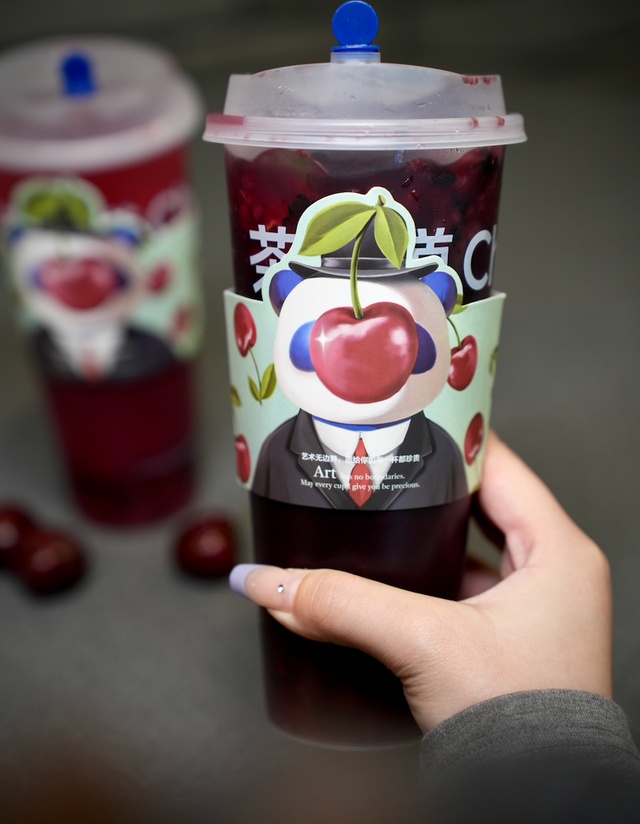
In addition, Baicha Baidao's product innovation efforts are significantly greater than Nayuki's. According to the prospectus, in 2023, Baicha Baidao developed more than 250 products and launched 48 new products. The company's products can be mainly divided into classic tea beverages and seasonal and regional tea beverages. Classic tea beverages consist of a series of iconic products, such as Mango Pomelo Sago, Soy Milk Jade Qilin, Signature Taro Ball Milk Tea, Jasmine Milk Green, and Watermelon Bobo.
Fourth, Nayuki and Baicha Baidao have different user positioning and target regions.
Nayuki's stores are mainly located in core areas of super-first-tier and first-tier city CBDs, with large store areas and expensive decorations, resulting in high store costs. Its core consumers are urban white-collar workers, and its product pricing is very high, once challenging Starbucks, which also leads to high product costs.
In contrast, Baicha Baidao's first store was opened near a school, targeting students with limited spending power. Therefore, Baicha Baidao focuses on new first-tier, second-tier, third-tier, fourth-tier, and lower-tier cities, targeting golden locations in shopping centers, residential areas, and near schools, emphasizing cost-effectiveness. The average price of classic tea beverages is only RMB 13.9.
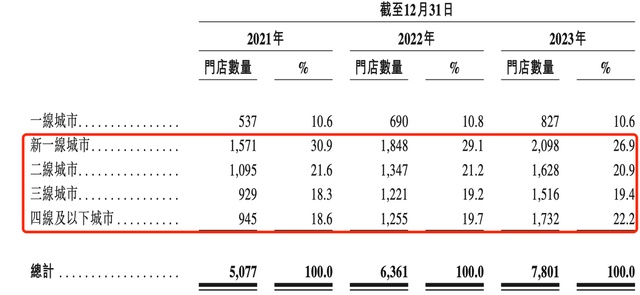
With many advantages, Baicha Baidao is highly likely to have more certain growth momentum after listing.
Buying Certainty
In summary, while Baicha Baidao's revenue growth is very impressive, its net profit margin, financial indicators, and business model far exceed those of its peers, and its market share ranks third in the industry, with future growth space still promising.
From this perspective, Baicha Baidao is highly likely to be a high-quality listed company.
Therefore, Baicha Baidao's listing is highly likely to provide secondary market investors with a good opportunity to "buy certainty at a low valuation."
In fact, from an industry perspective, Baicha Baidao's future growth certainty can also be guaranteed.
According to Frost & Sullivan, the size of China's beverage store market has gradually accelerated with the improvement of people's living standards, increasing from RMB 136 billion in 2018 to RMB 383.9 billion in 2023, with a compound annual growth rate of 23.1%.
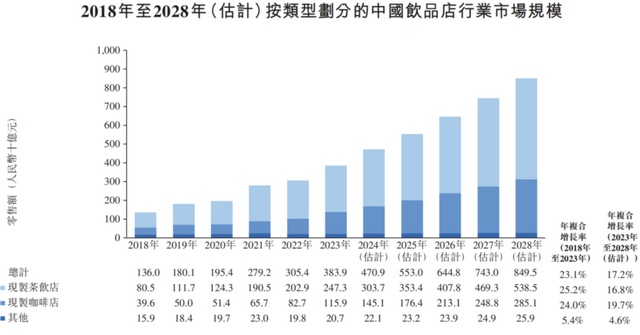
Among them, new tea beverage stores mainly include freshly made tea beverage stores and freshly made coffee stores. The market size of the freshly made tea beverage store industry increased from RMB 80.5 billion in 2018 to RMB 247.3 billion in 2023, with a compound annual growth rate of 25.2%, and its market share increased from 59.2% in 2018 to 64.4% in 2023. It can be foreseen that the size of China's new-style tea beverage market is still rising rapidly and is expected to increase to RMB 538.5 billion by 2028, with a market share of 63.4%.
Divided by different city tiers, freshly made tea beverage stores are expanding rapidly in new first-tier cities, third-tier cities, and fourth-tier and lower-tier cities, with market sizes increasing from RMB 16.4 billion, RMB 16.3 billion, and RMB 21.4 billion in 2018 to RMB 39.7 billion, RMB 71.6 billion, and RMB 73.5 billion in 2023, respectively, with compound annual growth rates of 19.3%, 34.4%, and 28.0%.
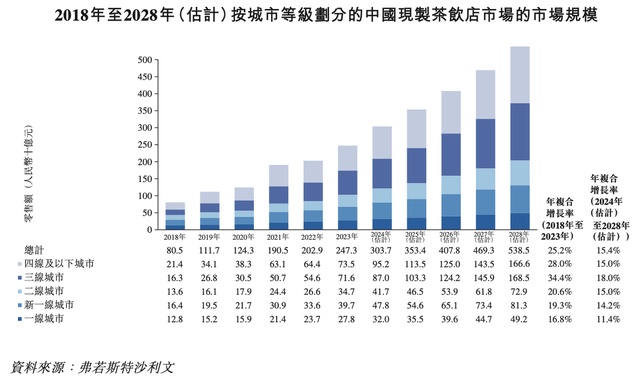
New first-tier cities, third-tier cities, and fourth-tier and lower-tier cities, which are still maintaining rapid growth, are Baicha Baidao's core regions, where it has significant advantages, and it is highly likely to maintain growth in the future.
The copyright of this article belongs to the original author/organization.
The views expressed herein are solely those of the author and do not reflect the stance of the platform. The content is intended for investment reference purposes only and shall not be considered as investment advice. Please contact us if you have any questions or suggestions regarding the content services provided by the platform.
