



Dividend "Red and Black List" released! Industrial and Commercial Bank of China (ICBC) "showers money", while Jinbei Automobile "doesn't give a penny".

With the sharp decline at the end of 2023, investor confidence in the A-share market was once very sluggish, which also gave rise to new reform measures.
In the new "National Nine Measures" released on April 12, new content on dividend risk warnings was added, as shown in the figure below.
Taking the main board as an example, companies with positive net profit in the most recent fiscal year and positive undistributed profits at the end of the parent company's annual report, whose cumulative cash dividends in the most recent three fiscal years are less than 30% of the average annual net profit in the same period, and whose cumulative dividend amount in the most recent three fiscal years is less than 50 million yuan.
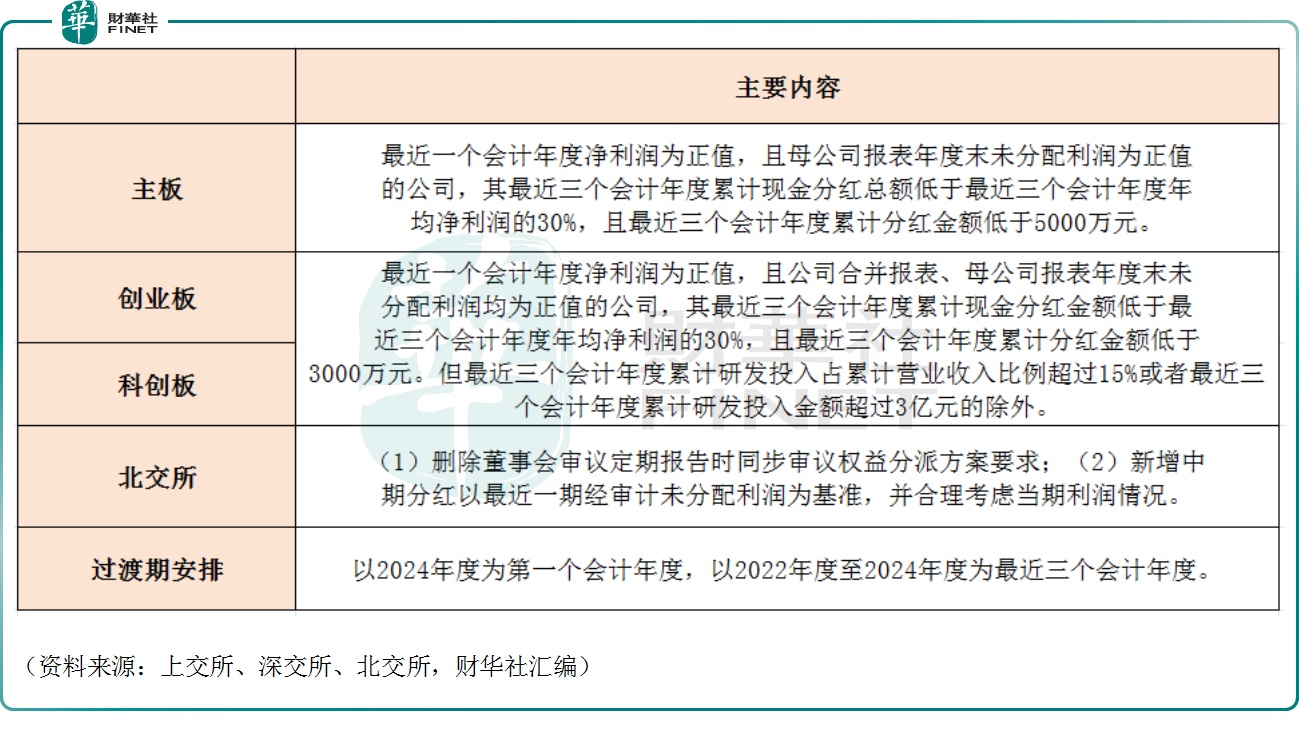
However, this regulatory policy has a higher tolerance for technology-listed companies, with exemptions on dividend requirements, involving companies listed on the ChiNext and STAR Market.
Overall, regulators place great importance on the dividend situation of A-share listed companies.
It is worth mentioning that the 2023 annual reports of the A-share market have not yet been fully disclosed. According to Guojin Securities' calculations, if the new dividend risk warning standards in the new regulations are applied, based on the financial data and dividend situation of listed companies from 2020 to 2022, there are 142 listed companies that fail to meet the dividend standards, including 107 on the main board, 33 on the ChiNext, and 2 on the STAR Market.
Which listed companies should be on the "blacklist" for dividends? And which companies should be on the "red list" for dividends?
Main Board "Blacklist": Jinbei Automobile is quite outrageous, not paying a single cent for over 20 years
Wind data shows that in the main board market of the Shanghai and Shenzhen exchanges, 36 companies did not pay any cash dividends from 2020 to 2022, including Shandong Hi-Speed Renewable Energy Group, New Journey Group, Gengxing Co., Ltd., Annil, Antong Holdings, Jinbei Automobile, etc.
It is reported that Jinbei Automobile is a relatively well-known company, but since its listing in 1992, it has not paid a single cent in dividends for over 20 years, earning the nickname "iron rooster."
Moreover, in terms of performance, Jinbei Automobile's profit performance in recent years has not been bad, achieving continuous profitability from 2020 to 2022, with a net profit of 150 million yuan in 2022.
In fact, there are quite a few A-share companies like Jinbei Automobile that have been listed for many years but never paid dividends, performing poorly in rewarding shareholders.
Additionally, Wind data shows that from 2020 to 2022, 766 main board companies had cumulative cash dividends in the 0-100 million yuan range, accounting for 23.93% of all main board companies, a significant proportion.
Wind data also shows that from 2020 to 2022, 439 main board companies had total cash dividends in the 100-200 million yuan range.
Overall, despite continuous improvements in recent years, many A-share main board companies still lack strong dividend awareness. While some companies may not have the financial conditions to pay cash dividends due to poor performance, more companies may simply not care about shareholder interests.
Among them, some main board companies have raised large amounts of funds in the market since their listing and made profits but are completely unwilling to pay dividends or only pay symbolic amounts, treating the A-share market as a "blood bag."
Main Board "Redlist": State-owned enterprises continue to pay dividends, ICBC "showers money"
However, there are still companies in the A-share market willing to pay dividends.
Wind data shows that from 2020 to 2022, only$ICBC(601398.SH) one main board company had total cash dividends exceeding 200 billion yuan. Additionally, ICBC announced another 109.203 billion yuan dividend in 2023, truly a "big money showerer."
Furthermore, from 2020 to 2022, four main board companies had cumulative dividends in the 100-200 billion yuan range, including Agricultural Bank of China, Bank of China,$PETROCHINA(601857.SH) ,$Moutai(600519.SH) , all of which also announced large dividends in 2023.
Among them, Kweichow Moutai's profit scale is still significantly smaller than that of ICBC and PetroChina, but the company has noticeably increased its dividend efforts in recent years, even paying dividends mid-year, making its total cash dividends stand out.
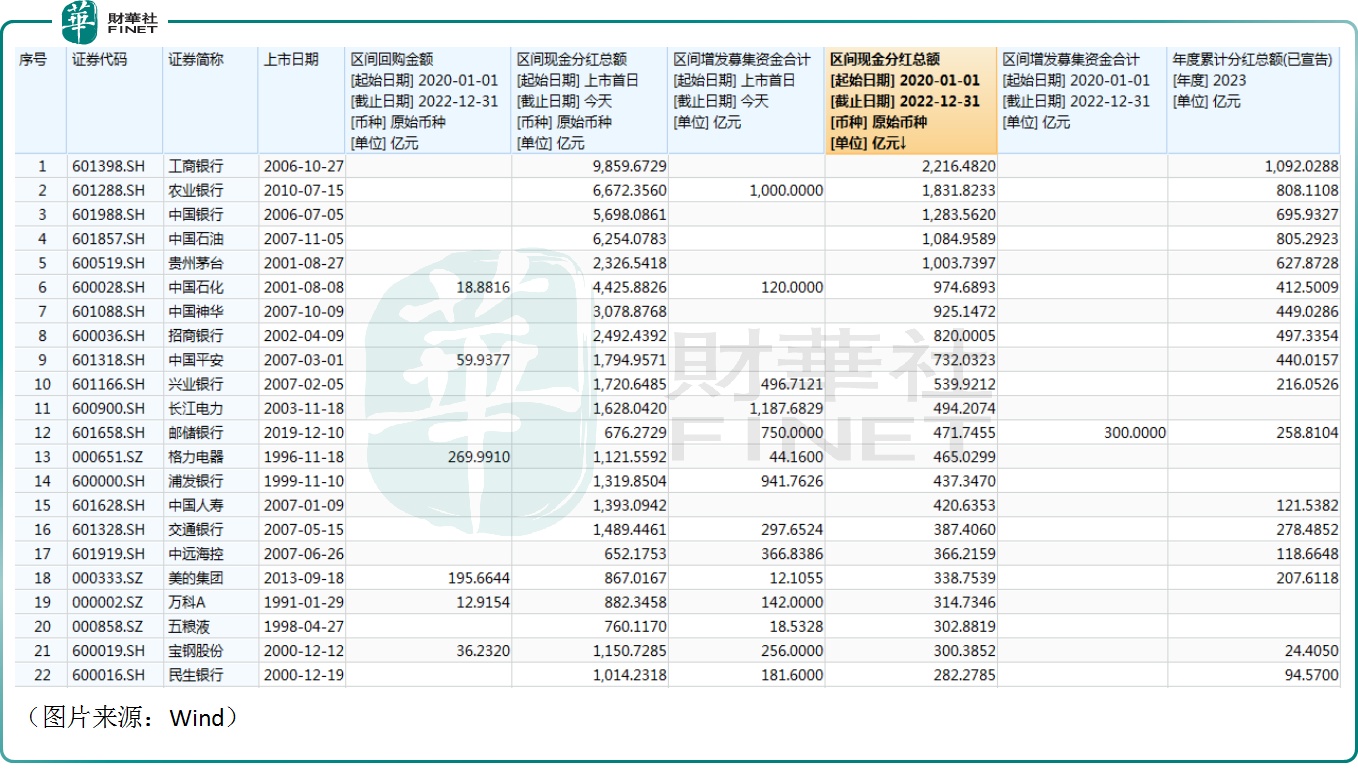
Additionally, from 2020 to 2022, five main board companies had cash dividends in the 50-100 billion yuan range, including Sinopec, China Shenhua, China Merchants Bank, Ping An Insurance, and Industrial Bank; 48 main board companies had cash dividends in the 10-50 billion yuan range; and 405 main board companies had cash dividends in the 1-10 billion yuan range.
It is not hard to see that these top cash dividend-paying main board companies are mostly well-known state-owned enterprises. Another characteristic is that in terms of cash dividends, main board companies show a clear polarization phenomenon, with a few leading state-owned enterprises contributing the vast majority of cash dividends.
"Dual Innovation" "Blacklist": Many companies are unprofitable, nearly half pay less than 100 million in dividends
It should be noted that the main board market gathers relatively traditional mature industries, while the "Dual Innovation" market (ChiNext and STAR Market) is dominated by innovative companies, which have greater capital needs, resulting in poorer dividend performance compared to main board companies.
Wind data shows that in the "Dual Innovation" market, from 2020 to 2022, 13 companies paid zero cash dividends, including Fullshare Holdings, Shanghai Yizhong, and Yihuatong-U; 907 companies had total cash dividends in the 0-100 million yuan range, accounting for 47.39% of "Dual Innovation" companies, a higher proportion than main board companies.
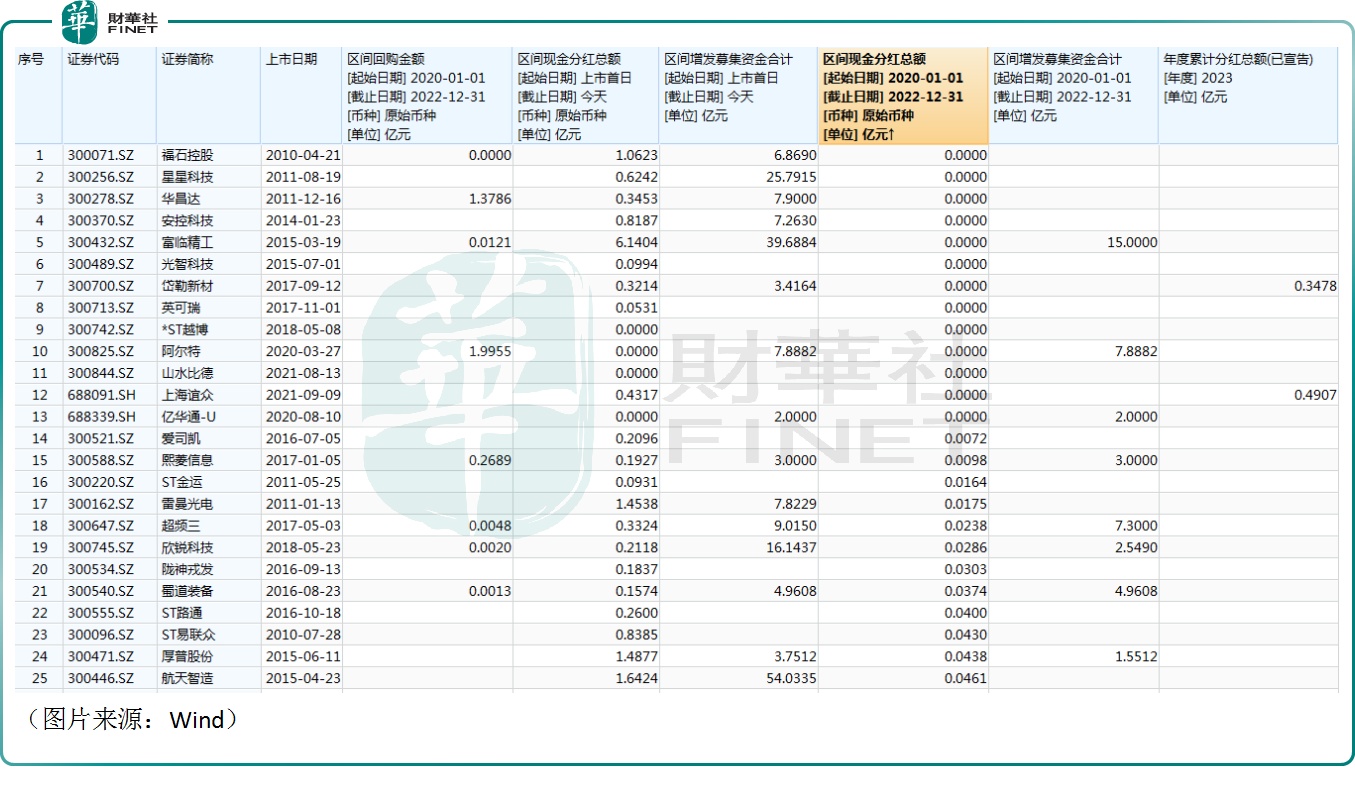
Notably, unlike main board companies, "Dual Innovation" companies mostly focus on emerging technology fields and are generally "newer" in terms of listing time compared to main board companies. Additionally, "Dual Innovation" companies not only have greater capital needs but some are still in the red, making them unable to pay dividends, especially those on the STAR Market, such as Yihuatong-U mentioned above.
Data shows that Yihuatong-U specializes in fuel cell systems and related technology development and services, reporting losses for the past three years.
Therefore, it is normal for "Dual Innovation" companies to underperform main board companies in terms of dividends.
"Dual Innovation" "Redlist": Mostly ChiNext companies, Mindray Medical pays another 5.2 billion
Additionally, Wind data shows that in the "Dual Innovation" market, from 2020 to 2022, two companies had total cash dividends exceeding 5 billion yuan, namely Wens Foodstuff Group and Mindray Medical (300760.SZ). Mindray Medical announced another 5.214 billion yuan dividend in 2023, while Wens Foodstuff Group is expected to report huge losses in 2023 and did not continue paying dividends.
Furthermore, from 2020 to 2022, 10 "Dual Innovation" companies had total cash dividends in the 2-5 billion yuan range, including China Railway Signal & Communication, Lens Technology, CATL (300750.SZ), Transsion Holdings, and Zhifei Biological. East Money Information, Inovance Technology, and Orient Securities also ranked high in cash dividends among "Dual Innovation" companies.
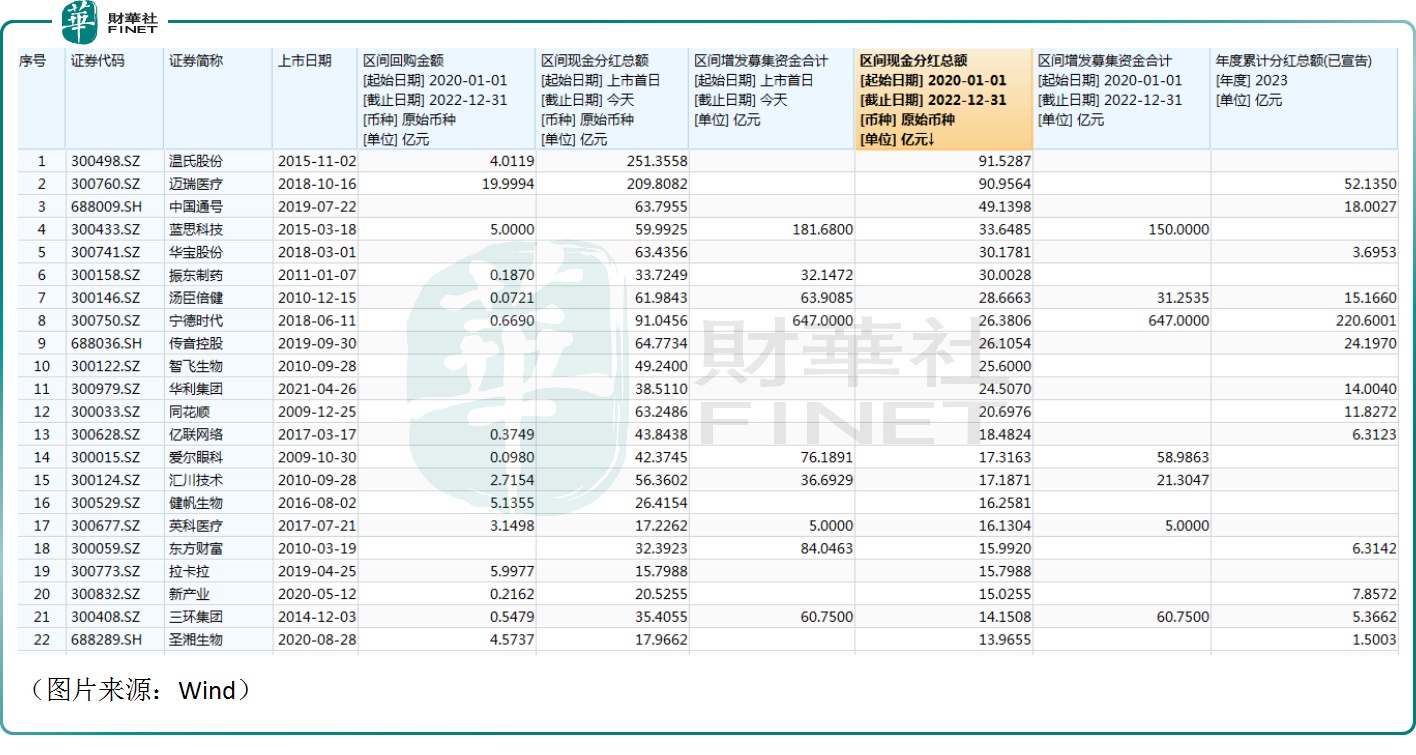
Generally, the top cash dividend payers in the "Dual Innovation" market are also well-known industry leaders, mostly from the ChiNext, with only a few from the STAR Market.
Conclusion
Cash dividends are an important way for listed companies to reward shareholders and the foundation for guiding long-term value investment. In the nearby Hong Kong market, some investors even consider investing in blue-chip stocks like HSBC Holdings, Cheung Kong Holdings, and Hang Seng Bank as an alternative savings behavior because these companies are very generous with dividends.
Although the A-share market also has companies like ICBC, Kweichow Moutai, and China Yangtze Power that pay continuous and stable dividends, such companies are still too few, accounting for a low proportion in the entire market. This may be one of the reasons why the A-share market lacks a strong value investment atmosphere and investors are keen on chasing rising and falling stocks.
Fortunately, in recent years, regulators have frequently introduced policies to guide A-share companies to value shareholder returns, and the introduction of the new "National Nine Measures" is expected to have a positive effect.
Author: Yun Zhi Feng Qi
The copyright of this article belongs to the original author/organization.
The views expressed herein are solely those of the author and do not reflect the stance of the platform. The content is intended for investment reference purposes only and shall not be considered as investment advice. Please contact us if you have any questions or suggestions regarding the content services provided by the platform.
