


 Likes Received
 Posts
PostsFrom a business model perspective, the leading security company's high-probability buying point has been updated!

Continuing from the previous article:
Last time we discussed how Hikvision's $HIKVISION(002415.SZ) performance has shown signs of recovery, but compared to the low base of the same period last year, it hasn't yet reached a true upward trend.
Considering the current performance and valuation, the valuation is relatively reasonable. Those holding can continue to hold.
But for those looking to enter, we're all about value for money.
In principle, judging from Hikvision's ROE, it is undoubtedly an excellent company. Even during the challenging years of 2022-2023, with the pandemic and less-than-ideal economic recovery, Hikvision still achieved an ROE of around 19.5%.
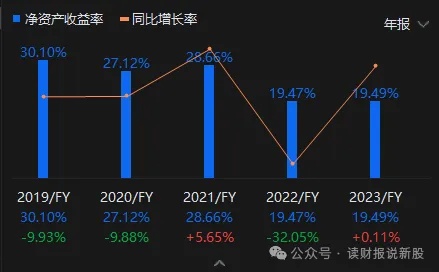
An excellent company at a reasonable valuation is worth considering, but Hikvision's business model means we should discount the current valuation somewhat.
This article will delve into Hikvision's business model to determine its true reasonable valuation.
......
From a profitability perspective, whether looking at ROE or PE, both involve the letter E, which stands for net profit.
However, due to China's accrual-based accounting system, net profit doesn't entirely equate to the money you've actually earned.
Therefore, we need to verify the quality of the profit using the formula: operating cash flow/net profit.

As shown in the chart, over the past 11 years, Hikvision's ratio of operating cash flow to net profit averaged 78.4%, indicating slightly lower quality of net profit.
Only in 2020 and 2023 did Hikvision improve cash flow recovery, but other years in between were less impressive.
This phenomenon is largely due to Hikvision's business model, particularly inventory and accounts receivable, both of which weaken the quality of its profits.
First, let's look at inventory.

Hikvision's absolute inventory value increased from 5.7 billion yuan in 2018 to 19.2 billion yuan by the end of 2023, with its proportion of total assets rising from 9% to 13.8%.
Inventory days increased from 76 days in 2018 to 141 days in 2023, nearly doubling.
These figures clearly indicate declining operational efficiency, leading to two issues:
First, large inventories can lead to significant impairment losses, potentially hiding some vulnerabilities;
Second, they tie up substantial cash. In 2023, Hikvision had interest-bearing debt of about 17 billion yuan. If inventory were reduced to 2018 levels, around 8 billion yuan in cash could be freed up, potentially cutting interest-bearing debt by half.
The increase in inventory is partly due to U.S. sanctions, but several years have passed, and chip supply issues have largely been resolved. Why maintain such high inventory levels?
At the end of 2023, Hikvision's inventory included 7.9 billion yuan in raw materials and 11.65 billion yuan in finished goods, with inventory impairment provisions of about 490 million yuan for the year.
Setting aside raw materials, the 11.65 billion yuan in finished goods, against annual sales costs of about 49.6 billion yuan, represents roughly 2.8 months of sales. In 2018, finished goods inventory covered only 1.7 months of sales.
Is 2.8 months overly conservative? Or does this inventory reflect weak sales, requiring mass production to maintain gross margins?
Hikvision aims to expand overseas sales, improve response times, and enhance service levels, which may require more overseas spare parts—a possible factor in high inventory.
A quick look at Dahua Technology$DAHUA INC(002236.SZ) shows its inventory situation is better than Hikvision's.
Inventory is a real headache!
Next, let's examine accounts receivable, which are excessive and growing, raising cash flow concerns. Here's the data:

At the end of 2023, Hikvision had 38.4 billion yuan in accounts receivable and notes, with accounts receivable alone reaching 35.8 billion yuan. Accounts receivable accounted for 27.67% of total assets, 13% higher than accounts payable (14.63%), tying up an additional 18 billion yuan in cash.
The accounts receivable turnover days reached 157 days in 2023, 13 days higher than in 2018.
This issue is largely dictated by Hikvision's business model, with major clients being governments and large enterprises that demand longer payment terms.
Historically, Hikvision's bad debt losses have been manageable, but as revenue grows, accounts receivable will continue to expand. Over time, will shareholders end up with just claims scattered across numerous clients?
Thus, considering Hikvision's business model, which is tough due to high accounts receivable and inventory, its current valuation of 21x PE and nearly 4x PB offers less value compared to consumer stocks with better business models (e.g., liquor).
A high-probability approach is to adjust the seemingly reasonable current valuation.
Given that Hikvision's long-term profit quality is around 80%, we should discount the current valuation by 10-20%.
Ultimately, this suggests a share price range of 26-29 yuan.
Entering at this range would be a high-probability bet!
That's all for today's analysis. I hope you found it helpful! I'm StockPro, an ordinary investor who enjoys reading financial reports, specializes in IPOs in Hong Kong, and invests in Hong Kong, U.S., and A-shares with a long-term focus and short-term supplements. See you next time!
The copyright of this article belongs to the original author/organization.
The views expressed herein are solely those of the author and do not reflect the stance of the platform. The content is intended for investment reference purposes only and shall not be considered as investment advice. Please contact us if you have any questions or suggestions regarding the content services provided by the platform.
