



Major counterattack! Why is Tesla boiling?

The market doesn't believe in tears, only in hard work.
Since the beginning of this year, the stock price of $Tesla(TSLA.US) has fallen by 42%, mainly due to declining vehicle deliveries and rumors that it may no longer launch affordable new cars.
However, after announcing its Q1 2024 results, these rumors were debunked. During the earnings call, Elon Musk stated that the company has updated its future vehicle launch timeline, accelerating the release of new models: previously mentioned to start production in the second half of 2025, it may now be brought forward to early 2025 or even the end of this year. These new models include affordable cars, which will use Tesla's existing production facilities to save costs.
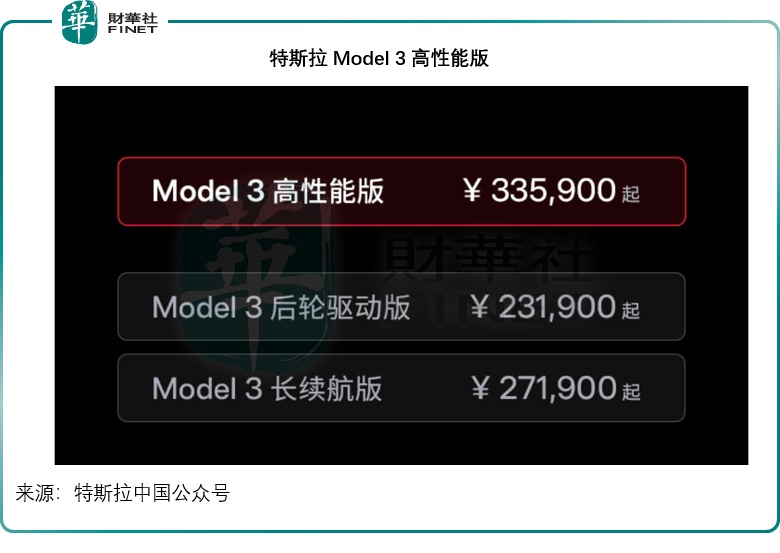
Alongside the earnings release, Tesla's official website launched the new Model 3 Performance edition, with Tesla China simultaneously offering it at a starting price of 335,900 yuan.
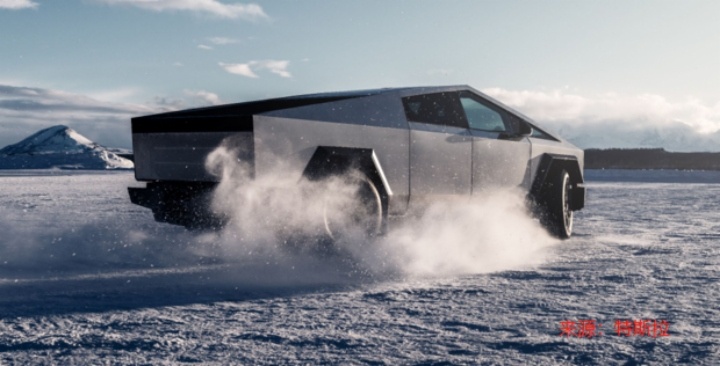
On the other hand, Tesla's updates in its earnings also sent positive signals to the market: Cybertruck production ramp-up is progressing smoothly, with weekly output reaching 1,000 units in April. Revenue and profits from non-automotive businesses continue to rise, partially offsetting the decline in automotive performance.
While releasing these positive updates, Tesla further introduced favorable financing options to attract buyers. For example, Tesla China announced on Weibo that customers ordering specified versions of the Model Y can choose between limited-time zero down payment or zero-interest plans, while those ordering specified versions of the Model 3 can enjoy zero down payment plus discounted interest rates. These measures aim to lower the entry barrier and attract more buyers.
Additionally, Musk revealed during the earnings call that the Optimus robot will begin limited production in Tesla factories by the end of this year to perform useful tasks, with sales to the public expected before next year.
Tesla also stated that construction has begun at its Reno, Nevada factory, with the first Semi scheduled for delivery starting in 2026.
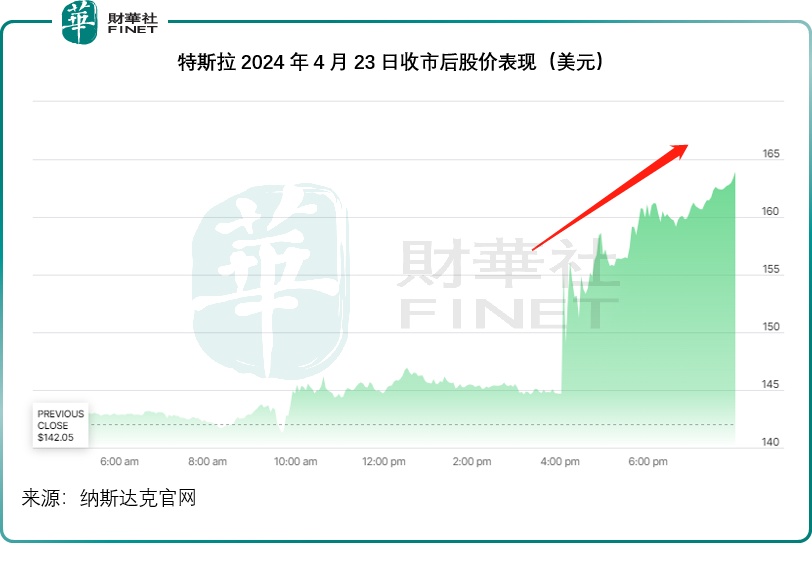
Despite Tesla's Q1 2024 automotive sales revenue falling 12.81% year-over-year and non-GAAP net profit attributable to shareholders dropping 47.59%, the stock price surged over 13% in after-hours trading following the earnings announcement, driven by these positive developments.
How to View Tesla's Q1 2024 Performance?
In Q1 2024, Tesla's vehicle production fell 1.69% year-over-year to 433,370 units, while total deliveries dropped 8.53% to 386,810 units. Model 3/Y production and deliveries declined 2.13% and 10.29%, respectively, to 412,380 and 369,780 units, while Model S/X production and deliveries grew 8.02% and 59.21%, respectively, to 21,000 and 17,030 units.
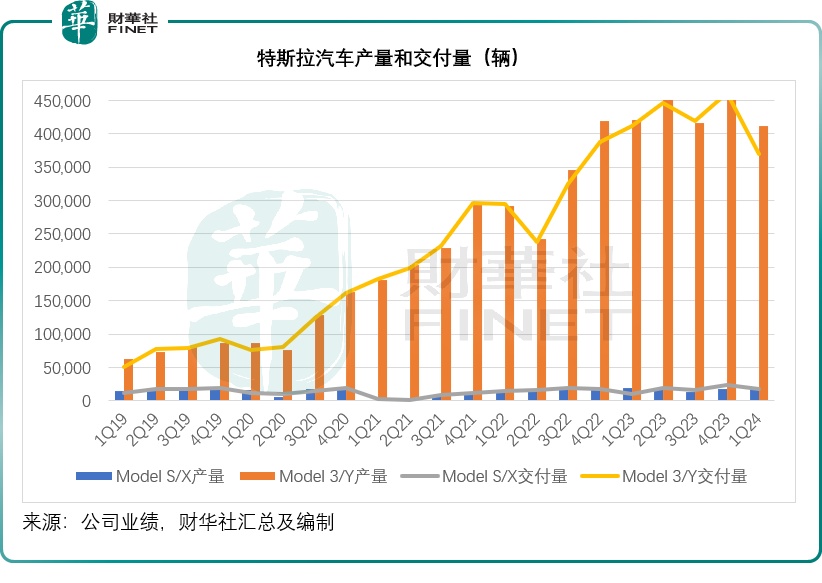
During the period, Model 3 production at the Fremont factory declined quarter-over-quarter due to production line changes for model updates. The Shanghai Gigafactory saw a seasonal dip due to the Lunar New Year holiday, while Model Y production in Berlin fell due to Red Sea risks and arson impacts.
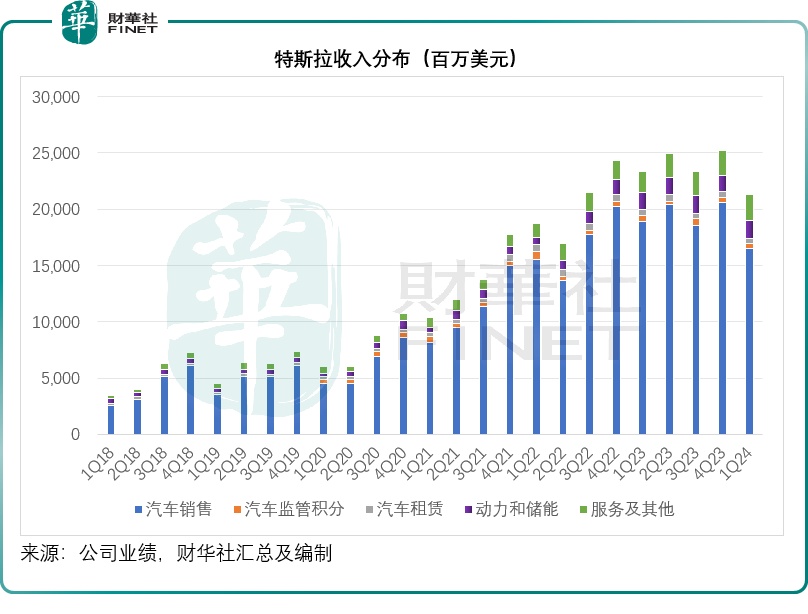
In Q1 2024, Tesla's automotive sales revenue dropped 12.81% year-over-year to $16.46 billion, primarily due to lower deliveries. However, energy generation/storage and services revenue grew 6.93% and 24.55%, respectively, partially offsetting the decline. Total revenue fell 8.69% to $21.301 billion.
Caijing noticed that Tesla's automotive gross margin further declined to 15.57% in Q1 2024, down 2.74 percentage points year-over-year and 1.05 percentage points quarter-over-quarter (see chart below).
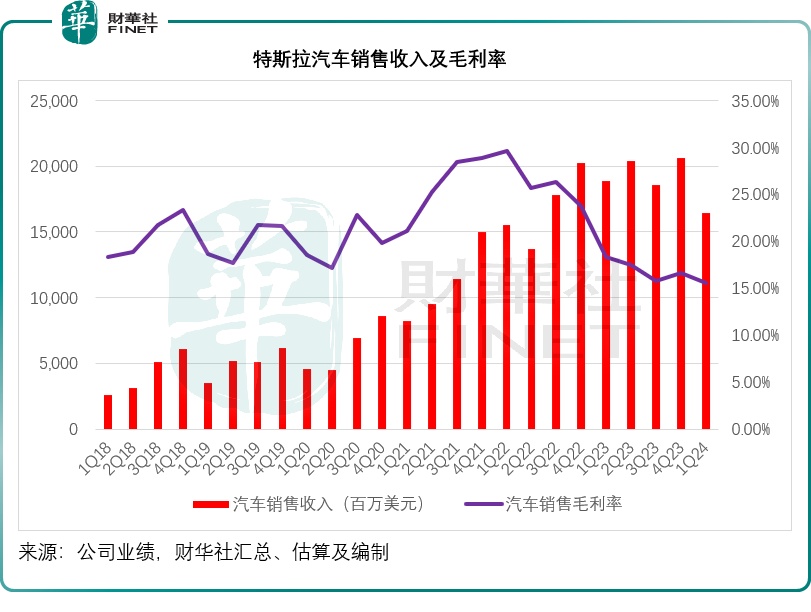
Tesla management disclosed that excluding Cybertruck impacts, automotive gross margin fell from 18.9% to 18.5%. Price adjustments were offset by lower unit costs and Autopilot revenue recognition for some U.S. vehicles. Fremont Model 3 ramp-up costs and Berlin disruptions raised expenses, but cost-cutting measures largely neutralized these effects. Excluding Cybertruck and Fremont costs, automotive margins slightly improved. Austin and Berlin Model Y costs are now close to Fremont levels.
Q1 operating profit fell 56.04% to $1.171 billion, with a 5.50% margin (down 5.92 percentage points year-over-year and 2.7 percentage points quarter-over-quarter), driven by lower average selling prices and higher costs, partially offset by AI, battery upgrades, and R&D benefits. Cybertruck costs and delivery declines outweighed material cost reductions, energy storage margin growth (including IRA credits), and FSD revenue recognition.
Non-GAAP net profit was $1.536 billion, down 47.59%. Operating cash flow fell 90.37% to $242 million, with free cash flow at -$2.53 billion (including $1 billion AI infrastructure capex). Cash and investments dropped $2.2 billion to $26.9 billion.
Capital expenditures totaled $2.8 billion as Tesla continues investing in AI infrastructure, capacity, Superchargers, service networks, and new products amid industry cutbacks.
This significant earnings decline aligned with Wall Street expectations, but Tesla's future actions will determine its market standing.
How Will Tesla Reverse the Downturn?
Beyond accelerating new model launches, Tesla shared details to boost investor confidence.
Management stated recent cost-cutting measures improved efficiency, with ongoing commitments to reduce per-vehicle operating costs. Tesla also focuses on profit growth by launching new models (including affordable ones) using existing facilities.
As mentioned, Q1 production declines stemmed from one-time factors like Fremont retooling, Berlin shutdowns, and Shanghai holiday slowdowns—issues unlikely to recur in Q2.
Tesla noted record Model Y production and cost improvements in Texas. Cybertruck ramp-up progressed, with April weekly output hitting 1,000 units. Shanghai will supply new markets like Chile.
4680 battery output now exceeds Cybertruck needs, with accelerating production and weekly cost declines signaling Q2 improvement.
For 2024, Tesla will detail robot and RoboTaxi (or Cybercab) plans in August. Musk expects higher annual vehicle sales. Energy storage deployments should grow ≥75% year-over-year, significantly contributing to profits. Since February, Tesla opened its North American Supercharger network to non-Tesla EVs, with further market expansions planned.
Management estimates global layoffs will save over $1 billion, with inventory rebuilding reversing in Q2 to restore positive free cash flow. Musk hinted at potential share buybacks if cash flows surge.
When asked about Chinese EV brands catching up, Musk emphasized uncertainty but noted competitors' sales declines outpaced Tesla's. As ARK Invest's Cathie Wood stated, Tesla is an AI/robotics company—not just a carmaker—with autonomous driving as the ultimate goal.
Musk said supervised autonomy systems will launch in regulated markets, including China, pending approvals. Tesla is also negotiating FSD licensing with a major automaker.
On upstream supply chains, Musk noted Tesla's 4680 production hedges against supplier risks, as past battery order surges caused 履约 challenges and 疯狂 lithium-ion prices. Now, supplier prices are more competitive with lower raw material costs, benefiting automotive margins.
Other executives added that Tesla's battery involvement allows supply chain oversight, with 4680 material partnerships extending cost savings.
For production, RoboTaxis will pursue revolutionary "unboxed" manufacturing—modular assembly replacing assembly lines to slash costs through parallel workflows.
Conclusion
Tesla's underwhelming Q1 2024 met expectations, but investors care more about its turnaround strategy. From upstream (battery supply chains) to downstream (layoffs, price cuts, financing incentives), automotive (accelerated launches, FSD licensing, Supercharger access) to non-automotive (energy storage expansion), Tesla is optimizing operations.
In AI, heavy investments in $NVIDIA(NVDA.US) H100 chips boost training/inference capabilities, while FSD refinements, cost cuts, and Optimus robots enhance efficiency.
Clearly, Tesla is aggressively cutting costs while chasing revenue streams.
With EV adoption surging recently, near-term demand growth may slow. Intensifying competition threatens incumbents.
As a pure automaker, Tesla's valuation would resemble Ford's (F) ~10x P/E—far below its current 49x premium, which hinges on AI leadership. Maintaining this requires sustained AI investments and dominance.
Author: Mao Ting
The copyright of this article belongs to the original author/organization.
The views expressed herein are solely those of the author and do not reflect the stance of the platform. The content is intended for investment reference purposes only and shall not be considered as investment advice. Please contact us if you have any questions or suggestions regarding the content services provided by the platform.
