


 Commemorative
 Likes Received
Earnings Report Interpretation of META 2024Q1: Revenue growth rate increased, key data exceeded expectations, performance guidance was weak

On Wednesday, April 24, after the U.S. stock market closed, META released its Q1 2024 earnings report. META reported revenue of $36.46 billion for the first quarter, a 27% year-over-year increase, surpassing market expectations of $36.22 billion. $Meta Platforms(META.US) $Dow Jones Industrial Average(.DJI.US) $S&P 500(.SPX.US) $NASDAQ Composite Index(.IXIC.US) $Hang Seng Index(00HSI.HK) $Invesco QQQ Trust(QQQ.US) $NVIDIA(NVDA.US) $Alphabet(GOOGL.US) $Microsoft(MSFT.US)
1. Summary of Personal Views
1. Regarding META's Q1 performance, the company continued to grow, with both revenue and profits exceeding expectations, primarily driven by a strong recovery in its core advertising business.
2. Despite significant losses in META's virtual reality business, the company remains committed to continued investment, maintaining high spending levels in both VR and AI. Whether these efforts will translate into future growth remains to be seen.
3. Compared to the significant post-earnings surge last quarter, META's performance this time, while decent, was followed by a sharp decline in stock price, mainly due to weak guidance and concerns over high spending. In the short term, the focus will be on whether AI can drive further growth in advertising.
Overall, META's Q1 performance showed continued growth, with revenue and profits exceeding expectations, largely due to a strong recovery in its core advertising business. However, losses in the virtual reality segment remain severe, and the company continues to invest heavily in both VR and AI. Despite solid results, the stock price dropped post-earnings due to weak guidance and market concerns over high spending. In the near term, the market will focus on whether AI can drive further growth in advertising.
2. Financial Analysis: Revenue Growth Accelerates, Key Metrics Beat Expectations
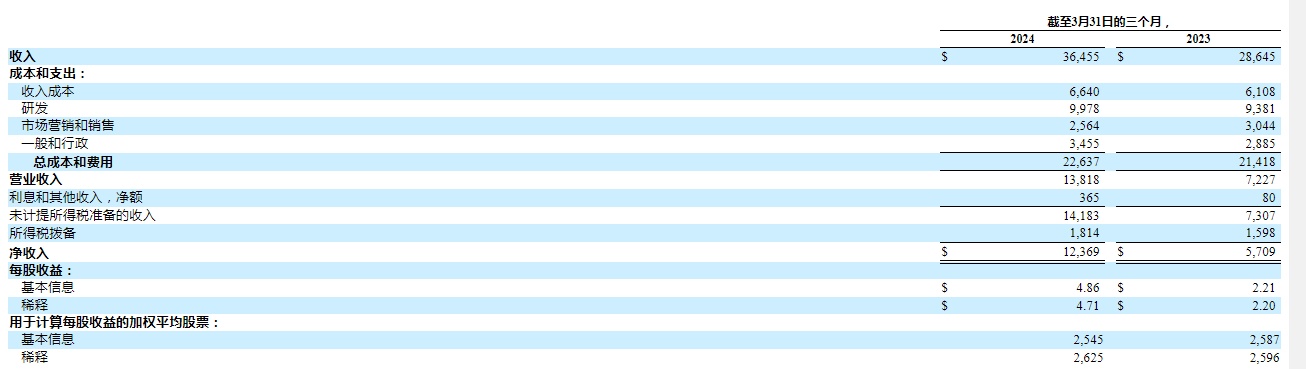
In terms of revenue, META reported $36.46 billion in Q1, up 27% year-over-year, surpassing market expectations of $36.22 billion. Breaking it down by segment, META's core advertising business performed exceptionally well, generating $35.635 billion in revenue, a 26.8% year-over-year increase. This growth rate improved from the previous quarter's 24%, suggesting that AI may indeed be accelerating META's advertising business.
In terms of profitability, META delivered outstanding results in Q1. Net profit reached $12.37 billion, a significant increase from $5.71 billion in the same period last year. Although this was down from $14.02 billion in the previous quarter, overall profitability remained strong. Additionally, EPS for the quarter was $4.71, beating market expectations of $4.32 and far exceeding the $2.20 from the same period last year. This achievement reflects META's efforts in cost-cutting and efficiency improvements over recent quarters, which have effectively enhanced profitability and laid a solid foundation for future growth.
3. Operational Insights: Strong Growth in Core Advertising, Continued Metaverse Dreams, Weak Guidance Sparks Market Pessimism
1. Strong Growth in Core Advertising
As mentioned earlier, the key driver behind META's growth this quarter was the continued strength of its advertising business. Advertising, META's core segment, generated $35.635 billion in revenue, up 26.8% year-over-year. This growth rate not only reflects strong momentum but also surpassed last quarter's performance. Additionally, the Family of Apps segment, which includes advertising revenue, also delivered impressive results, with revenue of $36.02 billion, up 27% year-over-year, further solidifying META's leadership in digital advertising.
Notably, after introducing AI features in its apps last quarter, META received positive feedback, prompting further investment this quarter. This strategy has proven effective, enhancing user experience and driving business growth.
Furthermore, in March 2024, META's Family Daily Active People (DAP) averaged 3.24 billion, up 7% year-over-year, indicating growing user engagement. In advertising, ad impressions across META's apps grew 20% year-over-year in Q1 2024, reflecting an expanding ad reach that supports revenue growth. Meanwhile, the average price per ad rose 6% year-over-year, demonstrating successful pricing strategies that further boost ad profitability.

2. Continued Metaverse Dreams
Beyond the Family of Apps, META's other major segment—Reality Labs (metaverse)—also warrants attention. As before, this segment underperformed in Q1, generating $440 million in revenue but incurring a staggering $3.846 billion in losses. While this was slightly better than the $3.992 billion loss in the same period last year, the figure remains concerning.
META explained that operating losses for this segment will increase significantly due to ongoing product development and ecosystem expansion investments. This means META must continue pouring money into the metaverse, with little hope of profitability in the near term. During the earnings call, Zuckerberg reaffirmed that the metaverse remains central to META's long-term strategy, and the company remains committed. He believes that as technology advances and the market matures, the metaverse could become a new growth driver.
However, for investors, the metaverse's losses add risk. They must weigh META's investments against potential returns and assess the segment's impact on overall performance. Meanwhile, the market will closely monitor META's progress in the metaverse for signs of change.

3. Weak Guidance Sparks Market Pessimism
As noted earlier, Zuckerberg remains highly optimistic about the metaverse, despite its lackluster performance. He continues to ramp up investment in this area, alongside high spending in AI to maintain META's industry leadership. Consequently, this quarter's guidance shows increased spending across multiple areas, sparking widespread market concern and discussion.
Specifically, META's capital expenditures rose significantly. The company raised its full-year capex forecast from $30-37 billion to $35-40 billion, citing accelerated infrastructure investments to support its AI roadmap. META also indicated that capex will likely increase further next year. This news is not ideal, as META's stock previously suffered due to excessive spending, and the market remains skeptical.
Beyond capex, META now expects total expenses for the year to reach $96-99 billion, up from the prior forecast of $94 billion, with the lower end raised by $2 billion.
Most notably, META's Q2 revenue guidance of $36.5-39 billion (midpoint: $37.75 billion, up 18% year-over-year) fell short of analysts' average expectation of $38.3 billion, signaling a potential slowdown in the recent growth trend.
This article represents my personal analysis of the earnings report, based on my own insights and research. Feedback and criticism are welcome. Note that this is not investment advice; readers should conduct their own due diligence.
The copyright of this article belongs to the original author/organization.
The views expressed herein are solely those of the author and do not reflect the stance of the platform. The content is intended for investment reference purposes only and shall not be considered as investment advice. Please contact us if you have any questions or suggestions regarding the content services provided by the platform.
