


 Rate Of Return
From this week's Hong Kong stock market performance, how to judge the trend reversal and its strength.

“ 『Enough』 is a powerful word—both in life and trading.”

Today, both Hong Kong and A-share markets continued to rise in the afternoon, with northbound capital net buying of A-shares hitting a record high of 22.4 billion yuan.
Hong Kong stocks surged again, with the $Hyatt Hotels(H.US)yatt Hotels(H.US)ang Seng Tech Index$Hyatt Hotels(H.US)ang Seng TECH Index(HSTECH.HK)$ soaring over 5% intraday before closing up 4.61%. The $Hyatt Hotels(H.US)yatt Hotels(H.US)ang Seng Index$Hang Seng Index(HSI.HK)$ and HSCEI rose 2.12% and 2.44% respectively, marking five consecutive days of gains and reaching new yearly highs.
Over the past two weeks, I reviewed what I learned from Shanghai Twelve and realized I made a foolish mistake—changing my familiar chart timeframes from 1-hour and intraday to Twelve’s preferred 30-minute and 3-minute charts.
This adjustment left me uncertain about trading opportunities, resulting in five days of ineffective market watching and missing the Hong Kong stocks rebound.
Yesterday, I finally understood why I hesitated to trade the Hang Seng Index and futures—the unfamiliar signal details on 30-minute and 3-minute charts undermined my confidence.
This reminded me of a quote from *Trading for a Living*: “『Enough』 is a powerful word—both in life and trading.”
In trading, 『enough』 is highly personal—
Your primary timeframe (minutes, hours, daily, weekly, or monthly) determines whether you’re scalping, swing trading, or investing long-term.
Choosing a timeframe depends on your risk tolerance and what constitutes 『enough』 for your strategy.
Different timeframes require different strategies. Even among swing traders using daily charts, secondary timeframes vary based on how much detail one needs to confirm entries/exits.
Blindly adopting Shanghai Twelve’s timeframes cost me this rally—a common mistake when learning from experts: Mimicking quirks while ignoring core principles.
Fortunately, reverting to my original timeframes restored clarity. Moving forward, I’ll differentiate between personal preferences and universal trading truths.
Today, I’ll share two essential lessons from Shanghai Twelve on identifying trend reversals and strength:
01—Trend Reversal Signals
Shanghai Twelve’s criteria:
1. Break trendline; 2. Break prior high/low.
These clear rules complemented my mean-reversion strategy during the $Hyatt Hotels(H.US)yatt Hotels(H.US)SI.HK$ rebound, offering three precise entry points.
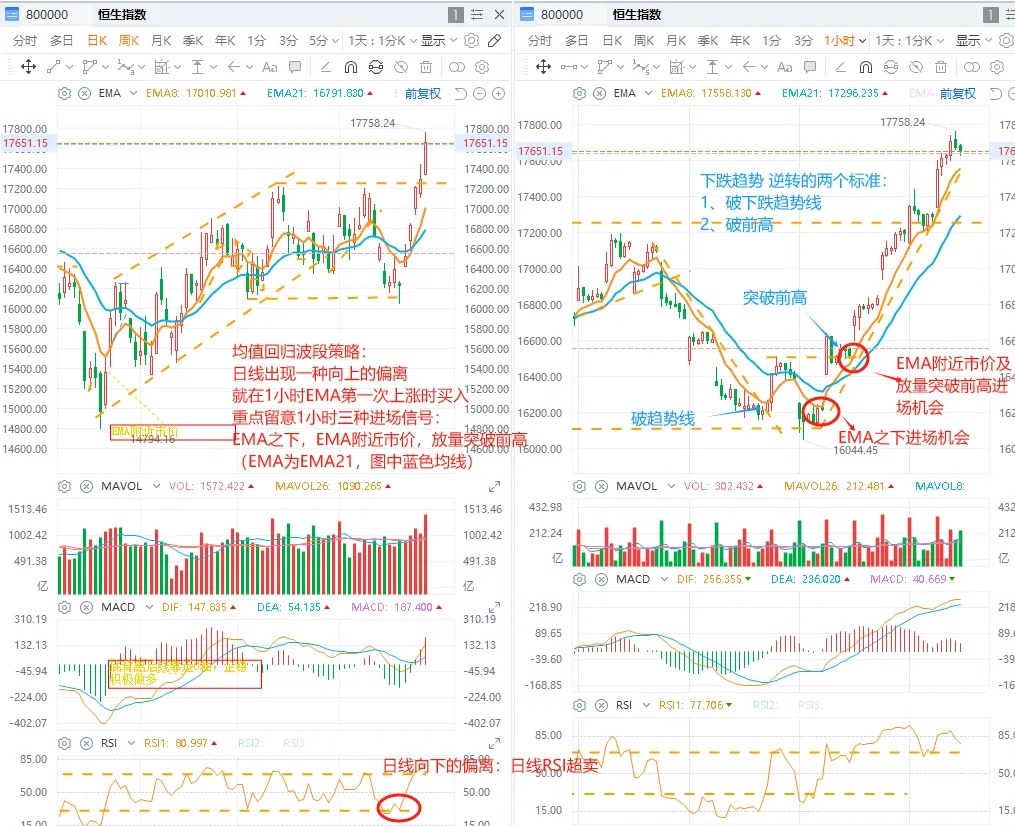
02—Trend Strength
Weak trends: Each pullback low falls below the prior high—ideal for mean-reversion strategies.
Strong trends: Pullback lows stay above prior highs—requiring momentum strategies (e.g., for $XL 二南方恒科 - 两倍多 HK07226$’s recent surge).
The key isn’t trendline steepness but rhythm—a revelation that separates pros from amateurs.
Disclaimer: This shares my trading framework, not advice. Stocks mentioned aren’t recommendations. Invest wisely.
The copyright of this article belongs to the original author/organization.
The views expressed herein are solely those of the author and do not reflect the stance of the platform. The content is intended for investment reference purposes only and shall not be considered as investment advice. Please contact us if you have any questions or suggestions regarding the content services provided by the platform.
