



Bitcoin crashed! CZ arrested

Cryptocurrency is prohibited in mainland China—you can't touch it or even talk about it. State media only reports negative news like flash crashes, liquidations, and market collapses, never mentioning that Bitcoin has tripled in the past two years, making it the best-performing major investment globally.
But things are different now. Hong Kong, following the U.S., has listed spot cryptocurrency ETFs. Even wilder is the in-kind creation/redemption mechanism (allowing investors to directly use Bitcoin and Ethereum to subscribe to ETF shares). In other words, you can use your Bitcoin to subscribe to ETF shares through a broker, then sell the ETF shares for cash—smooth as butter.
This is also an opportunity for crypto holders to legitimize their holdings, or as some call it, a way to "launder" their assets.
Everyone knows what's really going on. As one issuer executive put it: "Users in Hong Kong who already hold BTC or ETH can turn their 'alternative assets' into 'mainstream assets' through in-kind subscriptions, helping them obtain Hong Kong residency or PI (Professional Investor) status. This makes life and business in Hong Kong easier, attracting more Web3 natives to stay."
The message is both subtle and blatant—those in the know, know.
Of course, they still have to save face. Per regulatory requirements, crypto investors using in-kind creation/redemption must undergo KYT (Know Your Transaction) checks. Only after approval can their assets enter the compliant market. How strict the checks will be remains unclear. Currently, in-kind transactions are rare, likely because everyone's still watching and waiting.
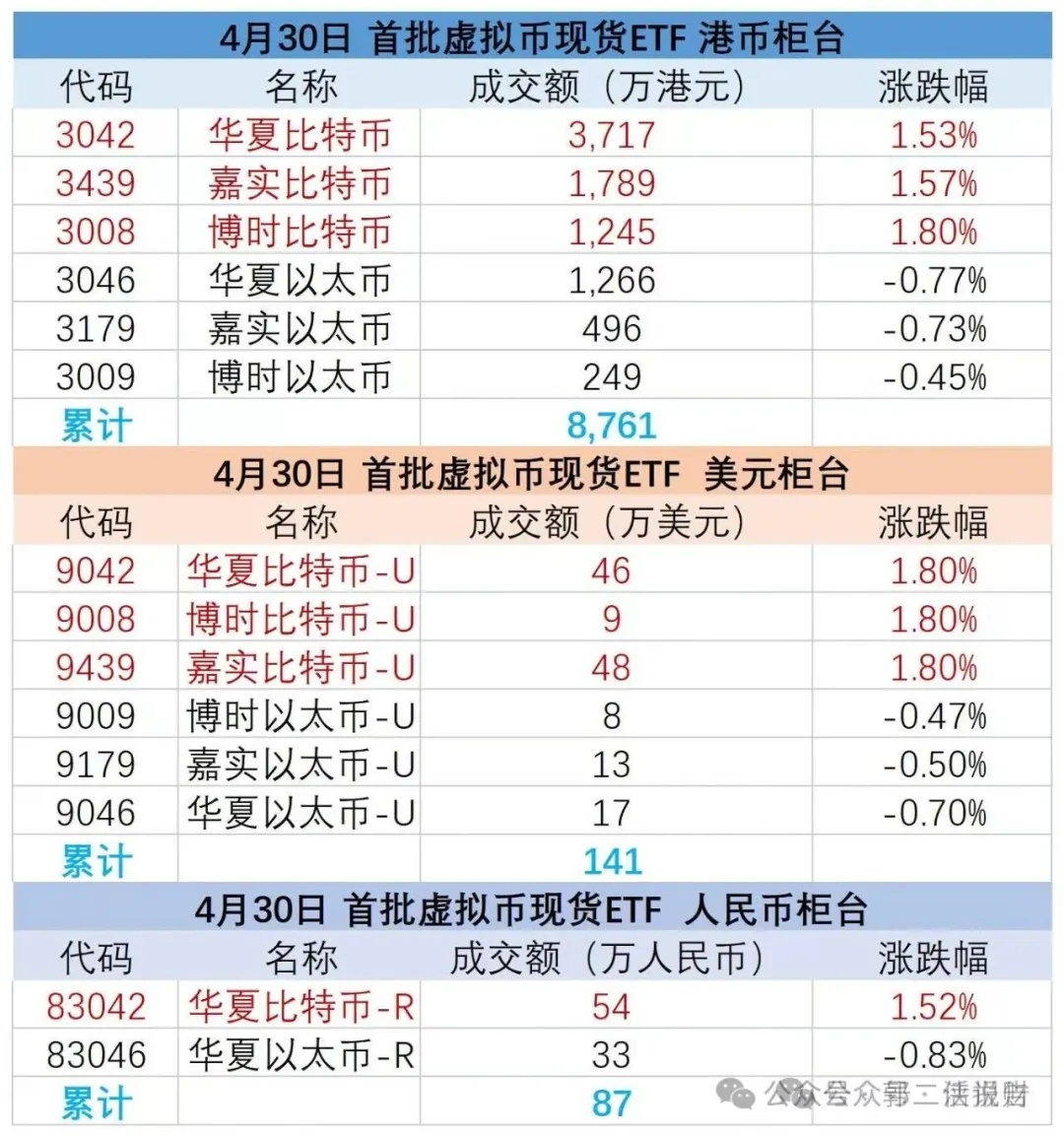
Despite the bold move, the market poured cold water on the ETFs' debut—way below expectations.
The first-day trading volume for all six spot crypto ETFs in Hong Kong was just about HKD 100 million (~USD 12.8 million). That's not even a fraction of the USD 4.66 billion traded on the first day for the 11 Bitcoin spot ETFs listed in the U.S. in January.
The gap is... significant.
Ironically, Hong Kong's spot crypto ETFs launched on April 30, and on May 1, Changpeng Zhao (CZ), CEO of Binance—the world's largest crypto exchange—was sentenced to four months in U.S. prison for money laundering. This triggered a Bitcoin sell-off, dropping from $63,000 to below $58,000, perfectly timing to wipe out investors who bought into Hong Kong's ETFs on day one.

With a net worth of $40 billion, CZ is now the richest inmate in U.S. history. Binance was already fined $4.3 billion by the U.S. Paying to settle might be a way out, but there's no guarantee the U.S. won't keep squeezing this cash cow—CZ still faces a pile of lawsuits.
Between Bitcoin and Ethereum, which is the better buy?
It depends on the investor's risk appetite.
As we know, Bitcoin has a fixed supply of 21 million coins, halving every four years. After the fourth halving on April 20 this year, the block reward dropped from 6.25 BTC to 3.125 BTC, pushing the mining cost to around $40,000 per BTC.
Post-fourth halving, 19,687,500 BTC (93.75% of the total supply) have been mined, leaving only 1,312,500 BTC to be mined over the next 126 years.
What happens after that? Not our problem.
Bitcoin's quadrennial halving keeps it deflationary. After the fourth halving, its supply growth rate is now lower than gold's, making it the scarcest asset.
This dynamic makes Bitcoin, with its $1.2 trillion market cap, more like a value stock—safer but unlikely to deliver explosive returns. A 10x surge seems improbable, though Cathie Wood predicts $1.5 million per BTC... someday. Whenever that is, take it with a grain of salt.

Meanwhile, Ethereum, dubbed "Bitcoin 2.0," has no supply cap. With ~120 million coins circulating ($360 billion market cap), it offers more upside but also greater volatility and uncertainty—more like a growth stock.
Why choose? If you believe in crypto, hedge your bets with both.
$HKEX(00388.HK) $iShares Bitcoin Trust ETF(IBIT.US) $TENCENT(00700.HK)
The copyright of this article belongs to the original author/organization.
The views expressed herein are solely those of the author and do not reflect the stance of the platform. The content is intended for investment reference purposes only and shall not be considered as investment advice. Please contact us if you have any questions or suggestions regarding the content services provided by the platform.
