


When Pony Ma and Zhou Hongyi shook hands

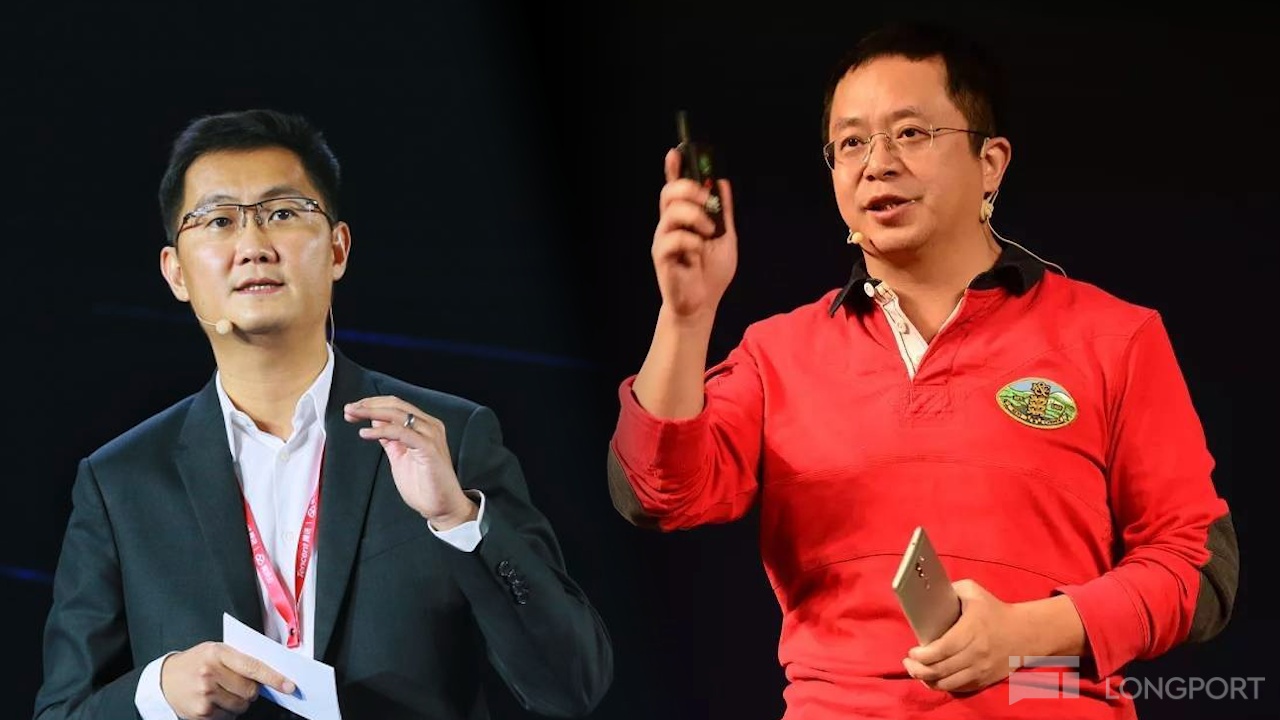
If one word were to describe a person's 30 years, "timely" would undoubtedly be the most fitting.
Similarly, if we look at the 30 years of China's internet from a 30-year perspective, we might arrive at the same conclusion.
The 30 years of China's internet have perhaps been a rollercoaster ride, filled with countless stories and figures worth commemorating and documenting.
However, if we had to pick the most iconic events and figures from this vast array, the 3Q War involving Pony Ma and Zhou Hongyi would undoubtedly be the most unignorable.
Yet, unlike the past conflicts between Pony Ma and Zhou Hongyi, at the 30-year milestone of China's internet, we now see them shaking hands in reconciliation, witnessing the transformation and renewed journey of Tencent and 360.
At this point, Pony Ma has already led Tencent through a comprehensive internal and external renewal, while Zhou Hongyi has become what Pony Ma calls an "influencer."
When Pony Ma and Zhou Hongyi shake hands, what we see is not just the reconciliation between Tencent and 360, but more importantly, the profound changes taking place in China's internet industry.
Only by recognizing this can we stand at the 30-year milestone of China's internet, remembering the past while exploring the future.
I
For every netizen who experienced the 3Q War, even today, the memories of that battle remain vivid.
The 3Q War was not just a battle between Tencent and 360; it revealed how the internet had become an integral part of people's lifestyles.
Thus, whether for Tencent or 360, their actions simply highlighted this reality.
Just as no war has a true winner, neither Tencent nor 360 emerged as the ultimate victor in the 3Q War.
However, through that war, we realized that the internet was not some distant entity but something deeply intertwined with our lives.
If we view the 3Q War as a watershed moment, it marked the transition from the PC era to the mobile internet era.
From then on, the internet was no longer confined to PCs but rapidly expanded into the mobile domain.
For Tencent and 360, their battle was largely a manifestation of the fierce competition for PC traffic.
For both Tencent and 360, the key to success lay in finding new sources of traffic beyond PCs.
Thus, we saw Tencent incubate WeChat, while 360 embarked on building a new ecosystem.
In hindsight, the 3Q War was more like a catalyst.
Behind this catalyst, we witnessed internet players like Tencent and 360 exploring new directions and business models, leading to an explosion of new internet innovations.
From then on, China's internet industry matured from its reckless youth into a stable adulthood.
II
With the advent of the mobile internet era, we saw the rise of new players like Didi, Meituan, and Toutiao, while giants like Alibaba, Tencent, and Baidu launched capital-driven battles.
For both Tencent under Pony Ma and 360 under Zhou Hongyi, survival in this new phase depended on finding new models and methods suited to their growth.
Thus, we witnessed Tencent's migration from QQ to WeChat and 360's shift from PCs to mobile.
Though their focuses differed, both were centered around traffic, adapting to the trend of the internet becoming a lifestyle.
If we were to define this phase for Tencent and 360, it was one dominated by capital and traffic.
In this era, both Tencent and 360 built their own ecosystems, using capital to fortify their moats.
This period marked the internet's evolution into a new form of infrastructure.
In this context, success hinged on integrating products and services into people's lives beyond niche domains.
It was under this backdrop that:
Tencent expanded beyond social media and gaming into retail, education, finance, and philanthropy;
360 moved beyond antivirus software into finance, search, news, and browsers.
In summary, both companies extended their reach beyond the internet into broader fields.
If we were to define this phase, "Internet+" would be the perfect term.
After the "Internet+" era, players like Tencent and 360 evolved from niche entities into true "infrastructure."
III
At the 30th anniversary of China's internet, we saw Pony Ma and Zhou Hongyi stand together again.
This time, however, they shook hands and joked, with no trace of their past rivalry.
Yet, their conversation revealed new themes like video accounts, influencers, and AI models.
Indeed, Pony Ma and Zhou Hongyi conveyed that China's internet industry had undergone a profound transformation.
Today, it's hard to define Tencent and 360—or Pony Ma and Zhou Hongyi—using old paradigms.
Under Pony Ma's leadership, Tencent has embarked on a radical transformation.
From concepts like the "all-real internet" and digital-physical integration to deep dives into industrial internet and the rise of video accounts, Tencent is undergoing a comprehensive upgrade.
Today, Tencent is no longer driven by traffic but by AI, short videos, and digital technology.
This new drive has enabled Tencent to transition seamlessly from the mobile internet era into the AI era.
Similarly, Zhou Hongyi has undergone his own metamorphosis.
Now an influencer, Zhou speaks less about cybersecurity and more about AI models.
Under his leadership, 360 has also transformed.
Today, 360 is no longer just an internet security company but one driven by AI models.
When Pony Ma and Zhou Hongyi shake hands, we see not the old Tencent and 360 but their perfect reinvention.
Similarly, Pony Ma, Zhou Hongyi, Tencent, and 360 are microcosms of China's internet industry.
Beyond them, players like Alibaba, JD.com, and Baidu are fully embracing AI, heralding a new era.
If we were to define this emerging AI era, it aligns with Pony Ma's concept of "renewal."
This "renewal" applies not just to Tencent but to China's entire internet landscape.
Conclusion
When Pony Ma and Zhou Hongyi shook hands at the 30th anniversary of China's internet, we witnessed the profound changes of the past 30 years and the ongoing "renewal" of the industry.
Their handshake symbolizes China's transition from the traditional internet era to the AI internet era.
From this point onward, Chinese internet companies like Tencent and 360 will undergo deep transformations, ushering people into a new phase of life and work.$TENCENT(00700.HK)
—The End—
Author: Meng Yonghui, Senior Writer, Columnist, Industry Observer, Influencer, Scholar of the Digital Economy.
The copyright of this article belongs to the original author/organization.
The views expressed herein are solely those of the author and do not reflect the stance of the platform. The content is intended for investment reference purposes only and shall not be considered as investment advice. Please contact us if you have any questions or suggestions regarding the content services provided by the platform.
