


 Likes Received
 Posts
PostsA 140% surge, the battle for control of Keling Electric's equity, is it the final showdown?

For excellent listed companies, dispersed equity can easily lead to a battle for control.
After the Vanke-Baoneng battle, the topic of "barbarians" in the A-share market seems to have faded away, and it is rare for capital to launch a "surprise attack" on A-share listed companies.
On March 18, an announcement from Kelectric pushed a battle for equity control into the public spotlight.
According to the announcement, the second and third largest shareholders, jointly with Hisense Grid, "hunted" the largest shareholder. Notably, Hisense Grid has a state-owned background.
According to the latest news, this two-month-long battle for equity control may soon come to an end.
The incident began on March 18 when Kelectric's General Manager Qu Guowang brought some outsiders to the company's securities department. Among them, someone claimed to represent Hisense Grid and presented a document stating that Hisense Grid had signed equity transfer agreements with several shareholders, acquiring 10.07% of Kelectric's shares and 19.64% of the voting rights.
This meant that Hisense Grid's voting rights in Kelectric exceeded the 11.07% voting rights held by the largest shareholder and Chairman Zhang Chengsuo.
They demanded that Kelectric issue an announcement disclosing the change in shareholder equity.
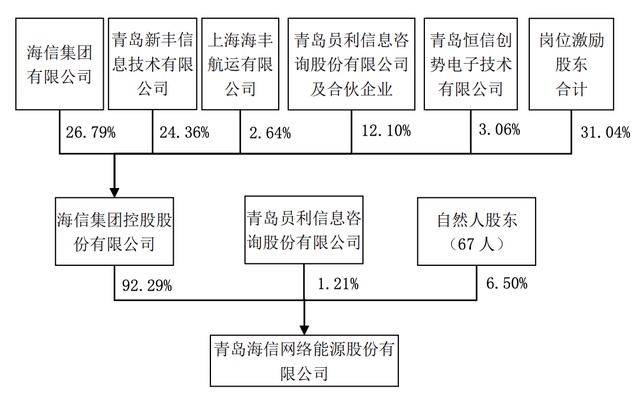
According to the shareholder equity change document provided by Hisense Grid, the company began buying Kelectric shares from the secondary market on March 11, accumulating 4.97% of the shares over five consecutive trading days. On March 15, Hisense Grid acquired an additional 5.1% of the shares from seven shareholders, including Vice Chairman Li Yanru and Director & President Qu Guowang, who held 3.19% of the shares.
Additionally, the two delegated all 9.57% of their voting rights to Hisense Grid.
Due to the financial reporting blackout period, during which listed company executives cannot trade company shares, Hisense Grid's sudden move left Chairman Zhang Chengsuo unable to counterattack.
As a result, Kelectric's stock price surged in the short term, with the highest increase exceeding 50%. From February, the increase exceeded 140%!
Facing the aggressive Hisense Grid, Zhang Chengsuo also launched a counterattack. On May 7, Zhang signed a concerted action agreement with three executives, including Qiu Shiyong, collectively holding approximately 17.46% of Kelectric's shares.
According to media reports, between April 29 and May 7, Zhang Chengsuo and Qiu Shiyong continuously increased their holdings by a total of 342,800 shares, while another major shareholder, Shijiazhuang State-Owned Investment Group, also increased its holdings.
On the evening of May 13, Kelectric announced that it plans to spend up to 1.5 billion yuan to acquire 20% of Kelectric's shares through a tender offer. This signals that the two-month-long battle for control may be heading toward a "final showdown."
According to the announcement, Hisense Grid issued a partial tender offer to all shareholders of Kelectric (excluding the acquirer) for non-restricted tradable shares, aiming to acquire 45.4188 million shares, or 20% of the company's total shares, at a price of 33 yuan per share.
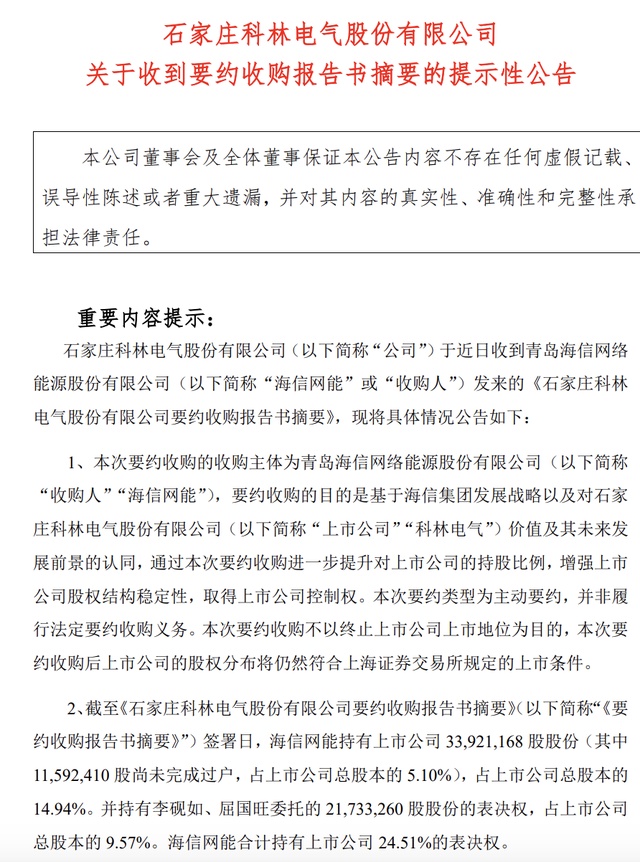
Hisense Grid's General Manager Shi Wenbo told the media that the purpose of the tender offer is to further increase Hisense Grid's shareholding in Kelectric, enhance the stability of the company's equity structure, and gain control of the listed company.
If the tender offer is completed, Hisense Grid will hold nearly 35% of Kelectric's shares and control 45% of the voting rights.
After the news was released, Kelectric's stock price hit the daily limit on May 14.
Currently, Kelectric's closing price is 31.56 yuan, less than 10% below the 33 yuan offer price. This means that after the tender offer period ends, Hisense Grid must acquire no fewer than 34.2912 million shares, or 15.1% of Kelectric's total shares, for the offer to be considered successful. Given the current stock price, there is a risk that the tender offer may fail.
Kan Jian Finance believes that the signs of Kelectric's equity battle were evident long ago. As early as April 2022, Zhang Chengsuo, Li Yanru, Qu Guowang, and two others stopped signing concerted action agreements, planting the seeds for today's split.
From the development of the incident, both sides have now begun increasing their shareholdings. This so-called "defensive battle" also serves as a reminder to high-quality listed companies with dispersed equity: they must not only focus on stable performance but also pay attention to shareholder returns.
The copyright of this article belongs to the original author/organization.
The views expressed herein are solely those of the author and do not reflect the stance of the platform. The content is intended for investment reference purposes only and shall not be considered as investment advice. Please contact us if you have any questions or suggestions regarding the content services provided by the platform.
