



The 'electronic foster mother' of car owners can't be a losing business.
A ship fears not the depth of the ocean but the shallows.
To prevent ships from running aground, shipbuilders create deep-keeled vessels to withstand storms.
Similarly, as smart cars enter a phase of consolidation, autonomous driving solution providers must focus on their strengths rather than striving to be a 'jack-of-all-trades.'
Recently, an article titled 'The Death of Second-Tier Autonomous Driving Solution Providers' described how some providers, amid the industry's shakeout, have formed a clear hierarchy: limited mass-production projects, inability to secure large funding, and insurmountable gaps in computing power and data.
After reading it, I forwarded the article to a top executive at a leading autonomous driving company, who replied: 'Pretty much.'
According to reports from Chip Flow Auto, it's now difficult for autonomous driving manufacturers to secure projects with development fees of 20-30 million yuan; most orders hover around a million and require white-box solutions.
On one side is industry consolidation, but on the other is a significant rise in consumer awareness of autonomous driving.
Today, the topic at dinner tables among Gen Z is which new-energy vehicle brand to choose. I once heard an IM Motors LS6 owner exclaim, 'Automatic parking is like my electronic foster mother.'
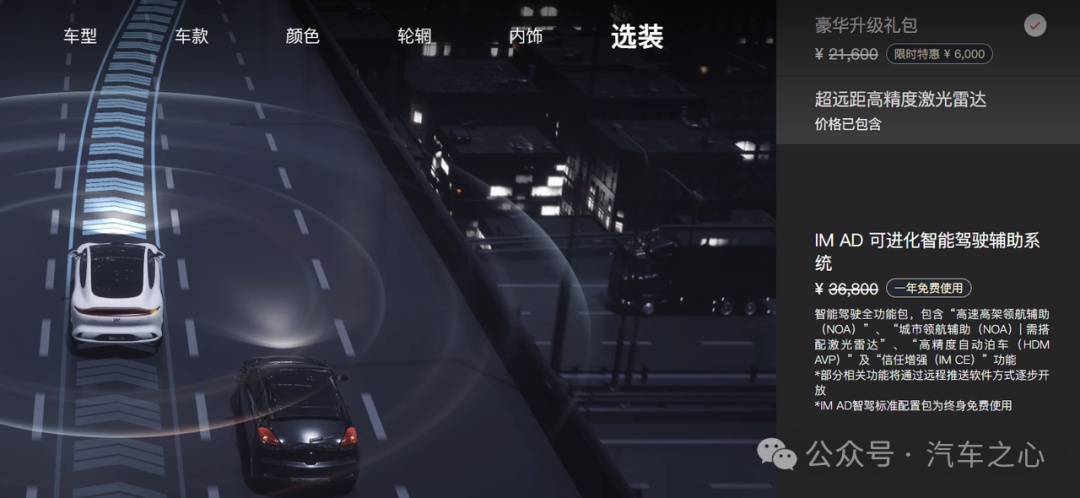
Autonomous driving features like automatic parking aren't cheap. The IM AD system for the IM Motors LS6 costs 36,800 yuan to purchase outright. From a pricing perspective, autonomous driving is still in its early stages of development.
From another angle, all manufacturing relies on scale. Only when smart cars achieve rapid scale will autonomous driving, seen as a cutting-edge technology, become more widespread and affordable.
When submerged underwater, one often overlooks the current's speed. Only by surfacing can we see the true situation facing autonomous driving suppliers today.
Thus, Auto Heart has mapped out the mainstream autonomous driving suppliers, analyzing trends from three dimensions: chips, sensor configurations, and pricing.
01. Chips and Autonomous Driving Suppliers: A Binding Relationship
Among consumers, the most recognized hardware for autonomous driving is chips and lidar.
A consumer might not understand the full picture of autonomous driving but likely knows whether their car's chip is domestic or from an overseas manufacturer.
Due to varying vehicle positioning, local suppliers like DJI Automotive, Huawei's Intelligent Automotive BU, Haomo AI, QCraft, and DeepRoute adapt their solutions across different chip platforms. For example, DJI Automotive initially used the 16 TOPS TDA4 for its 7V driving platform but recently added the 100 TOPS Qualcomm SA8650 as an option.
Currently, these five suppliers primarily use two types of chips:
One is from overseas manufacturers like NVIDIA, Qualcomm, Texas Instruments, and Ambarella.
The other is from local chipmakers like Horizon Robotics, Huawei, Black Sesame, and Axera.
Huawei stands out as the only all-in-one autonomous driving supplier. Its Intelligent Automotive BU spans seven areas: autonomous driving solutions, smart cabins, digital platforms, electric powertrains, cloud services, AR-HUD, and smart lighting.
The most critical aspect is the computing platform. Huawei's platforms have evolved significantly in recent years, with upgrades replacing older versions like the MDC 610 and 510. For L3 autonomous driving, Huawei is also developing new platforms.
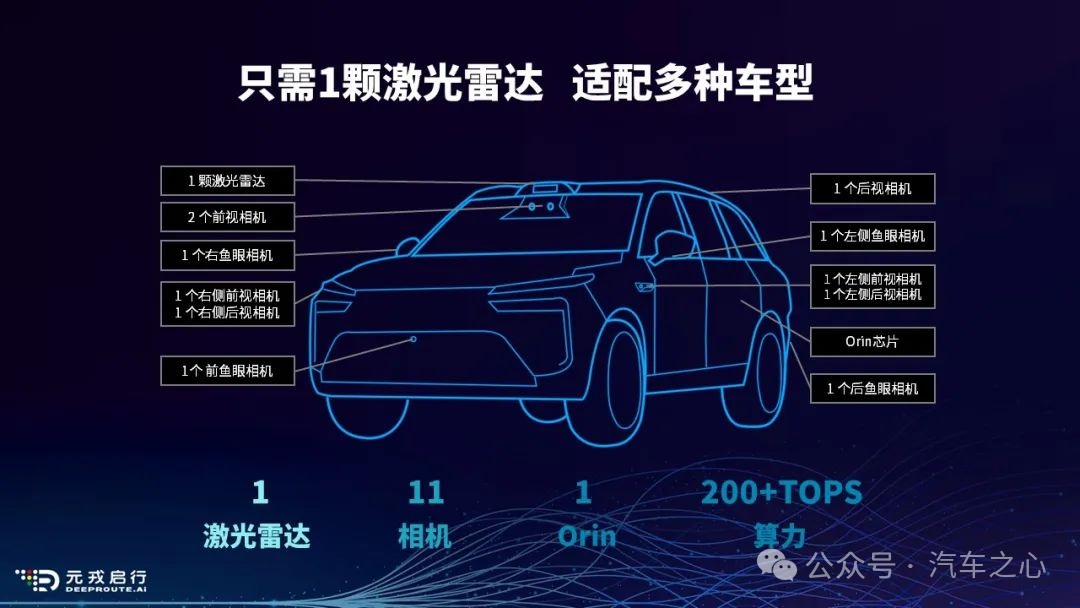
QCraft and DeepRoute, both transitioning from L4 to L2++ solutions, initially used NVIDIA chips for prototypes. DeepRoute's DeepRoute IO solution now uses the NVIDIA Orin-X (200+ TOPS), with plans for NVIDIA Thor. QCraft shifted to Horizon Robotics' chips post-2022.
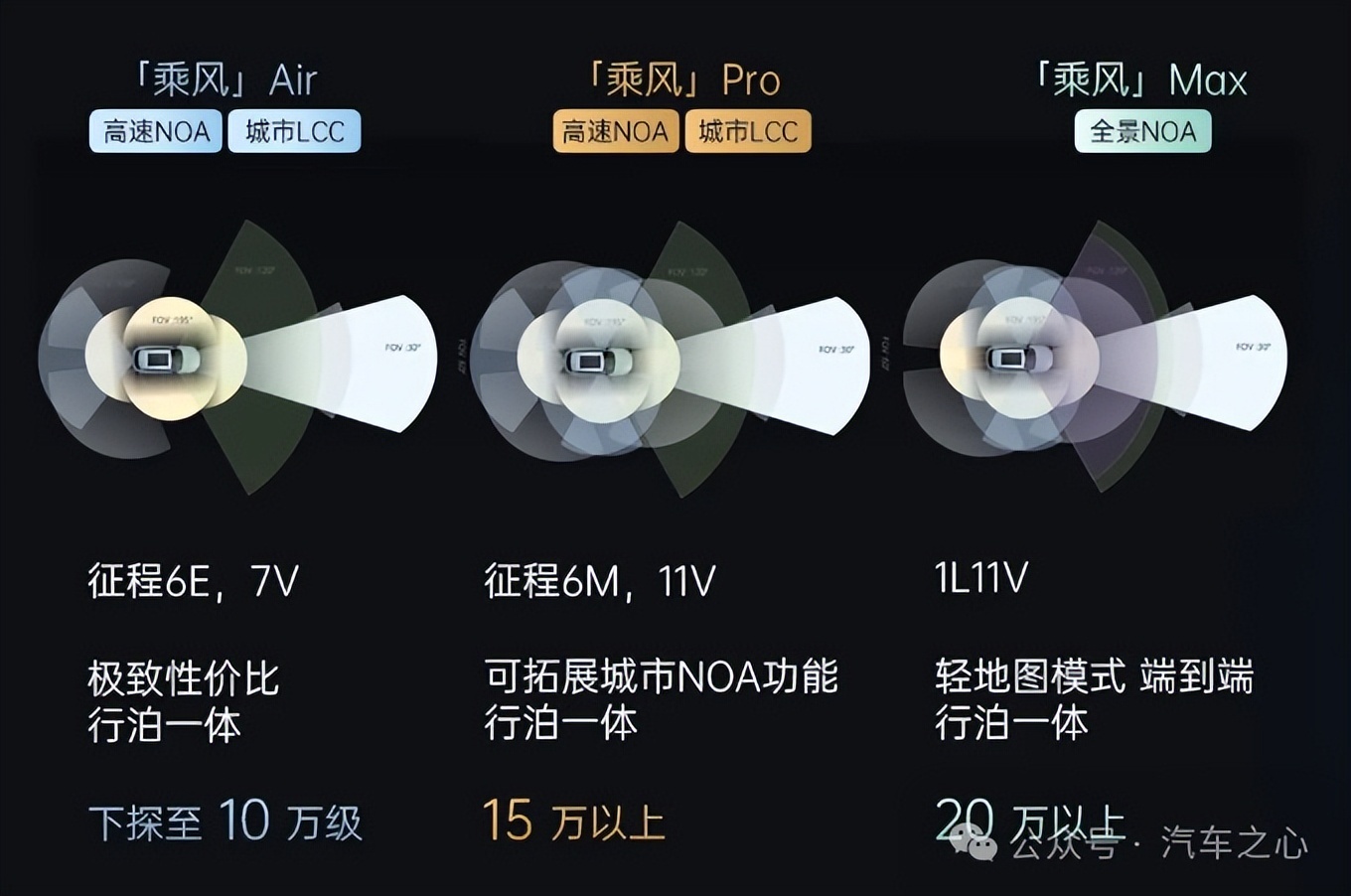
For example, QCraft's high-speed NOA solution uses a single Journey 5 chip, while its urban NOA solution uses dual Journey 5 chips. At Horizon's J6 launch, QCraft introduced the Air (6E) and Pro (6M) versions.
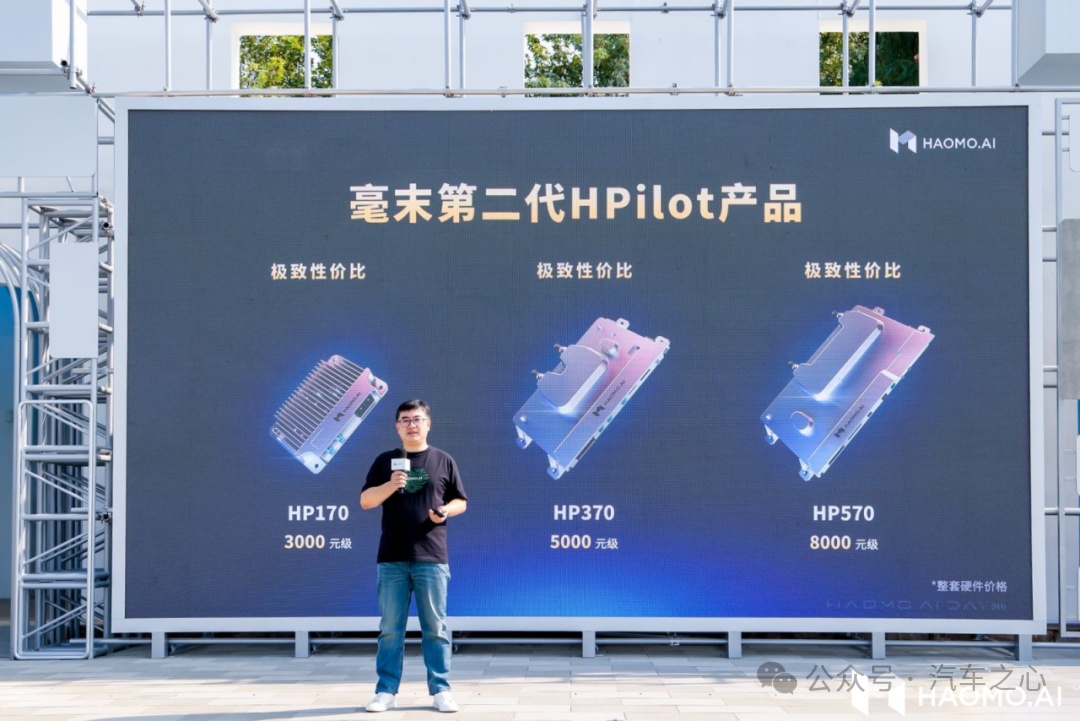
Haomo's three mass-production solutions—HP170, HP370, and HP570—range from 5 TOPS to 72/100 TOPS, likely using Qualcomm's SA8620P and SA8650. Momenta also uses SA8620P and SA8659P, with SA8775P for integrated cockpit-driving.
Similarly, DJI Automotive recently joined the Qualcomm camp, upgrading its Baojun Yunduo solution from TDA4 VH to SA8650 for urban navigation. At the Beijing Auto Show, DJI announced an advanced cockpit-driving solution based on SA8775P.
Looking ahead, the next five years may be dominated by Qualcomm, NVIDIA, and Horizon Robotics, with Thor, J6, and 8775 as their flagships. Cost-effectiveness, iteration speed, and toolchains will be key decision factors.
The logic is simple: automakers choose chips, while suppliers test mainstream options before settling on 1-2 for mass production. If cheaper chips like TI or Qualcomm can match NVIDIA's performance, why not choose them?
Commercial logic also matters. The binding relationships between suppliers and chipmakers are strengthening. For example, Qualcomm invested in Haomo, while Horizon Robotics backed QCraft.
02. Everything Can Be Optional—No More Talk of Ditching Lidar
After reviewing the sensor setups of the top five suppliers, no one is discussing 'ditching lidar' anymore.
For one, lidar has become cheaper, with RoboSense and Hesai offering sub-10,000 yuan automotive-grade options. Secondly, consumers now equate lidar with safety.
From an information theory perspective, more data dimensions mean greater reliability.
Lidar-equipped solutions often signify premium models. Among the five suppliers, lidar is optional for top-tier configurations, with automakers deciding the number.
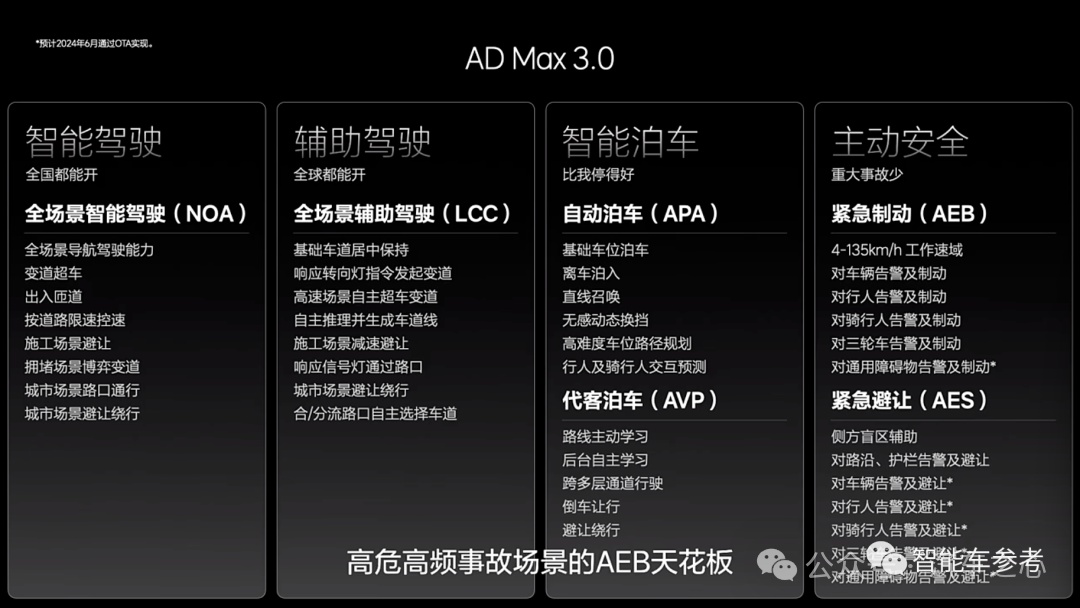
Huawei's ADS evolved from 1.0 to 3.0, reducing lidar from three to one and switching from RoboSense to in-house lidar.
- ADS 1.0: 3 lidars, 6 radars, 13 cameras.
- ADS 2.0: 1 lidar, 3 radars, 11 cameras.
- ADS 3.0: Features Huawei's 192-line lidar (details pending).
QCraft and Haomo offer tiered solutions. QCraft's Air (7V1R) handles highway NOA; Pro (11V5R) adds urban NOA; Max adds lidar for light-mapping. Haomo's HP170 (3,000 yuan), HP370 (5,000 yuan), and HP570 (8,000 yuan) scale features and sensors.
DeepRoute's DeepRoute IO, with 1 lidar and 11 cameras, is the most aggressive in end-to-end autonomy. CEO Zhou Guang explained the lidar is for redundancy.
DJI Automotive, once vision-only, now embraces both paths. Its 'Jimu' solution combines stereo cameras and a self-developed lidar for 2026 production.
Lidar + high-performance chips are now standard for advanced autonomy.
As TuSimple co-founder Hou Xiaodi said, 'If lidar is affordable, why not use it?' Chinese suppliers, facing complex roads, overwhelmingly choose lidar, with Huawei and DJI moving toward in-house production.
03. Software Value Awaits Discovery
China is the epicenter of autonomous driving—both for its challenging roads and cutthroat competition.
At the Aito M7 launch, Richard Yu declared, 'When Tesla FSD enters China, Huawei is confident it can outperform.' His confidence stems from Huawei's heavy R&D investment.
The market is brutal. Haomo's public pricing (3,000–8,000 yuan) and DJI's 3–5% rule reflect cost pressures. DJI's Shen Shaojie notes automakers spend 3–5% of vehicle price on autonomy, with 5% as the upper limit for sub-L3 tech.
Suppliers fall into two camps: those targeting 150,000–250,000 yuan vehicles (Haomo, DJI, QCraft) and those above 300,000 yuan (DeepRoute, Huawei). The latter avoid price wars but face profitability challenges.
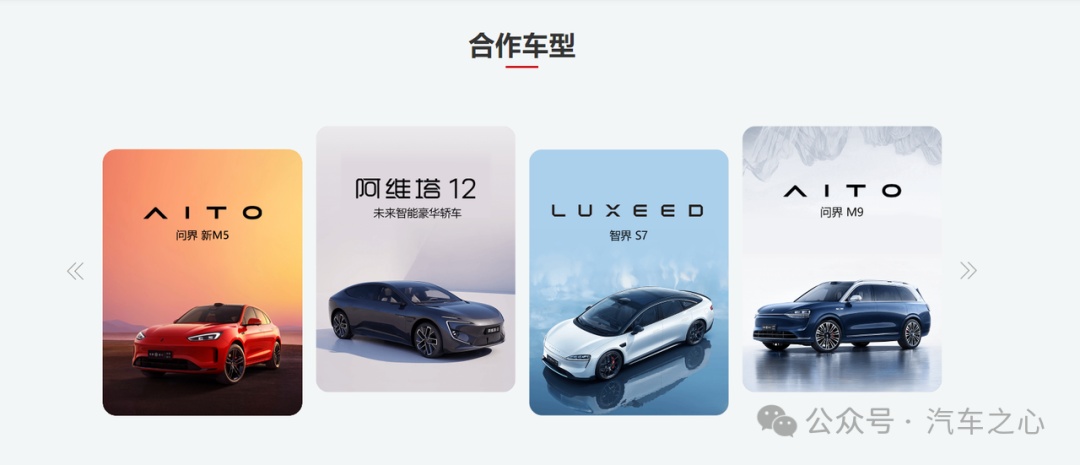
Huawei's systems are the priciest (reportedly ~15,000 yuan), limiting them to premium brands like Aito, Luxeed, and Stelato (priced up to 450,000 yuan). As one insider noted, 'Huawei's model is hard to replicate—it requires deep pockets and ecosystem support.'
DJI, known for affordability, powers models like Baojun Yunduo and VW Tiguan L Pro (~5,000–7,000 yuan). QCraft works with Li Auto and GAC, while Haomo, once reliant on Great Wall, seeks new partners. DeepRoute's end-to-end solution (reportedly ~10,000 yuan) will debut in Great Wall's Wey Lanshan.
Today, autonomy is no longer the cash magnet it was in 2020. Suppliers scrape by on development fees (~millions) and per-car royalties (1,000–2,000 yuan). Huawei uniquely earns from subscriptions and channels.
Two issues persist: automakers' price-war mentality and undervalued software. As Lei Jun once said of China's software industry, 'Growth will come.' Autonomy's software potential remains untapped—if suppliers can differentiate beyond price.
Like Microsoft's Wintel alliance, autonomy needs strong chip-supplier partnerships for industry dominance. Whether pursuing premium or volume, no one is backing down quietly—and that's a good thing.
$NVIDIA(NVDA.US) $Ambarella(AMBA.US) $Qualcomm(QCOM.US)
The copyright of this article belongs to the original author/organization.
The views expressed herein are solely those of the author and do not reflect the stance of the platform. The content is intended for investment reference purposes only and shall not be considered as investment advice. Please contact us if you have any questions or suggestions regarding the content services provided by the platform.
