



TSMC, the next trillion-dollar stock?

Chip giant $NVIDIA(NVDA.US)'s stock price soared after a "1-for-10" stock split.
Wall Street seems to view the stock split of AI-concept stocks as a major positive. With the boost from the AI wave, many AI semiconductor stocks have experienced significant gains. After the split, the price per trading unit becomes more affordable, allowing more retail investors to participate and further fueling the stock's upward momentum.
Following NVIDIA, semiconductor stock $Broadcom(AVGO.US) will also undergo a "1-for-10" split in mid-July.
Broadcom's Ethernet switches and AI accelerators for hyperscale customers are the main drivers of its AI revenue. The company expects this revenue to reach $11 billion in fiscal 2024. Its recently announced Q2 fiscal 2024 results (ending May 5, 2024) also exceeded expectations, with quarterly revenue hitting a record high of $12.49 billion. AI-related revenue reached $3.1 billion, accounting for 24.82% of total revenue—close to Broadcom's fiscal 2024 target of 25%. In fiscal 2023, generative AI accounted for only 15% of Broadcom's semiconductor revenue.
Driven by this, Broadcom's stock price has surged recently, with a year-to-date increase of 62.17%. Since announcing quarterly results on June 12, the stock has risen 20.53% in less than five trading days.
The "stock split" myth is coming true.
However, compared to Broadcom using the split to reach more investors, wafer manufacturer $Taiwan Semiconductor(TSM.US) , priced at $179.69 per share, is quietly surging. Year-to-date, TSMC has risen 74.03%, with its market cap reaching $931.9 billion—nearing the trillion-dollar mark! This is nearly $100 billion higher than Broadcom's $839.1 billion market cap and has surpassed the world's most valuable pharmaceutical company, Eli Lilly (LLY.US), which has gained 53.46% this year due to its weight-loss drug concept, with a market cap of $847.2 billion.
What is TSMC's advantage?
If NVIDIA's advantage lies in capturing the generative AI investment opportunity and becoming the foundation for tech giants and startups to build their AI strategies, TSMC's advantage is even stronger. It is not only the foundry for NVIDIA's most advanced AI chips but also the main supplier for NVIDIA's competitors $AMD(AMD.US) and $Intel(INTC.US).
When customers place orders with the three major chip companies, these orders typically land with TSMC because it has the most advanced mass-production capabilities. Even though Intel is ambitiously developing its foundry business, its capacity still lags behind TSMC.
The H100 relies on TSMC's 5nm capacity, while NVIDIA's upgraded AI chips, the H200/B100, use TSMC's 4nm and 3nm processes, causing TSMC's capacity to fill up rapidly. As shown below, TSMC's revenue has surged significantly over the past two years.
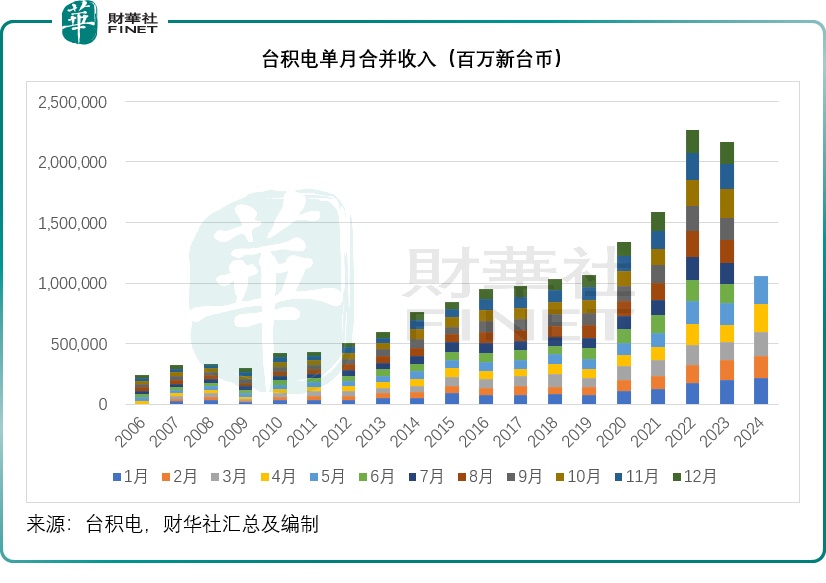
Although Intel's returning CEO, Pat Gelsinger, ambitiously aims to catch up with TSMC by advancing five nodes in four years, TSMC still holds an overwhelming advantage in terms of current technology and capacity. Intel's AI chip Gaudi 3, designed to challenge NVIDIA, uses 5nm technology and still requires TSMC's foundry services. Additionally, TSMC has reportedly secured orders for Intel's upcoming 3nm laptop processor series, continuing to dominate the three major chip companies.
TSMC's Chairman and CEO, C.C. Wei, mentioned during the Q1 2024 earnings call that as a key enabler of AI applications, TSMC stands to benefit from strong AI demand. He noted that nearly all AI innovators are collaborating with TSMC and expects AI accelerator revenue to more than double this year, accounting for about 10% of total annual revenue. Over the next five years, he projects this revenue to grow at a 50% CAGR, reaching over 20% of total revenue by 2028.
Thus, TSMC will be the biggest beneficiary of the AI wave, regardless of NVIDIA's success. The more intense the competition between AMD, Intel, and NVIDIA, the more TSMC's position is reinforced, as its technological advantage becomes more pronounced with the need for advanced production techniques.
In this light, TSMC breaking the trillion-dollar market cap is just a matter of time. Moving further up the supply chain, another supplier poised to benefit from AI chip development is lithography machine supplier $ASML(ASML.US).
Will ASML be the next company to split its stock?
Semiconductor production cannot proceed without lithography machines. ASML is like the TSMC of the lithography machine industry, with the most advanced technology and the broadest customer base.
Year-to-date, ASML's stock price has risen 40.72%, breaking the $1,000 mark. At its current price of $1,061.38, its market cap stands at $418.8 billion, surpassing LVMH (current market cap: €356.6 billion, or ~$382.2 billion) to become Europe's second-most valuable listed company. It trails only Novo Nordisk (NVO.US), Europe's most valuable company, by $200 billion. Novo Nordisk, the "king of weight-loss drugs," has gained 37.09% this year, with a current market cap of $627.1 billion.
Summary
In 2024, following 2023, AI and weight loss remain the two hottest investment themes in the capital markets. As mentioned earlier, the two major weight-loss drug suppliers, Eli Lilly and Novo Nordisk, have seen year-to-date gains of over 30%. Meanwhile, upstream leaders in the AI supply chain have performed even better: ASML is up 40.72%, and TSMC is up 74.03%, though they still lag behind NVIDIA's 173.81% gain. Whether they will catch up remains to be seen.
Author: Mao Ting
The copyright of this article belongs to the original author/organization.
The views expressed herein are solely those of the author and do not reflect the stance of the platform. The content is intended for investment reference purposes only and shall not be considered as investment advice. Please contact us if you have any questions or suggestions regarding the content services provided by the platform.
