



AI remains the darling of venture capital. What implications does this have for US stocks?


According to the latest data from Dealroom.co, a global startup and tech company data provider, venture capital investment in Q2 2024 amounted to $70.5 billion, down 14.86% quarter-on-quarter and 6.13% year-on-year. However, large-scale investment deals exceeding $250 million surged by 89.34% year-on-year, offsetting most of the negative impact from the quarterly decline in funding from seed to Series C rounds. See the chart below.
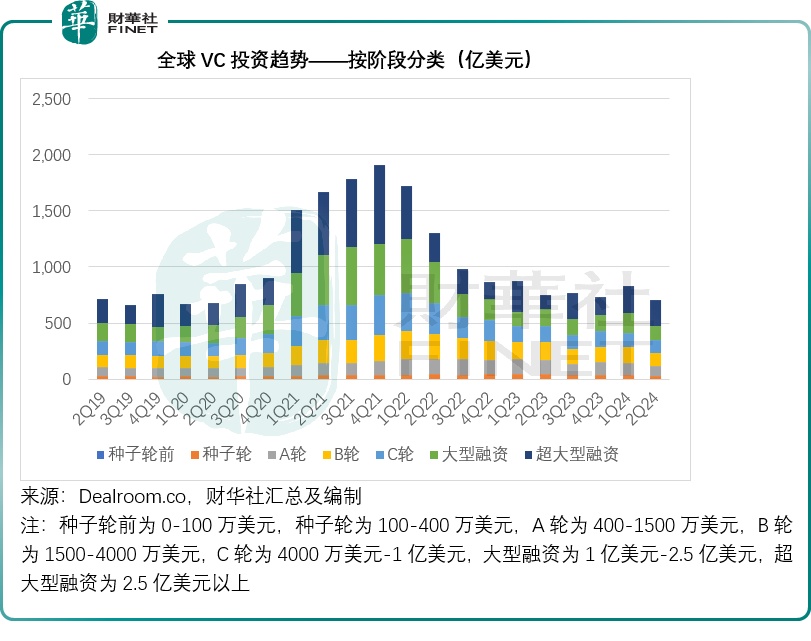
Combining Dealroom.co's data, Caihua News found that global VC investment in the first half of 2024 may reach $1.533 trillion, down 5.78% year-on-year. However, from a stage perspective, both large and mega financing rounds bucked the trend, increasing by 9.49% and 18.25% year-on-year to $30 billion and $47.3 billion, respectively, accounting for 50.4% of global VC investment.
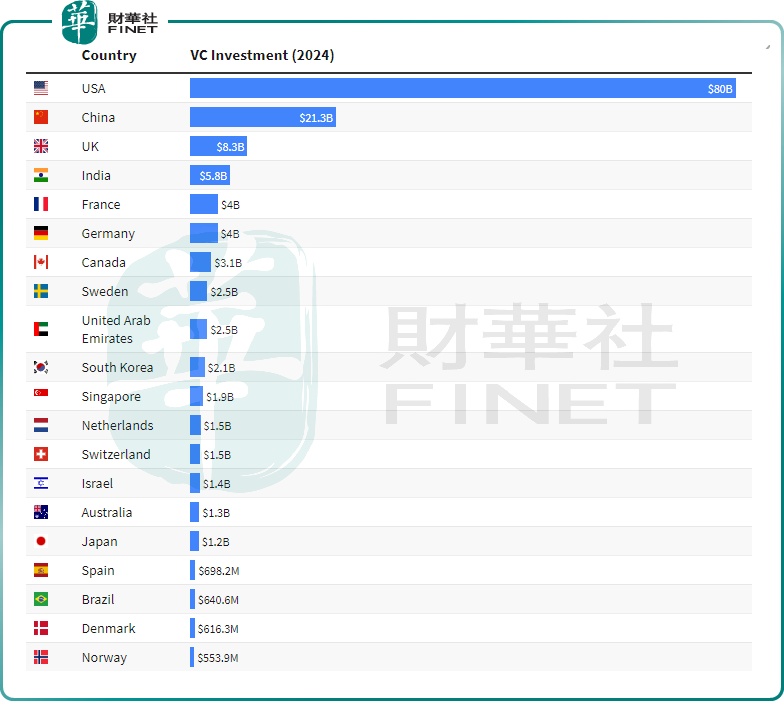
Regionally, the U.S. remains the largest VC market, with investment reaching $80 billion in the first half of 2024. China followed closely with $21.3 billion, while the UK and India ranked third and fourth with $8.3 billion and $5.8 billion, respectively. See the chart below.
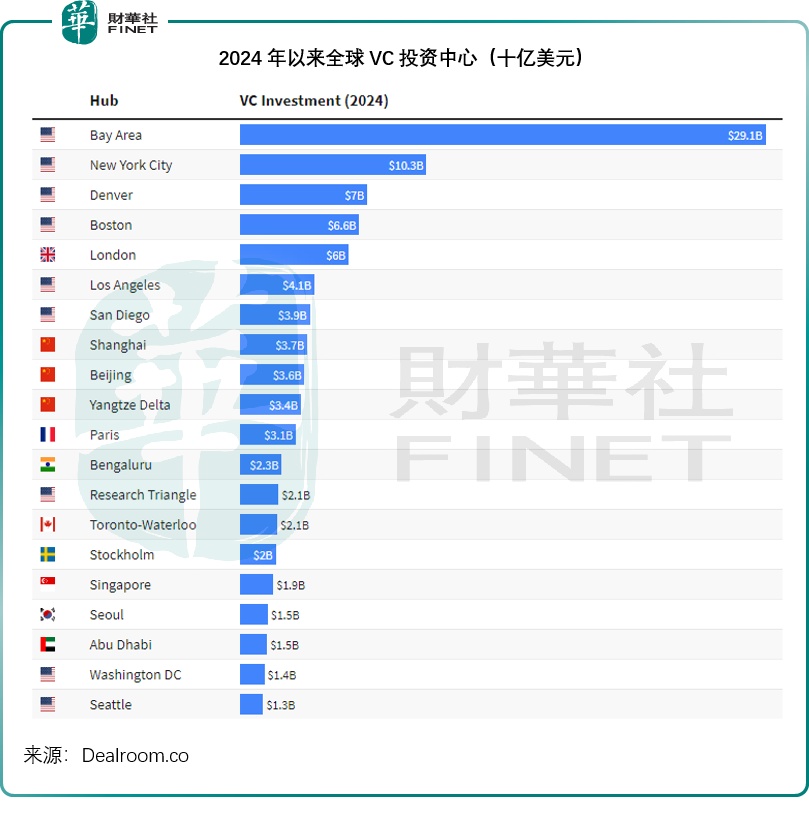
From a regional perspective, the Bay Area in the U.S. remains the most active VC investment hub, with investment potentially reaching $29.1 billion so far in 2024. In China, VC investment is mainly concentrated in Shanghai, the Yangtze River Delta, and Beijing. See the chart below.
AIGC Remains VC's Favorite
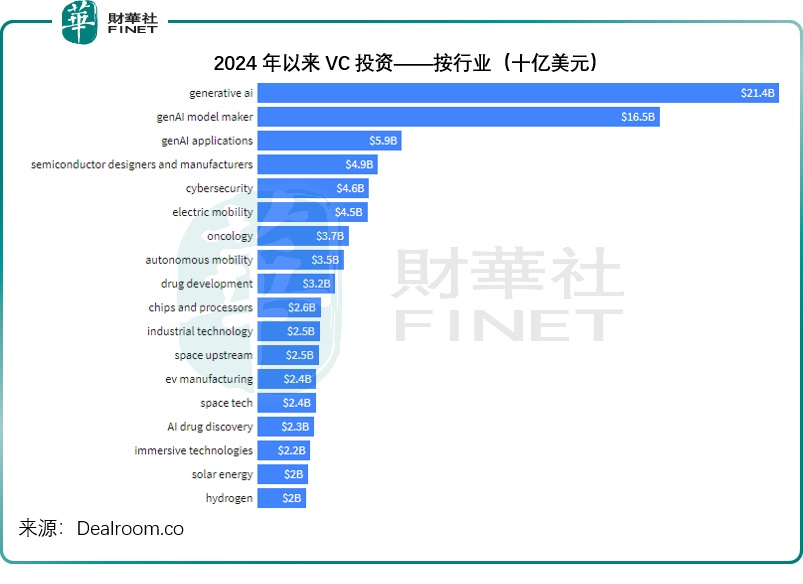
From an industry perspective, generative AI remains VC's top choice. In 2023, AIGC, the EV supply chain, and EV batteries were the most funded themes. In the first half of 2024, AIGC continued to lead as the most invested industry globally, with VC funding reaching $21.4 billion. The second and third places were taken by generative AI model manufacturers and generative AI applications, showing the dominance of generative AI concepts in the top three.
Driven by the continuous rise in market value of $NVIDIA(NVDA.US) , semiconductor chip designers and manufacturers have gained significant capital attention this year, following closely behind AIGC concepts.
Alongside the rapid development of AI, cybersecurity has become an increasingly important theme for internet companies, businesses, and individual users. VC investment in cybersecurity has also picked up, reaching $4.6 billion in the first half of 2024.
New energy vehicles (NEVs) have been a focal point in global capital markets in recent years. However, as NEV production capacity expands faster than demand growth, the popularity of the EV supply chain concept seems to be waning. VC investment in this sector was $4.5 billion in the first half of 2024, only 27% of last year's global VC investment, less than half.
xAI Secures Largest Funding
As the most active investment market globally, the U.S. sets the benchmark for VC activity, making its large-scale financing deals highly watched.
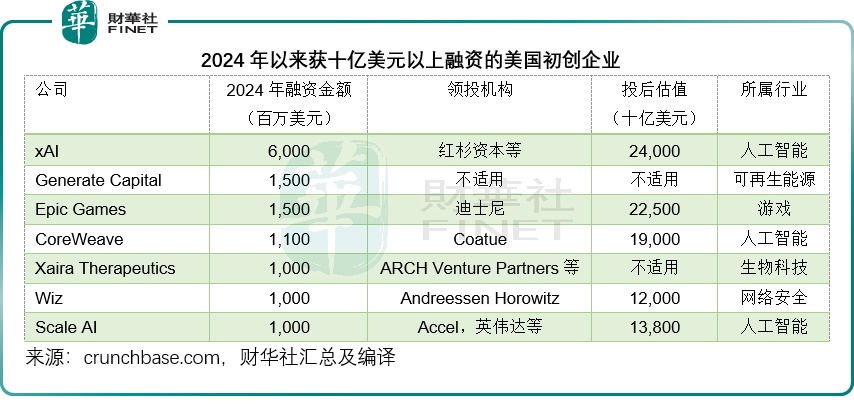
Elon Musk's AI startup xAI secured the largest funding in Q2 2024 and the first half of 2024, raising $6 billion on May 27, 2024, with participation from Sequoia Capital and others, potentially valuing the company at $24 billion post-investment.
Despite this substantial funding, it still falls short of OpenAI's $10 billion raise in 2023. $Amazon(AMZN.US) and $Alphabet - C(GOOG.US)-backed AI company Anthropic also raised $6 billion in 2023.
Generate Capital, a new energy investment and operations platform, raised $1.5 billion in the first half of 2024, far less than xAI but still ranking second in funding size.
Epic Games, the studio behind "Fortnite," also secured $1.5 billion in funding led by Disney (DIS.US), potentially valuing the company at $22.5 billion post-investment.
NVIDIA-backed cloud service company CoreWeave raised $1.1 billion led by Coatue, with NVIDIA participating, potentially valuing the company at $19 billion post-investment.
AI is everywhere, including pharmaceuticals. Xaira Therapeutics, an AI drug company led by a former Stanford University president, raised $1 billion led by top VC ARCH Venture Partners and biotech VC Foresite Capital.
As mentioned earlier, cybersecurity startups are gaining capital attention. Cloud security company Wiz raised $1 billion led by Andreessen Horowitz, potentially valuing the company at $12 billion post-investment.
Scale AI, founded by prodigy Alexandr Wang and dubbed NVIDIA's "shovel seller," is a data annotation platform for AI model training. The startup raised $1 billion on May 21, 2024, potentially valuing it at $13.8 billion post-investment, led by Accel with NVIDIA's participation.
Tech innovation "trendsetter" Cathie Wood isn't limited to secondary market tech stocks; she's also scouting future $Tesla(TSLA.US) among startups. She launched ARK Venture Fund (ARKVX) in 2022, with a net asset value of only $63.9 million as of June 30, 2024, but her picks are highly representative.
As of June 2024, ARKVX's largest holding is Elon Musk's SpaceX, with a 12.76% weighting. Next is Epic Games at 6.97%. Healthcare tech also features, with cancer detection company Freenome and AI pharma firm Relation Therapeutics (also backed by NVIDIA) at 5.56% and 5.24%, respectively.
Of course, Wood's VC portfolio includes AI darlings like OpenAI (4.00%), Anthropic (4.66%), and Figure AI (4.36%).
Conclusion
VC activity slowed in Q2 2024. Notably, funding from pre-seed to Series C rounds contracted significantly, while mega deals surged.
Caihua News observed that many large deals involve already high-valued companies like Epic Games, founded in 1991. Over three decades, Epic has weathered ups and downs, with $TENCENT(00700.HK) as a major shareholder alongside Disney, Sony, and Kirkbi (owner of LEGO).
As incumbents, these early shareholders need higher valuations to cover costs before accepting new investors. Rising valuations demand ever-larger funding rounds.
Why do VCs still invest in such high-valued projects?
With high dollar interest rates, capital costs are elevated, requiring VCs to target even higher returns to justify risk premiums. This scrutiny makes investors more cautious.
VC cycles typically don't exceed ten years, so funds can't afford to wait idly—they must deliver returns to their backers.
In today's high-rate, high-risk environment, mature private companies with proven products, customers, and markets offer safer bets—hence the VC logic.
Caihua News also notes VCs' preference for hot sectors like AIGC.
AI valuations, fueled by OpenAI and NVIDIA, have skyrocketed, as seen in xAI's funding and valuation. Why do VCs still flock to these stars?
Hot sectors attract investor capital more easily, and while the hype lasts, upside potential remains. Even if the bubble bursts, VCs can exit by finding "bag holders" in the frenzy.
VC exit routes include selling to other investors (management, PE, institutions), IPOs, or liquidation.
Larger early funding rounds mean higher exit hurdles—requiring even loftier valuations. The recent surge in mega deals may foreshadow a wave of AI IPOs (amid record-high U.S. tech stocks), which could spell trouble for their publicly traded peers. Wall Street's AI darlings might face headwinds ahead.
Author: Mao Ting
The copyright of this article belongs to the original author/organization.
The views expressed herein are solely those of the author and do not reflect the stance of the platform. The content is intended for investment reference purposes only and shall not be considered as investment advice. Please contact us if you have any questions or suggestions regarding the content services provided by the platform.
