


 Posts
PostsHelloDex: A decentralized exchange that distributes 80% of profits to everyone.

Web3, widely regarded as the third generation of the internet, is a new era of the internet that helps users achieve goals such as data ownership and self-governance.
Initially, all entrepreneurs participating in Web3 held the ideal of building a more fair, transparent, and trustworthy digital ecosystem. In this vision, every Web3 user is part of the network, owning control over their data and being able to exchange value in a trustless, borderless environment.
However, over time, some platforms leveraged their first-mover advantage to gain market dominance and influence, causing Web3's original ideals to fade in reality. They prioritize short-term profits over the interests of their users.
Faced with the reality that "the dragon-slayer eventually becomes the dragon," users have chosen to stop supporting such platforms. The crypto market, where no one is willing to hold the bag, reflects retail investors voting with their capital—they'd rather participate in Meme coins than support projects that betray their original mission and exploit naive investors.
Now, perhaps a new dragon-slayer is needed to change the status quo.
HelloDex is a decentralized exchange that has announced it will distribute 80% of its profits to all users. In its whitepaper, it quotes Che Guevara to describe itself: "One day, they will give money back to users, not because they realize they took it from them, but because we have arrived."
Users vs. Platforms, Naive Investors vs. Scythes
Binance, the world's largest exchange, has long claimed that its success lies in being "user-centric." In reality, this principle was shaped by external market challenges.
Currently, Binance holds the most resources, industry influence, and strategic positioning in the crypto space, yet its primary revenue still comes from user trading fees. Even in its early days as one of the largest exchanges, Binance's users earned far less than they do now. The main reason is that Binance understands users are the driving force behind its platform economy.
Previously, FCoin introduced a "transaction mining" model, refunding trading fees to users in the form of platform tokens. For every trade, users received 100% of their fees back as tokens. This model quickly attracted massive user adoption and trading volume, briefly making FCoin surpass Binance as the world's largest exchange by volume. In response, Binance even announced a digital asset exchange alliance program, offering 1,000 slots to support exchanges with transaction mining and token dividend models.
Later, FCoin exited the market due to mismanagement and financial issues, but its impact lingers. Binance introduced more reward mechanisms, lowered fees, and launched initiatives like Launchpad and Launchpool to give back to users.
A similar dynamic exists in the DEX space. Ave, one of the largest on-chain aggregators, reportedly earns at least $14.8 million annually, yet its users see none of these profits.
Ave's revenue comes from four main sources: token listing and logo fees, trending token ranking fees, pop-up and banner ad fees, and others.
Listing a token and its logo costs around 350-650 USDT, with an average of five listings per day, generating at least $638,000 annually.
Trending token ranking fees range from 3,988-6,888 USDT. Assuming the top eight slots are filled daily, this brings in at least $11.64 million per year.
Pop-up and banner ads are the highest-priced service at 6,888 USDT, contributing $2.51 million annually.
According to SimilarWeb, Ave averages 19,400 daily visits, meaning each active user contributes $763 daily or $278,000 annually.
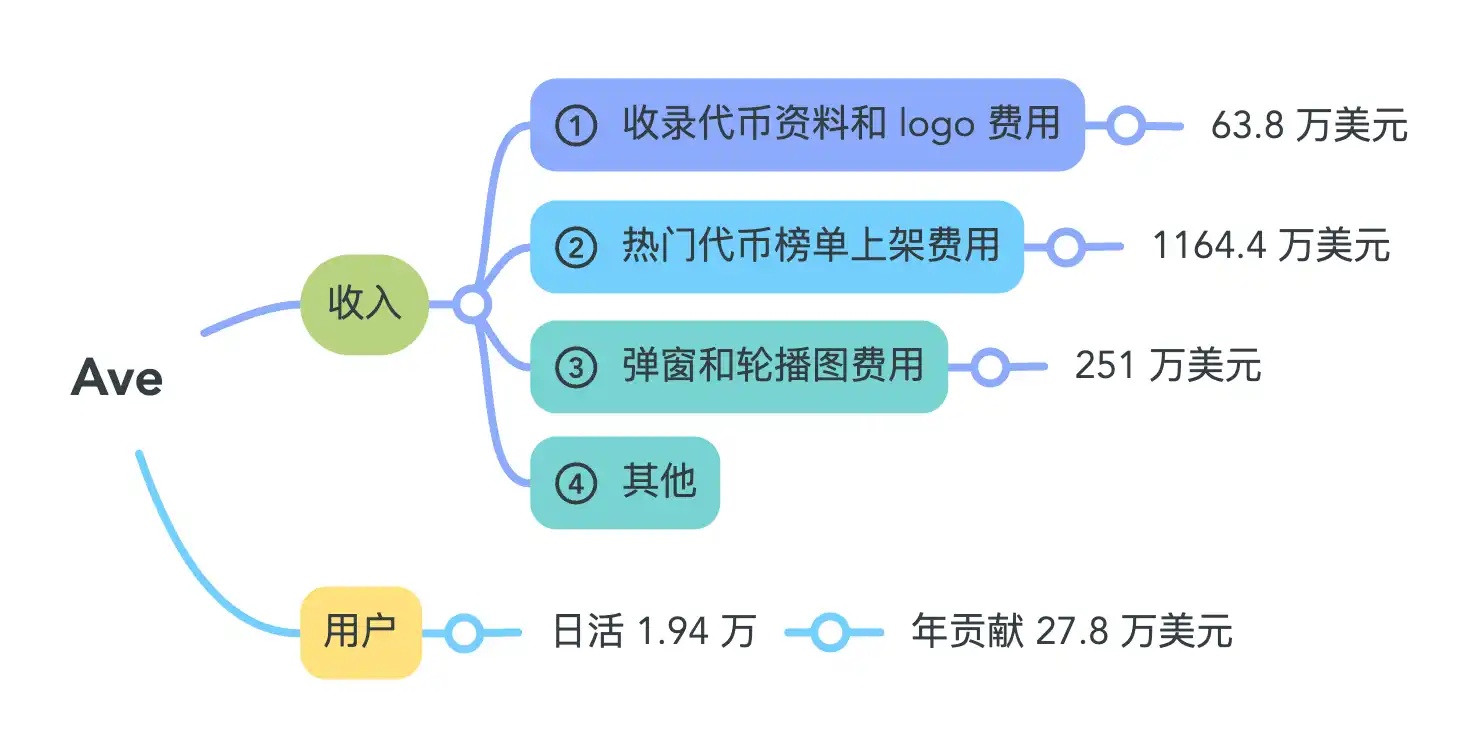
Ave's massive profits rely entirely on user activity, yet none of these gains are shared with users. Instead, users become mere numbers behind Ave's profit machine.
HelloDex Pioneers a Profit-Sharing Revolution
Traditional exchanges and projects often profit from user traffic and engagement while sidelining the very users who sustain them—sometimes even exploiting them. Users have long been conditioned to believe that platform profits are none of their concern, leading to widespread abuse of power.
In reality, users are the backbone of any platform or project. Without their participation and support, no platform or project can survive or grow.
HelloDex, a new decentralized exchange, is changing this by redefining the relationship between platforms, projects, and users through an innovative profit-sharing model.
HelloDex allocates 80% of its profits to users, making them the primary beneficiaries and key stakeholders in the platform's growth. Its innovation lies not just in functionality and efficiency but in a fundamental shift in philosophy—the platform is no longer just a profit tool but a collective for user benefit.
HelloDex empowers users to resist exploitation. When using HelloDex, users enjoy seamless trading while also earning real returns from platform profits. It’s more than an exchange—it’s a movement that unites and empowers users.
This embodies the true spirit of Web3, where every ordinary user reclaims their rightful share.
A Truly Decentralized Platform
HelloDex is an innovative decentralized exchange designed to transform the crypto trading ecosystem by returning profits to users. Its development unfolds in three phases, each with clear goals.
Phase 1 focuses on core features, matching Ave's functionality while establishing a revenue model via trading fees and ads.
Users can track real-time inscriptions across blockchains, customize network IDs and RPCs, and batch-mint inscriptions with multi-wallet support. Speed and simplicity are HelloDex's strengths, alongside MEV bot protection to minimize losses.
HelloDex also parses on-chain data from ETH, Solana, BNB, Base, ARB, and OP, providing full transaction records, liquidity pool analytics, token holder rankings, whale tracking, and profit/loss leaderboards. iOS and Android apps streamline transactions to 1-2 seconds.
Phase 2 integrates messaging (debox, btok, Telegram), enabling group chats, voice calls, and meetings.
Leveraging its data analytics and DeFi protocol insights, HelloDex will launch asset management tools akin to DeBank and Dune. It will also offer public RPC nodes, breaking monopolies while still sharing 80% of revenue.
HelloDexSwap will debut, allowing Meme tokens and HelloDex governance tokens to form liquidity pools, expanding utility and building an early ecosystem.
Phase 3 introduces HelloDex's own blockchain, completing its decentralized ecosystem. Governance tokens will upgrade to mainnet coins, integrating native DeFi products like decentralized derivatives (similar to dYdX) and lending—all transparently on-chain, unlike opaque centralized exchanges.
HelloDex Chain will also distribute 80% of profits to users, realizing true shared ownership.
The Dragon-Slayer: Users Get 80% of Profits
HelloDex's profit-sharing ensures maximum user benefit. Revenue comes from token listings, trending rankings, ads, and other services, preferably paid in governance tokens.
Initially, HelloDex will waive fees to build traction. Once profitable, revenue splits as follows:
50%: Governance token holders vote to burn tokens or distribute rewards based on stake size/duration.
20%: Team.
10%: Security audits, operations, development, and servers.
10%: All users, even non-token holders.
10%: Community, influencers, and referrals based on trading volume (rules pre-token launch).
HelloDex's governance token has a 100M supply, cross-chain between ETH and SOL. Allocation:
30%: Treasury (locked).
10%: IDO presale.
10%: Referral/trading rewards (conversion rate at TGE).
10%: Airdrops/marketing.
10%: Team (locked until FDV hits $100M).
10%: Exchange listings (locked; surplus goes to treasury/burns).
10%: User security fund (hack reimbursements).
10%: Treasury/HelloDex Chain development (locked until FDV hits $300M).
At launch, circulating supply is ~30% (10% IDO, 10% referrals/trading, 10% airdrops). The IDO has two rounds: 3M tokens at $0.18 and 7M at $0.19, raising $1.87M. At peak pricing, HelloDex's initial market cap is ~$5.7M.
Latest data shows only $390K left in Round 1.
Notably, HelloDex's circulating supply ties to FDV, likely staying near 30% until the token hits $1. If HelloDex matches Ave's revenue, each token holder earns at least $0.247 yearly—far above IDO prices. Non-holders collectively get $1.48M annually, as do community/influencers.
Beyond Ave, HelloDex's upcoming products (like "sniper bots") will further boost earnings and user payouts.
This is Web3's true revolution—returning power to users, not platforms. As the whitepaper states: "Money generated by user activity should mostly go back to governance token holders and every user." Join HelloDex's ongoing Twitter Spaces for details.
The copyright of this article belongs to the original author/organization.
The views expressed herein are solely those of the author and do not reflect the stance of the platform. The content is intended for investment reference purposes only and shall not be considered as investment advice. Please contact us if you have any questions or suggestions regarding the content services provided by the platform.
