



Better-than-expected earnings growth failed to 'boil' the stock price. Is Google's AI battle heating up?

Recently, Alphabet, the parent company of Google, announced its second-quarter earnings after the U.S. market closed. Total revenue reached $84.7 billion, up 14% year-over-year, surpassing analysts' consensus estimate of $84.2 billion. Net profit was $23.6 billion, with earnings per share (EPS) at $1.89, higher than the expected $1.84.
Overall, the performance showed a positive trend. However, after the earnings release, the stock price fluctuated, initially rising about 2% in after-hours trading before dropping 2.18%. As of the close on July 25, the company's stock price fell 2.99% to $169.16 per share.
Behind the volatility lies a clash of two different market expectations. Investors are pleased with the robust growth of Google's cloud and search advertising businesses but are concerned about when Alphabet's massive investments in AI will yield returns.
Google, betting big on AI, faces a divergence between operational performance and technological prospects. Where does it go from here?
As large models reshape the application ecosystem, how effective is Google's focus on "AI+"?
From the silence after ChatGPT's launch to catching up and surpassing with new models, Google has reclaimed its position as a market leader. Currently, AI technology has positively impacted Google's advertising and cloud businesses.
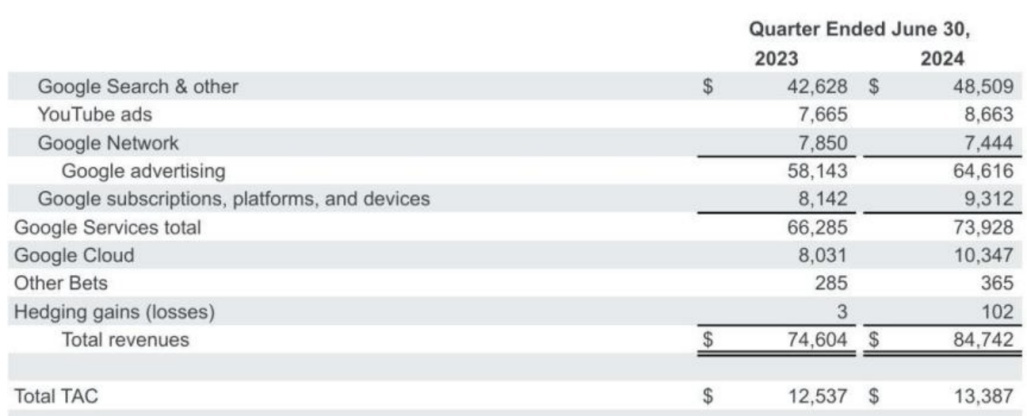
The earnings report shows that in Q2 2024, Google's advertising revenue totaled $64.616 billion, up 11% year-over-year. Google Search and other advertising revenue was $48.509 billion, up 14%, while YouTube ad revenue reached $8.663 billion, up 13%. Cloud revenue exceeded $10 billion for the first time, hitting $10.347 billion, a 29% increase.
Specifically, in its core advertising business, Google has integrated AI into every aspect of operations, significantly improving the overlap of its two-sided market.
An Amazon study found that among advertisers who failed to run successful ad campaigns, nearly 75% cited creating and selecting creative formats as their biggest challenge. Generative AI enables advertisers to produce brand-themed images at scale and with high efficiency, enhancing creativity and streamlining workflows. It has become a daily creative tool for advertisers. A Gartner survey shows that 63% of marketing leaders plan to invest in generative AI solutions within the next two years.
To help advertisers leverage generative AI, Google has improved the usability of products like Performance Max by integrating new large models to achieve better ad performance.
The earnings report reveals that in Q2 2024, Google announced over 30 new AI-powered products. Vidhya Srinivasan, VP and GM of Google Ads, stated that with generative AI applied to Performance Max, advertisers saw an average 6% increase in ad effectiveness. Thus, AI is accelerating the overlap between advertisers and brands in the two-sided market.

As for the new growth curve—cloud services—current demand for cloud computing is strong. Canalys reports that global cloud infrastructure spending reached $290.4 billion in 2023, up 18% year-over-year, and is expected to grow 20% in 2024.
Enterprises "move to the cloud" to deploy foundational systems, management, and operations online, connecting more collaborators to form a mutually beneficial ecosystem. The resulting data interactions and accumulation support management and decision-making.
Thus, key concerns for enterprises purchasing cloud services include: What are the costs of "moving to the cloud"? How well can cloud platforms connect social resources? Can they meet personalized needs, run multiple devices, and enable unified resource management?
To address these questions, Google Cloud is building a full-stack AI platform. Google has integrated various AI development tools and machine learning tools into its Vertex AI platform, facilitating model training, inference, and AI application development for enterprises.
Google's cloud business has been profitable for several consecutive quarters, showing strong momentum. Google CEO Sundar Pichai noted that AI solutions have become the absolute pillar of Google Cloud, with over 70% of generative AI unicorns using Google Cloud.
In summary, the stable growth of Google's advertising and cloud businesses is now inseparable from AI. As AI drives massive innovation, Google has positioned itself as one of the biggest opportunists.
But the market is equally concerned about whether Google's AI investments will yield multiplied returns. Sequoia Capital partner Cahn once said, "Speculative frenzy is part of technological progress, so it's not scary. But we mustn't delude ourselves into thinking AI can make people rich quickly." The market's expectations and concerns about Google coexist.
As the AI war escalates, Google faces growing pains.
On July 25, the Nasdaq fell 3.64%, its biggest single-day drop in over two years, with major components like Google, Microsoft, and Meta down 5.03%, 3.59%, and 5.61%, respectively. Investors are cautious about AI-related stocks.
Goldman Sachs stated that large enterprises will eventually be required to prove their investments generate revenue and profits. Failing to meet this expectation could lead to significant valuation and stock price declines.
The market's skepticism is not unfounded. Even though Google has maintained quarterly growth with AI, long-term development pressures remain heavy.
From an internal development perspective, the growing costs of AI—such as computing power and capital expenditures—are increasingly impacting overall profit margins.
A Sequoia Capital report emphasized that AI companies must earn about $600 billion annually to cover infrastructure costs like data centers.
As tech companies ramp up AI investments, capital expenditures are rising. Meta raised its 2024 capex forecast to $35-40 billion (from $30-37 billion). Morgan Stanley expects Microsoft's total capex to rise from $32 billion in FY2023 to $63 billion in FY2025.
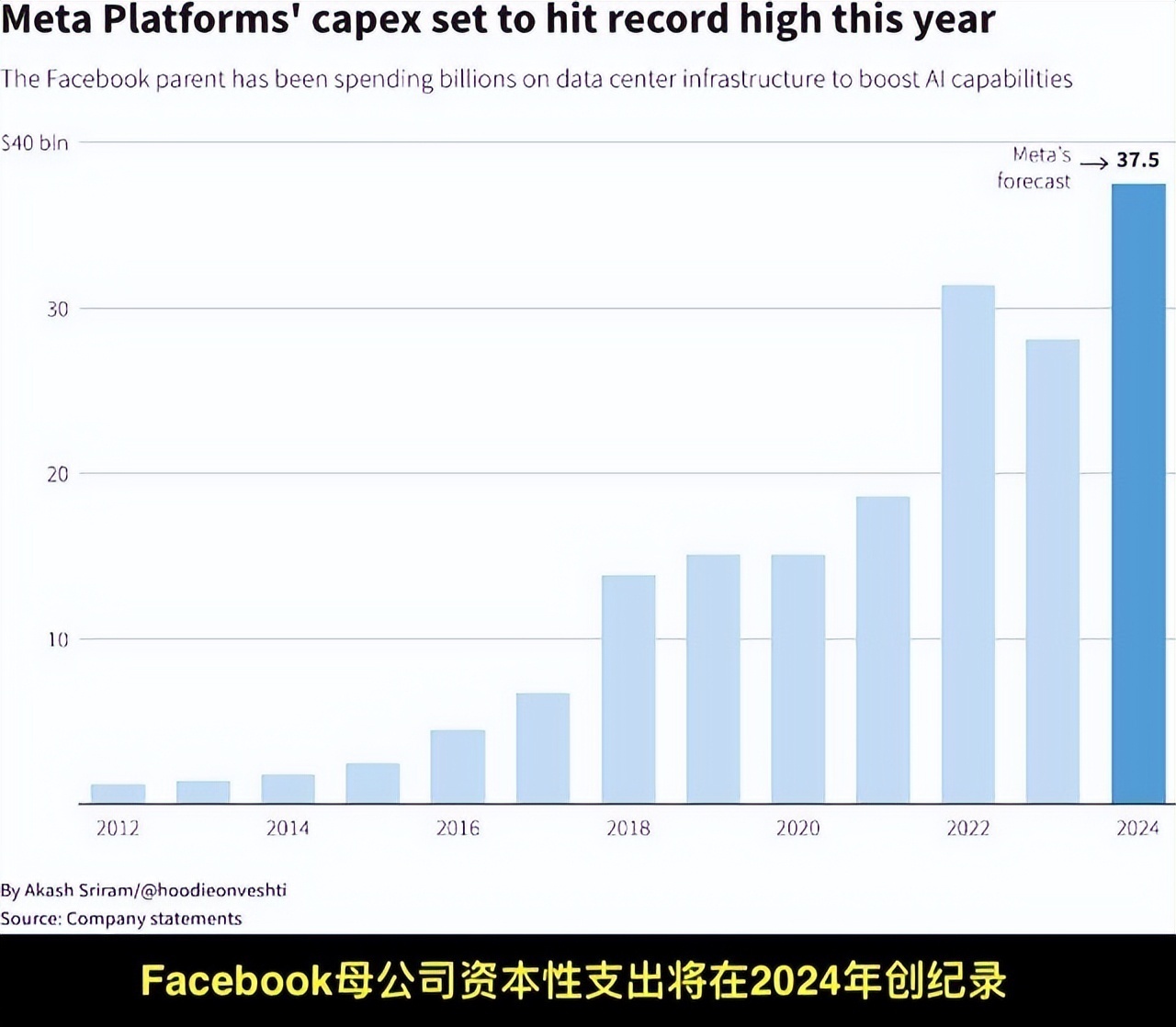
Google is no exception. In Q2 2024, Alphabet's capex surged to $13.2 billion, exceeding market expectations of $12.2 billion and nearly double the $6.9 billion from the same period last year. Q1 capex also rose 91% year-over-year, alarming investors with its sustained high levels.
Sundar Pichai explained, "We are in the early stages of a transformative field. In tech, when you undergo such a shift... the risk of underinvesting far outweighs overinvesting."
These capital expenditures have deferred returns, as the assets they create take time to recoup costs and generate profits. But the spending race among companies will undoubtedly prolong this cycle.
Meanwhile, competition in AI products is intensifying. In May, OpenAI launched GPT-4o, twice as fast as GPT-4 Turbo at half the cost. In July, Meta released its latest open-source model, Llama 3.1. Microsoft launched SenseAvatar, a digital human platform combining advanced large language models and video generation algorithms.
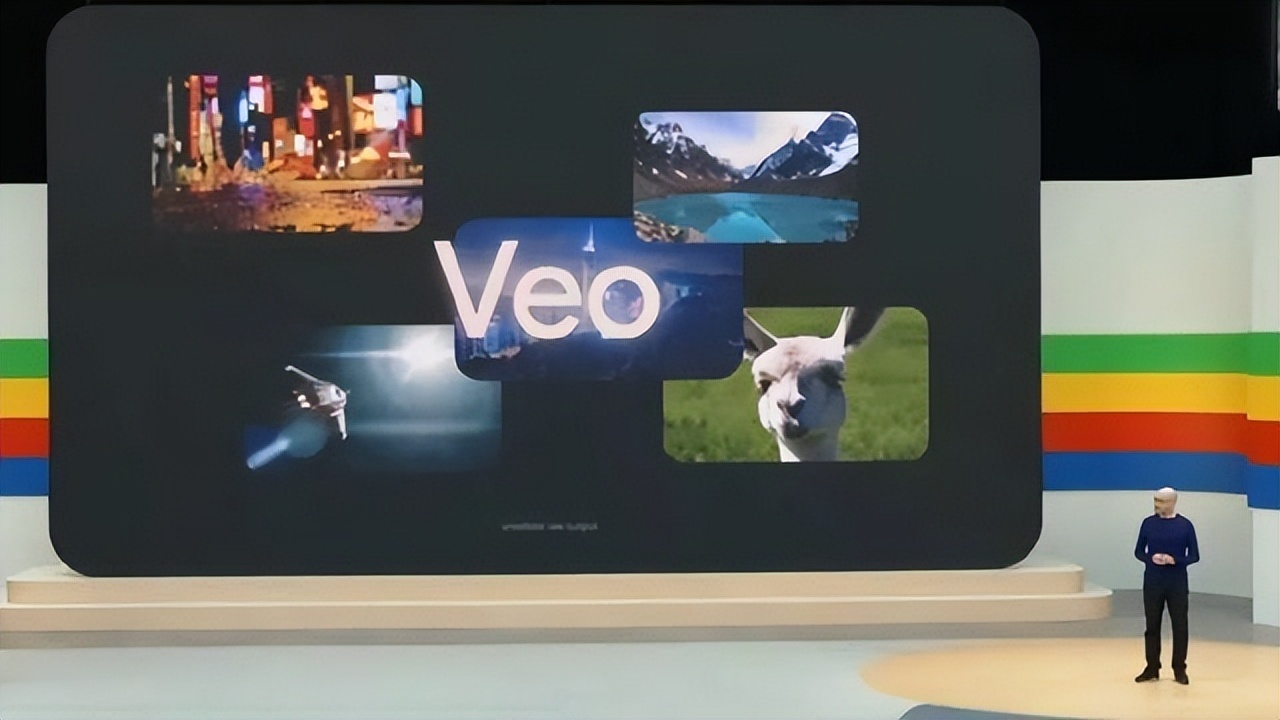
At its I/O developer conference, Google unveiled its "AI 全家桶" (AI 全家桶)—Project Astra (an AI assistant), Veo (a text-to-video model rivaling Sora), and the sixth-generation Trillium TPU chip.
However, integrating these diverse AI products into existing businesses will take time. Past missteps with Bard and AI Overview show Google still has room for improvement in deploying AI in real-world scenarios.
In summary, the battle among AI large models is far from decided, but the strategies of leading players are diverging. OpenAI's GPT-4o is deeply aligned with Apple, optimizing for Siri integration to improve speed and reduce errors.
Google, however, is pursuing multiple breakthroughs, such as AI Teammate for office suites, Notebook LM for education, the general AI agent Astra for daily life, and AI updates in Android 15—all reflecting its ambition to lead the global AI race.
For everyone passionate about AI, a new era of 百花齐放 (a hundred flowers blooming) has arrived, driven by transformative forces.
Author: 好蓝不灵
Source: 美股研究社
The copyright of this article belongs to the original author/organization.
The views expressed herein are solely those of the author and do not reflect the stance of the platform. The content is intended for investment reference purposes only and shall not be considered as investment advice. Please contact us if you have any questions or suggestions regarding the content services provided by the platform.
