


Meta's future path: an in-depth analysis of user growth, advertising innovation and the Metaverse dream

On Wednesday, July 31, after the U.S. stock market closed, Meta, the "metaverse platform" and a social media and digital advertising giant heavily betting on AI, released its second-quarter earnings report for fiscal year 2024.
Although Meta's total revenue growth in Q2 was weaker than the 27% year-over-year increase in Q1, the total amount increased by 7% quarter-over-quarter, and EPS was significantly higher than Q1's $4.71, both indicating some performance returns from AI investments. The company reported Q2 revenue of $32 billion, up 22% year-over-year, marking the fourth consecutive quarter of growth exceeding 20%. Net profit surged 73% from $7.79 billion in the same period last year to $13.47 billion, or $2.98 per share.
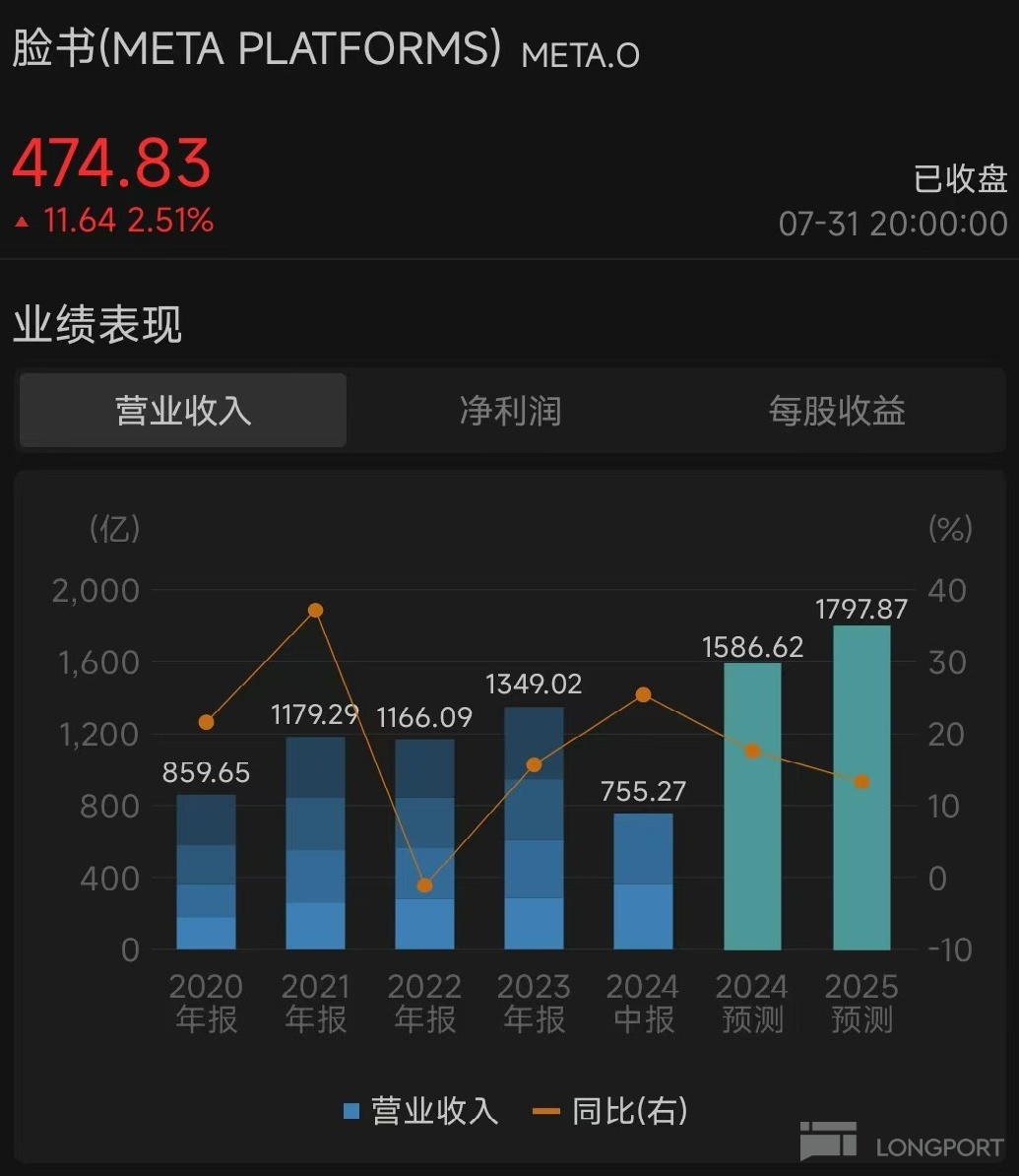
Other highlights of Meta's earnings report include: As of the end of June, ad impressions and the average price per ad for its Family of Apps (including Facebook, Instagram, WhatsApp, and Messenger) both grew by 10% year-over-year in Q2. $Meta Platforms(META.US) provided Q3 revenue guidance of $38.5 billion to $41 billion, with a midpoint of $39.75 billion, compared to analysts' expectations of $39.1 billion.
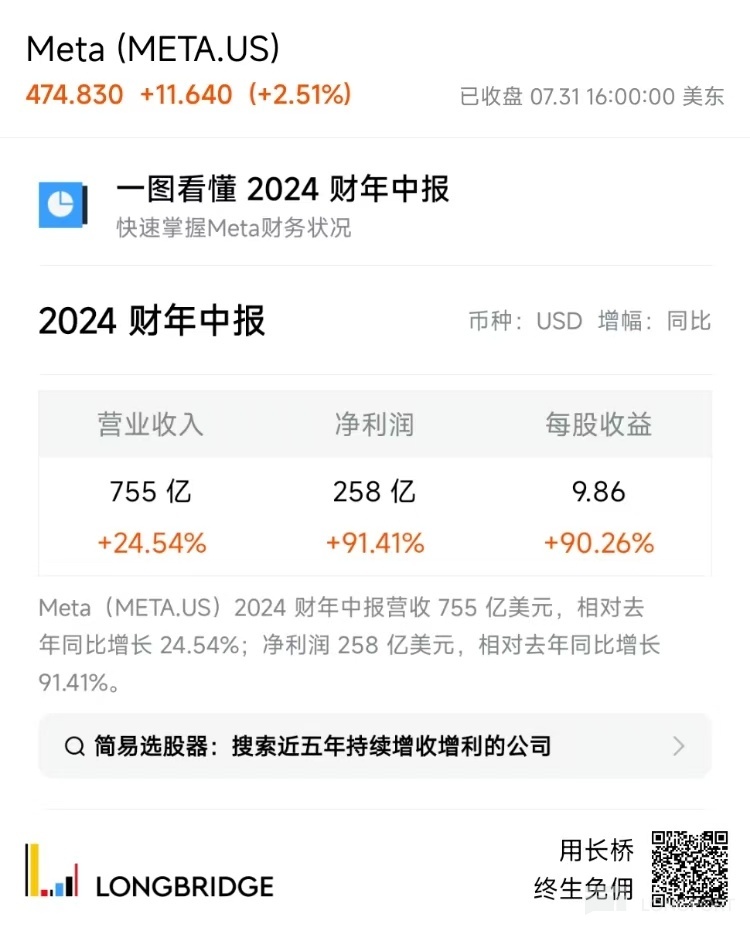
AI spending has become the market's top focus. Analysts estimate that Meta's capital expenditures surged over 40% quarter-over-quarter to $9.6 billion in Q2. Driven by AI, Meta is expected to achieve strong growth in both revenue and profit in Q2.
Meta CEO Mark Zuckerberg noted, "By the end of this year, Meta AI is expected to become the world's most widely used AI assistant. We released the first frontier-level open-source AI model, Ray-Ban Meta AI glasses continue to attract widespread attention, and our Family of Apps has also achieved solid growth."
- Meta's Past and Present
Let's deconstruct Meta's business landscape by looking at its history:
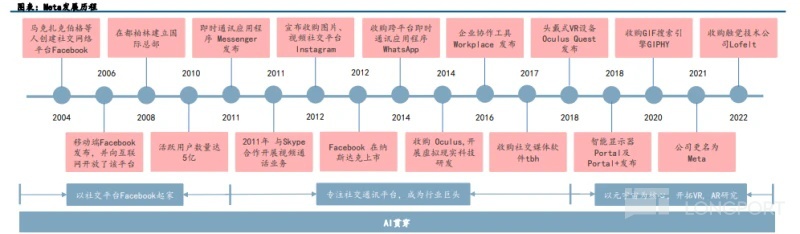
Meta was founded by Mark Zuckerberg in February 2004 as a leader in social media platforms and AR/VR. In April 2012, the company went public on NASDAQ under the ticker FB, later changed to META after rebranding. Since 2011, the company has continued to deepen its presence in social media, forming a matrix of apps including Facebook, Instagram, Messenger, and WhatsApp. In 2014, it acquired Oculus, expanding into AI, VR/AR, and metaverse-related businesses. In 2021, to align with its metaverse strategy and rebrand, the company announced its name change to "Meta."
II. Meta's Core Business Structure
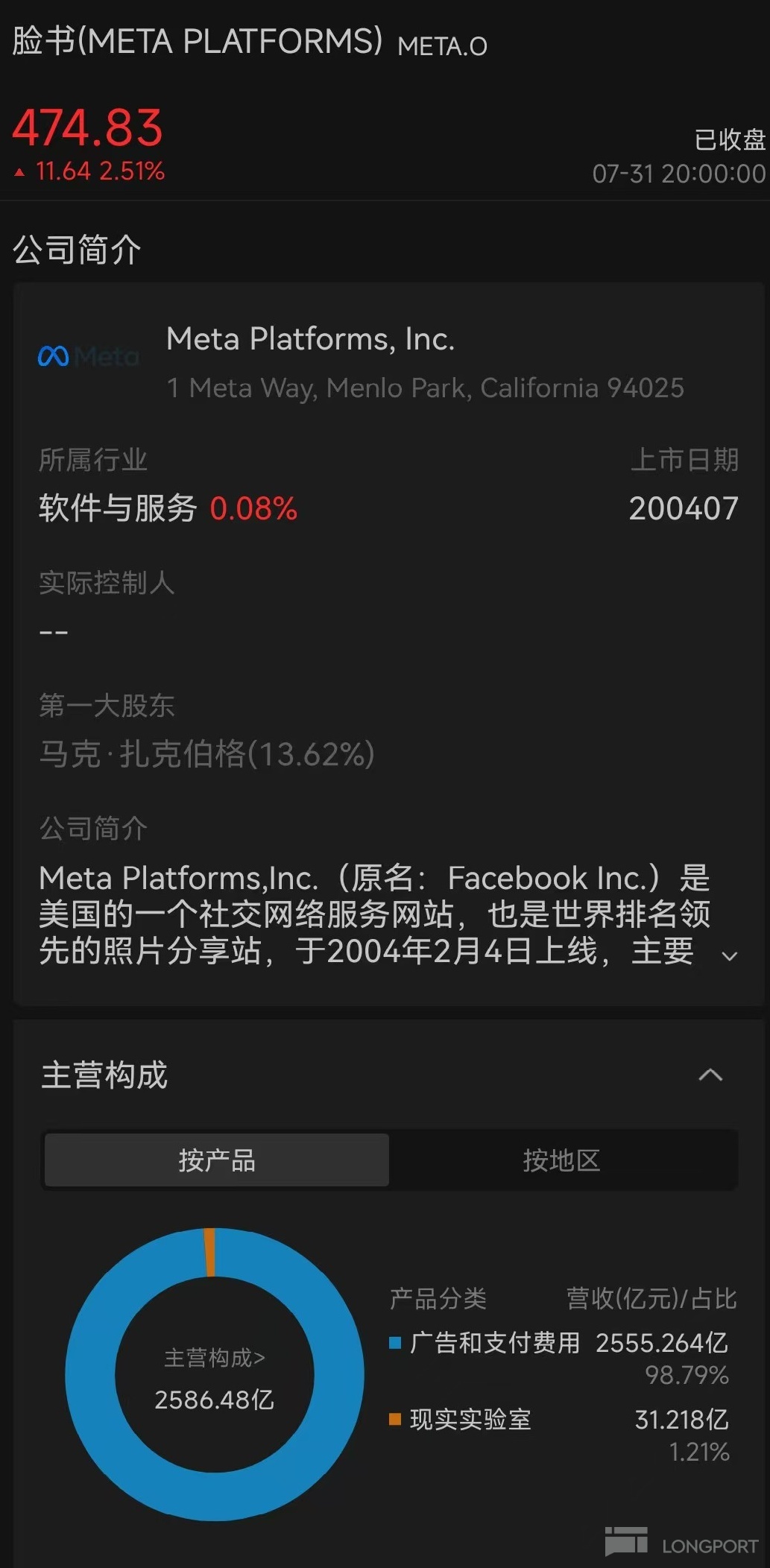
Currently, Meta's main businesses consist of two parts: Family of Apps (FoA) and Reality Labs (RL). Family of Apps (FoA) accounts for the vast majority of revenue, with advertising contributing over 95%. This includes social media and communication apps like Facebook, Messenger, Instagram, and WhatsApp, as well as business software Workplace and the metaverse platform Meta Horizon.
Reality Labs (RL) focuses on AR/VR devices, AR/VR technology, AI development, and the metaverse.
For a social ecosystem company like Meta, user traffic is its core productivity, and user growth is the fundamental driver of revenue growth. Currently, Meta owns blockbuster social products like Facebook, Instagram, and WhatsApp.
In terms of user scale, in Q4 2023, Meta's monthly active users across all platforms reached 3.98 billion, up 20 million quarter-over-quarter, while daily active users hit 3.19 billion, up 50 million quarter-over-quarter, setting a new record. In Q1 2024, daily active users rose to 3.24 billion, another increase of 50 million.
User metrics show Meta reported Q2 daily active users (DAP) of 3.27 billion, indicating sustained growth in social media user scale and a solid position in the digital advertising market. Meanwhile, Meta's massive investments in AI have positively impacted its business development.
When focusing on Meta's earnings, one cannot help but be shocked by the dominance of ad revenue, which reached $255.5264 billion, accounting for 98.79%, while Reality Labs revenue was just $3.1218 billion, a mere 1.21%.
As a social media giant, ad revenue makes up over 98% of Meta's total revenue, essentially propping up the Meta empire. Although Meta rebranded to signal its commitment to the metaverse, the market remains most focused on its ad business.
According to market consensus, Q2 revenue from Meta's app family (including Facebook, Instagram, WhatsApp, and Messenger) is expected to reach $37.7 billion, up 18.9% year-over-year. Like Google, Meta may benefit from ad spending tied to this year's U.S. election and the Olympics.
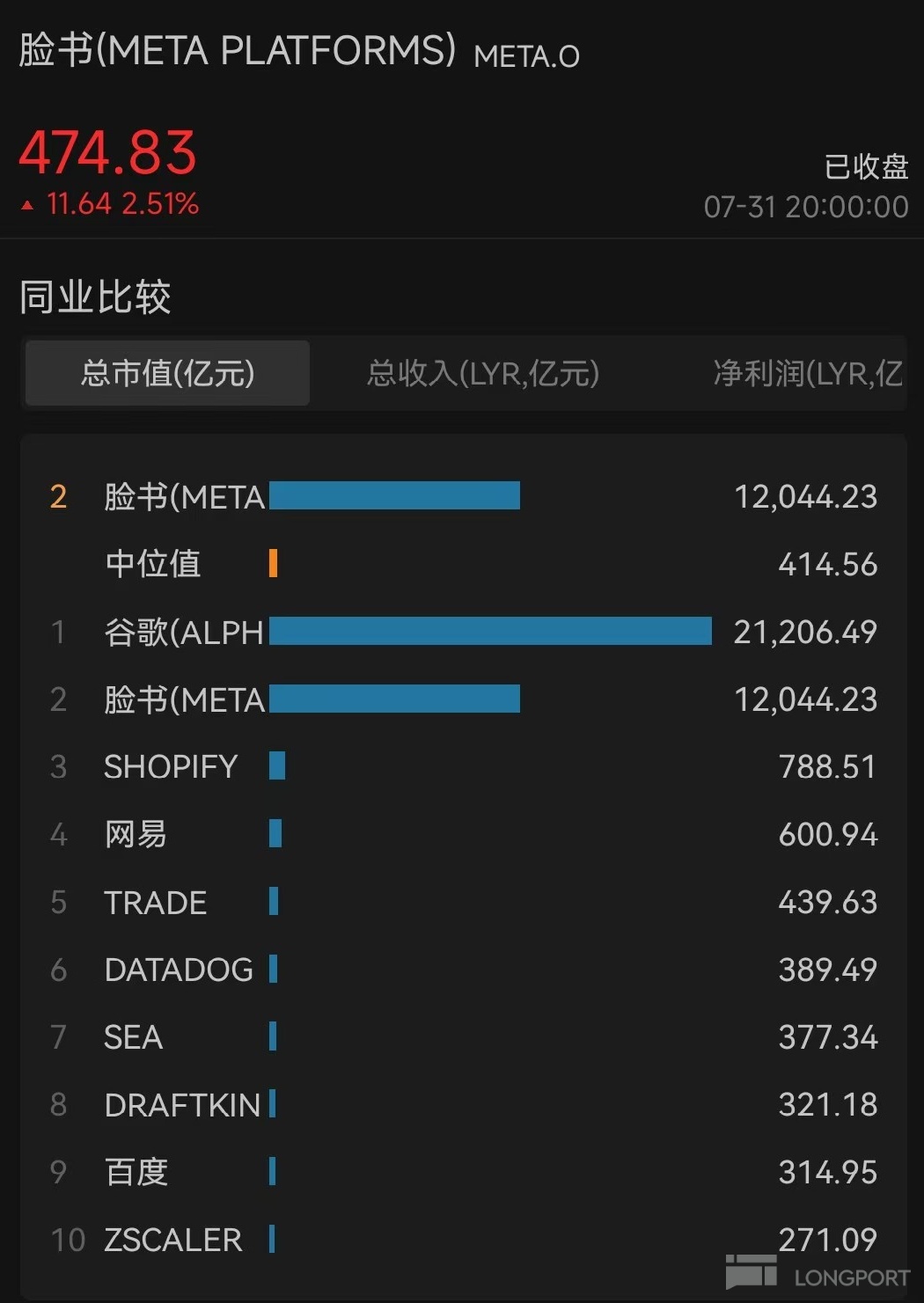
Meta's performance shows its core business—digital advertising—continues to expand its market share. Ad revenue, primarily from Facebook and Instagram, grew 22% year-over-year. In contrast, top competitor Alphabet reported 11% growth in Google ad sales, while YouTube fell short of expectations.
III. Meta's Metaverse
Beyond hardware, as the parent company of traditional social media platforms Facebook, Instagram, and WhatsApp, Meta is undoubtedly going all out to build a metaverse social platform with its massive user base.
In December 2021, Meta officially launched its VR social platform Horizon, where users can create avatars and interact with others.
Although Meta's metaverse strategy is forward-looking, it faces significant financial pressure. Currently, its metaverse business has been rocky.
The main reason is that the metaverse is still in its early stages, with immature content and business ecosystems. Early adopters dominate, making widespread adoption difficult. Meanwhile, the market remains cautious about the metaverse's future, prioritizing tangible economic benefits.
Reality Labs, Meta's metaverse division, has invested heavily in R&D but generates minimal revenue. Due to high upfront capital expenditures and operational losses, Reality Labs negatively impacts Meta's profits and cash flow.
This suggests Meta needs to find better business models and profit drivers to realize the economic value of its metaverse ambitions.
IV. Meta and NVIDIA's AI Strategy
Meta and NVIDIA are closely aligned in the metaverse, standing among the few tech giants still firmly investing in this direction.
Jensen Huang has said smart glasses coincide with the generative AI boom, and Ray-Ban smart glasses' vision of bringing AI into the virtual world aligns with NVIDIA's goal of integrating AI models into Omniverse.
Beyond hardware and metaverse platforms, Meta and NVIDIA jointly launched a new AI Research SuperCluster (RSC) and partnered with Spanish telecom Telefónica to establish a metaverse innovation hub, advancing infrastructure like AI, computing power, and network transmission.

At the SIGGRAPH computer graphics conference on July 30, NVIDIA founder and CEO Jensen Huang introduced 40-year-old Meta founder and CEO Mark Zuckerberg, who gifted Huang a leather jacket and teased Llama 4's potential to disrupt AI.
In fact, Meta and NVIDIA have long been close. In January, Zuckerberg revealed plans to buy 350,000 H100 GPU chips from NVIDIA by year-end, bringing Meta's total GPUs to 600,000—making it one of NVIDIA's most important customers.
Meanwhile, NVIDIA is also a key client for Meta. Huang noted in an interview that NVIDIA internally uses the Llama 3.1 405B model, optimized for its A100 GPUs, which also power Llama 2.
Will Meta's dual-track strategy—betting big on both AI and the metaverse—succeed? Only time will tell.
The copyright of this article belongs to the original author/organization.
The views expressed herein are solely those of the author and do not reflect the stance of the platform. The content is intended for investment reference purposes only and shall not be considered as investment advice. Please contact us if you have any questions or suggestions regarding the content services provided by the platform.
