


 Commemorative
 Buffett Apprentice
[Earnings Report Analysis] Walmart earnings report analysis and interpretation


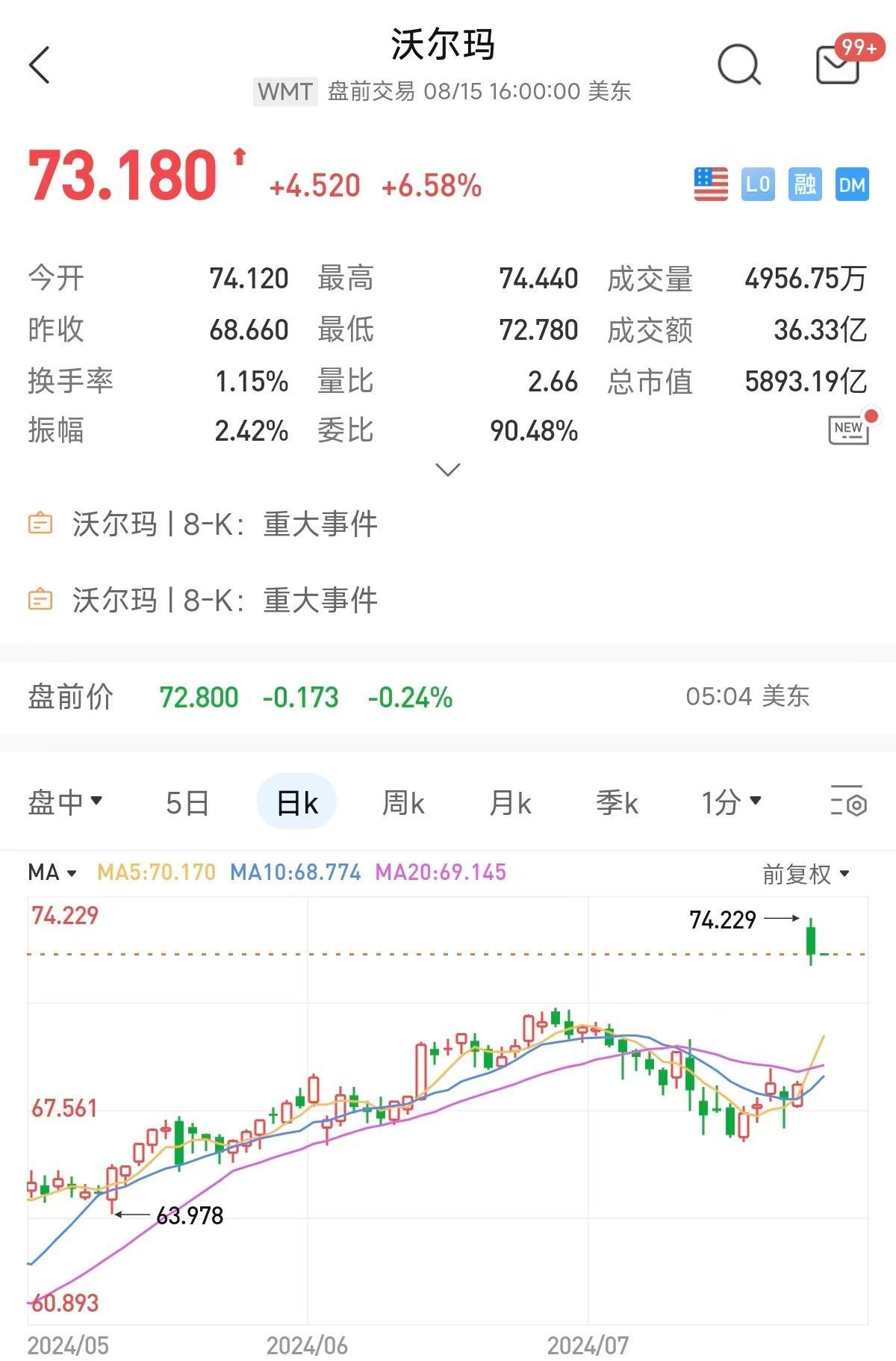
Walmart (WMT.US), as one of the world's largest retail chains, has always been a focal point for market attention with its financial reports. On August 15th, Eastern Time, Walmart released its second-quarter financial results, showcasing not only the company's operational resilience in a complex market environment but also providing investors with important clues about future performance trends.
1. Financial Report Overview
Revenue Performance: Walmart's second-quarter revenue reached $169.34 billion, a 4.8% year-over-year increase, surpassing market expectations of $168.46 billion. This achievement indicates that despite multiple pressures such as global economic uncertainty, supply chain challenges, and changes in consumer behavior, Walmart has been able to maintain steady growth thanks to its robust supply chain system and diversified business model.
Profitability: Adjusted earnings per share were $0.67, also exceeding the market estimate of $0.65, demonstrating the company's strong cost control and profitability. Walmart has effectively improved profitability through measures such as optimizing inventory management, enhancing operational efficiency, and accelerating digital transformation.
Forward Guidance: For the third quarter, Walmart expects adjusted earnings per share to be between $0.51 and $0.52, below the market estimate of $0.55. At the same time, the company anticipates revenue growth between 3.25% and 4.25%, reflecting a cautiously optimistic outlook for future performance but also indicating some growth pressures.
2. Key Factor Analysis
1. Supply Chain Optimization and Cost Control: Facing global supply chain tensions, Walmart has increased investment and management efforts in its supply chain, ensuring stable product supply through diversified suppliers and advance stocking. Meanwhile, the company continues to optimize its cost structure, reduce waste, and improve operational efficiency, providing strong support for profit growth.
2. Accelerated Digital Transformation: Walmart is continuously advancing its digital transformation, leveraging big data, artificial intelligence, and other technologies to enhance customer experience and operational efficiency. For example, through improvements in online shopping platforms, the application of intelligent recommendation systems, and the popularization of mobile payment functions, the company has successfully attracted more young consumers and promoted the development of an integrated online-offline new retail model.
3. Market Competition and Strategic Adjustments: Facing competitive pressure from e-commerce giants like Amazon, Walmart has actively adjusted its market strategy, strengthening its layout and investment in the e-commerce sector. At the same time, the company has focused on upgrading physical stores, attracting customers through improved shopping environments, a richer product variety, and the introduction of more experiential consumption.
3. Investment Outlook
Short-Term Bullish: Although Walmart's third-quarter earnings guidance is slightly below market expectations, considering its strong brand influence, stable financial condition, and proactive digital transformation strategy, the company is expected to achieve steady growth in the short term through measures such as strengthening internal management and optimizing cost control. Therefore, from a short-term investment perspective, Walmart remains attractive.
Long-Term Bullish: In the long run, as the global economy gradually recovers and consumer confidence rebounds, Walmart, as a leader in the retail industry, will benefit from growing market demand. At the same time, the company's ongoing digital transformation and the development of an integrated online-offline new retail model will provide broader growth opportunities. Therefore, from a long-term investment perspective, Walmart has significant growth potential and investment value.
4. Conclusion
In summary, Walmart's second-quarter financial report demonstrates the company's operational resilience and profitability in a complex market environment. Although facing certain growth pressures and market challenges, Walmart continues to enhance its competitiveness through supply chain optimization, cost control, digital transformation, and strategic adjustments. Therefore, both in the short and long term, Walmart holds substantial investment value and growth potential. Investors should closely monitor the company's subsequent operational dynamics and market performance to make more informed investment decisions.$Walmart(WMT.US)
Disclaimer: The views expressed herein are solely personal opinions and do not constitute investment advice. Investors should assess risks independently and seek professional advice when making investment decisions. The market carries risks, and investments should be made cautiously.
The copyright of this article belongs to the original author/organization.
The views expressed herein are solely those of the author and do not reflect the stance of the platform. The content is intended for investment reference purposes only and shall not be considered as investment advice. Please contact us if you have any questions or suggestions regarding the content services provided by the platform.
