


 Top 10 Influencers in 2025
 Likes Received
An article to understand Mr. Z's stock valuation table

It is said that many of my followers initially came for the valuation tables I post in my weekly live portfolio updates, but they also admit that they don't quite understand it, though they find it impressive, because stock prices often fluctuate dramatically around the price points I provide.

This article will address all your questions.
---
1. Before interpreting this valuation table, let’s answer a core question: What is Mr. Z's investment philosophy?
Answer: Learn from Buffett and practice value investing.
Unfortunately, the Simplified Chinese internet has distorted "value investing," completely misrepresenting Buffett's original intent.
Value investing on the Simplified Chinese internet:
1) Pick a few stocks, ignore prices, buy and never sell, planning to hold them long-term mindlessly, even calling it "sealing the position."
This behavior is often seen in the rhetoric of domestic financial influencers, though whether they actually do it is questionable (they usually don’t).
2) Buy a stock for some reason, get stuck, choose to tough it out hoping to break even, and then claim they’re practicing value investing.
This behavior is common among losing retail investors.
3) Ideology first, ignoring company fundamentals and investment logic, buying certain stocks for reasons like "patriotism" or "anti-America," hoping grand narratives will make their country "win" for them.
This behavior is also common among losing retail investors.
Mr. Z's understanding of value investing (localized translation of Buffett's original intent):
1) All money is equal; investing in gold is no nobler than investing in manure. What matters is whether it’s worth the price.
2) All stocks/companies/commodities can be valued, but valuation is subjective. Everyone assigns different prices based on their own understanding, and trading happens because of these disagreements.
3) Valuation must be a fuzzy range, and mistakes will happen. Always leave a sufficient margin of safety: buy below reasonable valuation—the further below, the safer; sell above reasonable valuation—the further above, the higher the profit, but also the harder to achieve.
4) No asset is worth holding forever. The only reasons not to sell are either not reaching your selling point or lacking a better alternative with higher odds. It should never be because you "don’t want to sell."
Here’s a real-world example to help you understand:
Coca-Cola has been priced at 3 yuan per bottle in China for years, which is the standard price in regular channels.
If you buy it at a tourist spot, it’s 5-10 yuan;
But if you buy it on Pinduoduo, you can get it for 2.5 yuan with free shipping;
And if you dig deeper, some special channels might even sell it for 2 yuan, though you’d have to pick it up yourself, factoring in travel and time costs.
Based on these everyday observations, we can apply value investing logic to conclude:
1) The reasonable price for a bottle of Coca-Cola is 3 yuan—this is its anchor point.
Anything above is expensive; anything below is cheap.
2) Whether to buy now depends on the specific scenario:
If I’m really thirsty and craving it, I’d pay 5 yuan at a tourist spot—or even 100 yuan in a desert!
But if I’m not thirsty or don’t care much for it, even 2.5 yuan, though "slightly undervalued," isn’t very appealing, and I still wouldn’t buy.
However, if I can get it for under 2 yuan, that’s a different story. At that price, not only can I drink freely, but I could even resell it to other vendors for a profit! Once the profit covers costs like gas, it’s a guaranteed win!
I’ve used plain language and a lengthy explanation to clarify what true value investing is. I hope you, the reader, now fully understand it.
---
2. Various questions about Mr. Z's valuation table
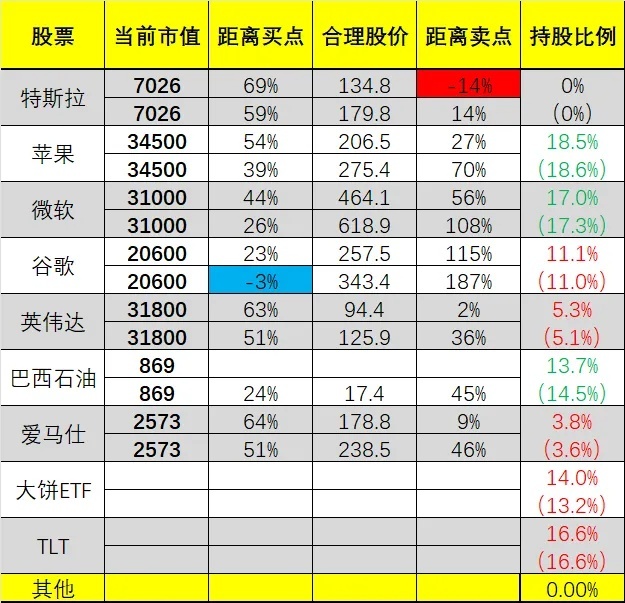
1) How is the valuation table created?
The table I share publicly isn’t the full version. The original Excel file contains many functions, formulas, and parameters I’ve subjectively set.
Each company’s valuation method varies. This table shows the results of my calculations, omitting the intermediate steps that are hard for outsiders to understand and that I don’t want to debate.
As companies evolve, new positives/negatives emerge, so I periodically adjust the parameters in the original Excel, updating each company’s data. Don’t just save one table and treat it as a long-term reference.
2) How should you interpret the valuation table?
In Part 1, I used Coca-Cola to explain value investing: find the anchor point for reasonable valuation and judge whether it’s worth buying based on external variables like the environment.
This table quantifies that logic. Most companies have 2 buy points, 2 reasonable price ranges, and 2 sell points.
Since stocks can’t be pinned to an exact value like Coca-Cola, each range is split into upper and lower bounds.
So, the most common way to use this table is to check the current stock price against the 3 ranges to see where it stands.
But does knowing its position mean you should buy/sell?
Answer: No!
The ranges help you gauge the general situation, but whether to buy "this Coke" depends on whether you’re thirsty, want it, or see profit potential.
When pessimistic, you might wait to buy until it falls below the lower buy point. When optimistic, you might hold until it rises above the upper sell point. There’s no fixed rule. But the closer to the boundary, the higher the odds—and the higher the risk.
Remember, the decision-maker is always you—not this table. It’s just a reference!
3) Are the companies in the valuation table fixed?
Answer: No.
My expertise lies mainly in tech, consumer, and energy sector leaders.
The table reflects my current focus. If I see no short-term opportunities, I remove them to avoid wasting effort.
For funds, though I include those I hold, they aren’t valued like stocks. That column is often empty, and I reference the valuations of their top holdings—e.g., for my S&P Info Tech fund in China, I look at Microsoft, Apple, and NVIDIA.
4) What valuation methods do I use most?
Though the parameters and formulas are subjective, investment logic is universal. I mostly use discounted cash flow (DCF) and Shiller P/E.
I won’t explain these terms here (you can search them), but here’s how I use them:
DCF is for stable, growing cash flow businesses; Shiller P/E is for cyclical stocks with volatile earnings due to macro factors.
But these are just my preferences—not the only way, nor are other methods wrong. There’s no single answer.
Any method that makes money is valid. Don’t argue over it—focus on facts, logic, and sharing ideas, not convincing others.
---
End of article.
If you have any questions, leave a comment.
The copyright of this article belongs to the original author/organization.
The views expressed herein are solely those of the author and do not reflect the stance of the platform. The content is intended for investment reference purposes only and shall not be considered as investment advice. Please contact us if you have any questions or suggestions regarding the content services provided by the platform.
