


 Likes Received
China's overcapacity status: Goldman Sachs in-depth analysis of seven industries' prospects

Goldman Sachs recently released a research report aimed at assessing the severity of China's overcapacity. The study selected seven industries as analysis samples, including photovoltaic modules, new energy vehicles, lithium batteries, power semiconductors (IGBT chipset), construction machinery, air conditioners, and the steel industry.
The results show that the photovoltaic and lithium battery industries are expected to bottom out soon. However, the prospects for new energy vehicles, power semiconductors, construction machinery, and the steel industry need to be viewed with caution, while the air conditioning industry is expected to maintain healthy development.
This conclusion may be surprising. How did Goldman Sachs arrive at these conclusions? Among the seven industries analyzed, five had capacity utilization rates in 2023 ranging between 30% and 60%, while a healthy capacity utilization rate should be 80%. Low capacity utilization reflects the problem of overcapacity. Goldman Sachs compiled data from these seven industries into a single chart. Although the chart is complex, it allows for a detailed interpretation of each industry's specific situation.
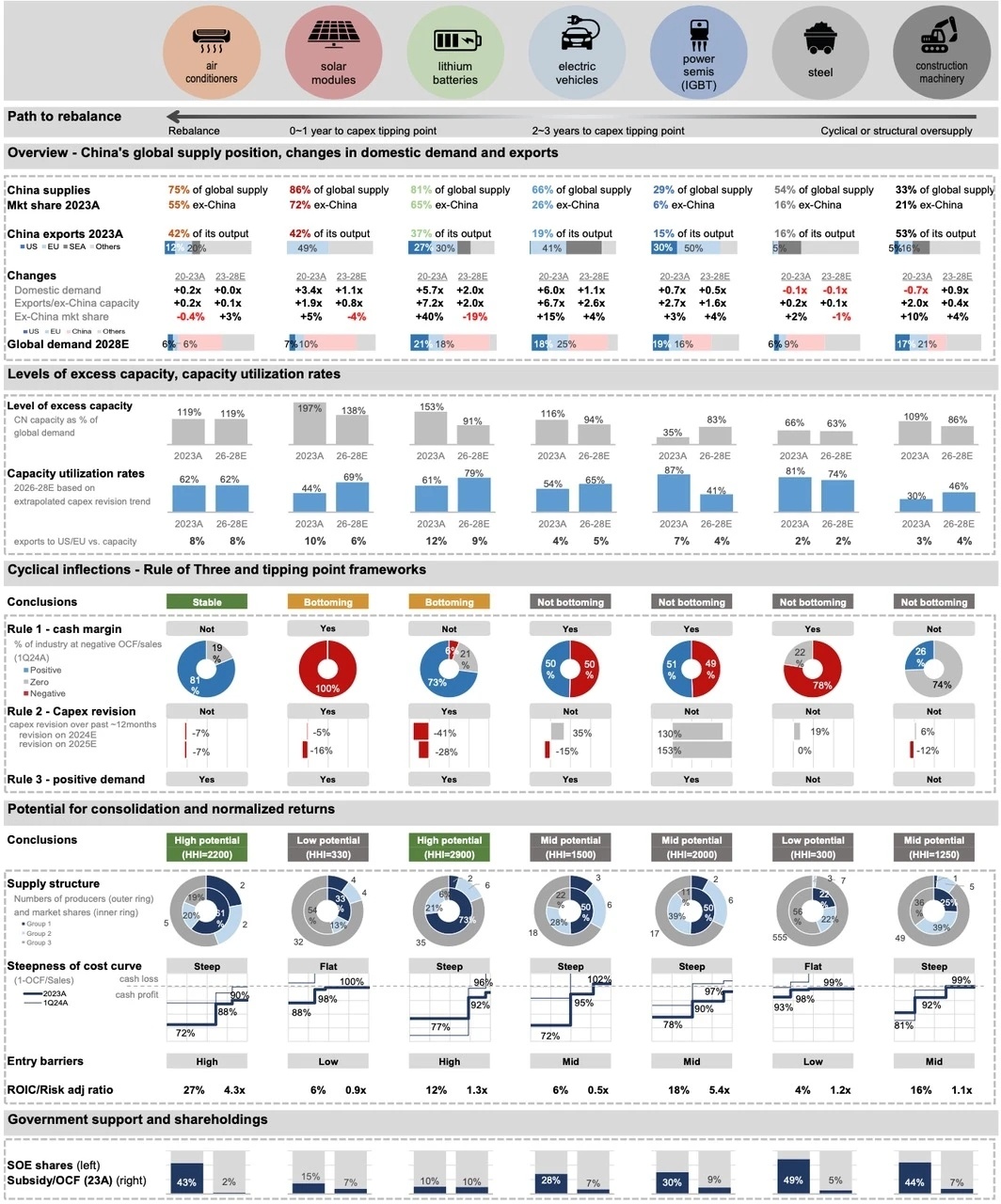
Taking the photovoltaic industry as an example, China's photovoltaic module capacity in 2023 was four times the domestic market demand and twice the global demand, with a capacity utilization rate of only 44%. Overcapacity usually leads to falling product prices and corporate losses, both of which are evident in the photovoltaic industry. In the first quarter of 2024, photovoltaic module prices fell by 46% year-on-year, and the entire industry's operating cash flow was negative, indicating losses across the sector. Nevertheless, Goldman Sachs believes the photovoltaic industry is in the final stage of the current downturn and expects it to hit bottom in 2025.
The lithium battery industry also faces severe overcapacity. In 2023, China's lithium battery capacity was 3.3 times domestic demand and 1.5 times global demand, with a capacity utilization rate of 61%. Lithium battery prices fell by 45% year-on-year in the first quarter, with about a quarter of companies reporting losses. Goldman Sachs expects 2024 to be the trough of the current downturn for the lithium battery industry, with capacity utilization rebounding to between 55% and 60% from 2024 to 2026.
Goldman Sachs concludes that although both the photovoltaic and lithium battery industries face severe overcapacity, the severe losses suffered by companies are driving capacity reduction, and the dawn of industry recovery may be near. The lithium battery industry is expected to bottom out in 2024, while the photovoltaic industry will do so in 2025.
The situation in the new energy vehicle industry is different. In 2023, China's new energy vehicle capacity was about 2.1 times domestic demand and 1.2 times global demand, with a capacity utilization rate of 54%. Despite overcapacity, companies in the new energy vehicle industry are still expanding production. Goldman Sachs believes the industry's turning point has not yet arrived, and it may continue to face fierce competition in the coming years.
The power semiconductor (IGBT) industry presents a unique case. In 2023, China's power semiconductor capacity was 1.4 times domestic demand and 35% of global demand, with a capacity utilization rate of 87%, seemingly without obvious overcapacity. However, nearly half of the companies reported losses while still expanding capacity, a somewhat contradictory phenomenon. Goldman Sachs expects the industry may face overcapacity in the future, leading to price declines, and thus maintains a cautious outlook.
The construction machinery industry is in a more severe situation. In 2023, China's construction machinery capacity was 7.2 times domestic demand and 1.1 times global demand, with a capacity utilization rate of only 30%. Goldman Sachs believes the industry may need to adjust through production cuts in the future.
The steel industry is relatively healthy. In 2023, China's steel capacity was 1.5 times domestic demand and 66% of global demand, with a capacity utilization rate of 81%. Despite the ongoing downturn in the real estate sector, the steel industry's profitability is expected to remain stable, thanks to supply-side reforms from 2015 to 2017.
Finally, the air conditioning industry is considered the healthiest among the seven. In 2023, China's air conditioning capacity was 2.7 times domestic demand and 1.2 times global demand, with a capacity utilization rate of 62%. Although there is some degree of overcapacity, Goldman Sachs believes air conditioning companies are more disciplined in expanding capacity and are likely to maintain a good supply-demand balance and profitability in the future.
In summary, Goldman Sachs believes the photovoltaic and lithium battery industries will bottom out and rebound in 2024 and 2025, while the new energy vehicle and power semiconductor industries may face more challenges in the coming years and require cautious handling. The steel and construction machinery industries may be affected by the real estate downturn, while the air conditioning industry is expected to remain healthy.
It is important to note that while Goldman Sachs' research reports are of high quality, their content is for reference only, and investors should make decisions based on their own judgment. When it comes to research reports, especially those from Goldman Sachs, a rational attitude is essential—neither blindly following nor completely dismissing them.
The copyright of this article belongs to the original author/organization.
The views expressed herein are solely those of the author and do not reflect the stance of the platform. The content is intended for investment reference purposes only and shall not be considered as investment advice. Please contact us if you have any questions or suggestions regarding the content services provided by the platform.
