


The dream of international expansion behind Midea's failed high-end strategy and IPO

Facing challenges in the high-end market and the slowdown in the air conditioning industry, Midea is demonstrating its global ambitions through its Hong Kong IPO, striving to find new growth paths.
@新熵 Original
Author 丨 Xiao Wei Editor 丨 Jue Ying
Hong Kong's largest IPO in three years is here!
Midea Group officially listed on the Hong Kong stock market on September 17, marking the successful conclusion of an IPO process that lasted over a year. The first day saw strong market enthusiasm, with the closing stock price rising by 7.8%. The fundraising amount exceeded HKD 30 billion, making it the largest IPO since Kuaishou's listing in February 2021. Midea has now become another "A+H" dual-listed company and the second-largest IPO globally this year.
Looking back at Midea's recent transformations, there's a clear trend: shifting from a white goods giant to diversification. The essence of this IPO isn't about funding—Midea isn't short on cash—but rather about international expansion.
As the second white goods giant to dual-list after Haier Smart Home, finding multiple growth drivers in the increasingly competitive white goods sector is a must for companies like Midea.
That said, following in the footsteps of peers reduces the risk of drowning.
Air Conditioning Dominance, But Growth Slows
The debate over who's number one in air conditioning between Midea and Gree has been going on for a long time.
Back in 2021, the two sides clashed over this issue, each citing third-party market data in their financial reports to prove their dominance.
Gree cited data from "Industry Online," claiming a 33.89% share of the domestic household air conditioning market in the first half of 2021, ranking first in the home appliance industry. Midea, on the other hand, used all-channel sales data to assert its leadership in both online and offline markets, with shares of 37.6% and 36.5%, respectively.
Each has its own argument, but one thing is clear: being number one in air conditioning matters.
The answer is yes. Among home appliances, air conditioners have the highest profit margins, surpassing refrigerators, washing machines, and other categories. Hence, the industry consensus: "He who controls air conditioning controls white goods."
The numbers speak for themselves. In the first half of 2024, Midea Group reported revenue of RMB 217.274 billion, up 10.30% year-on-year, with net profit reaching RMB 20.804 billion, a 14.11% increase. Heating, ventilation, and air conditioning (HVAC) accounted for 46.70% of revenue. Gree, meanwhile, posted total operating revenue of RMB 100.287 billion in the first half of 2024, up 0.50%, with net profit attributable to shareholders at RMB 14.136 billion, an 11.54% increase. Air conditioning made up 78.14% of Gree's revenue.
Looking at the broader market, data from AVC shows that China's home appliance retail market (excluding 3C) reached RMB 849.8 billion in 2023, with air conditioning accounting for RMB 211.7 billion, or 24.91%—nearly the combined share of washing machines and refrigerators.
High profits and a large market naturally attract more players. Since December 2022, mid-tier and smaller brands like TCL, Philips, Zhonghuida, MBO, and YueTu have announced new production bases. This surge in capacity is expected to add 20 million units annually, intensifying competition.
This explains why both Midea and Gree insist on being the air conditioning leader—it's about securing dominance in a fiercely competitive market. But no matter how they compete, they can't change the fact that the air conditioning market is shrinking.
According to National Bureau of Statistics data, by the end of 2023, there were 145.9 air conditioners per 100 urban households, with 171.7 in cities and 105.7 in rural areas.
AVC data shows that from January to July 2024, domestic household air conditioner sales fell 10.2% year-on-year to 39.114 million units, with retail sales dropping 13.9% to RMB 132.13 billion. Even during the peak months of June and July, sales showed no signs of recovery.
With weak demand and overcapacity, the domestic air conditioning market faces grim prospects. The entire home appliance industry is grappling with this slowdown, making it urgent for companies like Midea to find a way out. How urgent? Midea has skipped China's premier home appliance expo, AWE, for two consecutive years. Where is the air conditioning leader? It's a mystery. This also hints at Midea's eagerness to shed its "home appliance" label, now positioning itself as a "technology group."
Bumpy Road to High-End Home Appliances, Midea Seeks Alternatives

There's no denying that air conditioning and other home appliances are Midea's core business. Despite consistently outperforming Haier and Gree in overall revenue, Midea has struggled in the high-end segment.
In 2007, Haier Smart Home launched its high-end brand "Casarte," which has since become an industry benchmark. According to Haier's 2024 interim report, Casarte holds 39.5%, 82.3%, and 32% market shares in refrigerators, washing machines, and air conditioners, respectively, leading the high-end market for eight consecutive years.
Midea, meanwhile, has faced repeated setbacks in its high-end push. Around 2010, it introduced "Fandiro" and "Beverly" as premium sub-brands, but both have since faded away.
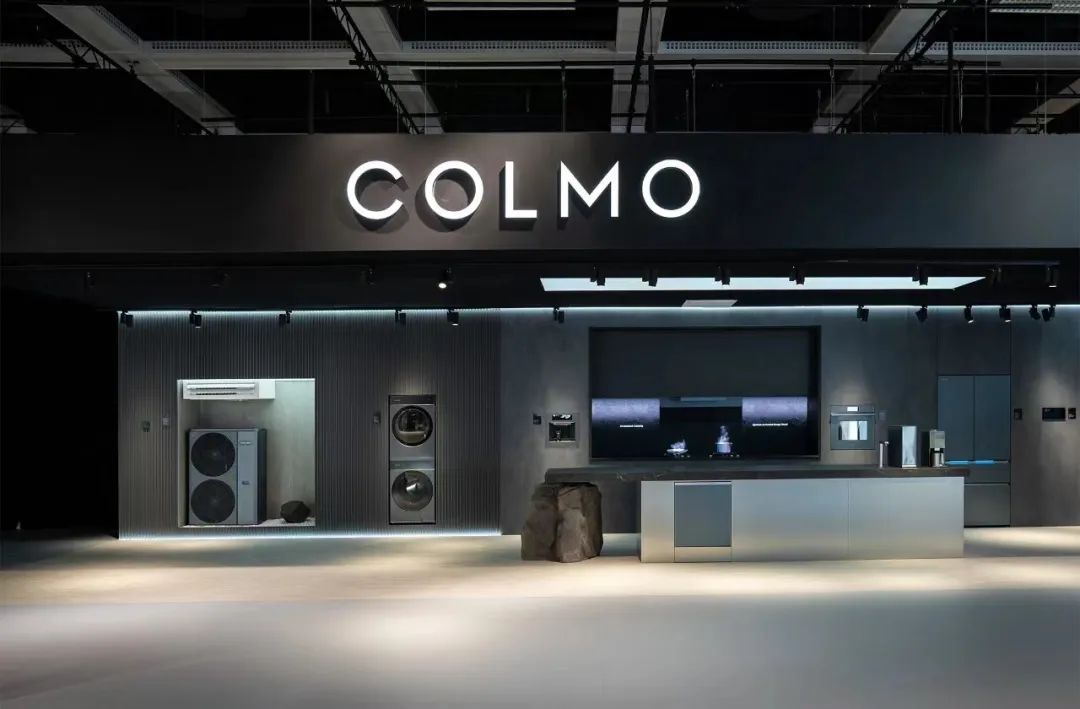
Later attempts included the 2018 launch of COLMO and the 2019 internet brand BUGU, along with acquisitions like Toshiba, Little Swan, and Hualing. None made a significant impact domestically, leaving Midea perpetually overshadowed by Haier in the high-end market.
With repeated failures in the high-end segment, how has Midea maintained high revenue growth? The answer lies in diversification.
Midea has acquired companies like Lingwang Elevator, Hekang New Energy, Wandong Medical, Tianteng Power, and Kelu Electronics, spanning elevators, new energy, and healthcare. Such aggressive moves into non-home-appliance sectors have given Midea a reputation for being "unfocused."
Notably, Midea's new ventures are largely B2B, a stark contrast to its B2C home appliance business. Yet, this "unfocused" strategy has allowed Midea to rebrand itself as a "technology group" rather than a home appliance giant.
In its 2022 letter to shareholders, Midea stated: "We will balance B2C and B2B breakthroughs, using B2C product strength and core technology to stabilize and enhance profitability, providing strategic support for B2B transformation."
This B2B focus is also reflected in its financials. In the first half of 2024, Midea's smart home segment reported revenue of RMB 147.6 billion, up 11% year-on-year; new energy and industrial technology revenue rose 26% to RMB 17.1 billion; smart building technology grew 6% to RMB 15.7 billion; while robotics and automation revenue fell 9% to RMB 13.9 billion.
Clearly, B2B performance is mixed, but it now accounts for nearly 30% of revenue, becoming another pillar for Midea.
This shift was foreshadowed in May 2023, when Midea Group President Fang Hongbo warned that the home appliance industry would face an unprecedented winter in the next three years, forcing Midea to find a "second engine."
High-end struggles, B2B gains—Midea's loss may yet turn into fortune.
Going Global at a Discount: A Bold Move
For its Hong Kong IPO, Midea plans to issue 492 million H shares, with 95% allocated to international investors and only 5% to the Hong Kong public, plus a 15% over-allotment option.
Most companies IPO to raise funds, but Midea isn't short on cash. As of the end of 2023, it held RMB 81.674 billion in cash, accounting for 16.80% of total assets, including RMB 59.8 billion in cash equivalents.
If not for funding, what's the purpose of this IPO? The answer lies in the 95% international allocation—Midea is targeting global investors, making this IPO part of its overseas expansion strategy.
As early as its 2017 annual report, Midea stated that "overseas sales will exceed 50% of total revenue." In late 2020, Midea's international VP Zhao Wenxin reiterated this goal at a forum, aiming for overseas revenue to surpass 50% within three years. By 2024, Midea is close: interim reports show overseas sales account for over 40% of total revenue, with products exported to 200+ countries and regions, supported by 5,000 service outlets. In the first half of 2024, overseas revenue reached RMB 91.08 billion, up 13.09% year-on-year, making up 41.92% of total revenue.
Strong overseas performance has bolstered investor confidence. Midea's IPO was fully subscribed on the first day, closing a day early on September 11. The enthusiastic response is also due to its attractive pricing: based on Midea's A-share closing price of RMB 62.37 on September 12, the H-share offer price of HKD 52–54.80 represents a 76–80% discount.
This profit-sharing approach attracted 18 cornerstone investors, including COSCO Shipping, Boyu Capital, UBS Asset Management, BYD, and China Structural Reform Fund, collectively subscribing to 37.25% of the offering—a testament to Midea's strong investor network.
While Midea's overseas expansion seems natural given its revenue dominance, it's also a reflection of management's vision. Founder He Xiangjian built Midea from a 23-person township enterprise into China's white goods leader over 44 years—a legendary feat. But even more remarkable is his decision to adopt a professional management system instead of passing the company to his son. Since his 2021 retirement, his only son, He Jianfeng, served as a non-executive director but stayed out of operations. By June 2024, He Jianfeng stepped down entirely, ending any notion of a family succession.
Why didn't He Jianfeng take over? His track record may hold the answer. In late 2023, he spent RMB 8.88 billion to acquire a 29.42% stake in Kuka Home at an average price of RMB 36.7 per share. Today, Kuka's stock trades at RMB 22.57, a 38.5% loss, wiping out over RMB 3.4 billion. His 2018 acquisition of film studio Bona Qiancheng for RMB 1.8 billion resulted in a RMB 3.4 billion loss that year. After a few profitable years, it lost RMB 186 million in 2023 and another RMB 29.53 million in the first half of 2024. For a would-be leader of a trillion-yuan empire, such results are hardly convincing.
In contrast, Midea's current operations are far more stable. For this tech giant, steady growth is paramount. From this perspective, Midea's evolution from a family business to a modern corporation—achieving such success—is no small feat, market boom notwithstanding.
After all, for any company, making money is easy; building a legacy is hard.
The copyright of this article belongs to the original author/organization.
The views expressed herein are solely those of the author and do not reflect the stance of the platform. The content is intended for investment reference purposes only and shall not be considered as investment advice. Please contact us if you have any questions or suggestions regarding the content services provided by the platform.
