


 Likes Received
 Posts
Posts$39 billion market cap gone up in smoke! Haidilao, with record-high performance, is still lingering at the bottom.

The chairman remains unchanged while CEOs come and go.
Three months ago, Gou Yiqun replaced Yang Lijuan as the new CEO of Haidilao.
During Yang Lijuan's tenure, Haidilao's performance bottomed out and rebounded, reaching a historic high.
In response to the CEO adjustment, Haidilao told the media that it corresponds to different stages the company is facing.
So, what prompted Daniel Zhang to replace this "firefighter" at the peak of performance? What new story will the "Gou Yiqun era" of Haidilao tell?
A veteran Haidilao employee once told China Entrepreneur that at Haidilao, Chairman Daniel Zhang proposed many plans, and many systems were also his brainchild, including the "Woodpecker Plan." Yang Lijuan, who collaborated with him, was the unwavering executor of these plans.
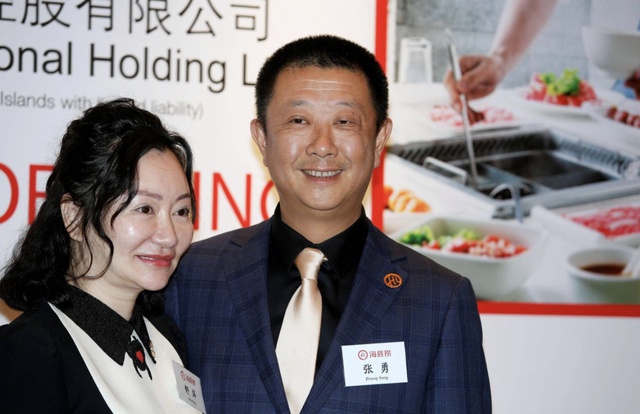
In the early days, when Daniel Zhang proposed expanding Haidilao "nationwide," the 20-year-old Yang Lijuan went to the unfamiliar Xi'an market as a pioneer, doing everything possible to "crack" the first store outside Sichuan. Later, after Daniel Zhang proposed internationalization, she led the team to "crack" the Singapore and U.S. markets.
As Daniel Zhang's "sharp sword," Yang Lijuan's adjustment is understandable, and internationalization will likely remain a key focus of Haidilao's overall expansion strategy.
And this is probably Daniel Zhang's motivation for adjusting Haidilao's CEO.
At this year's shareholders' meeting, Daniel Zhang mentioned, "We hope Haidilao store managers can become multi-store managers. The hot pot category can have many levels, such as Haidilao hot pot and other street hot pot options. Beyond hot pot, there can also be barbecue, noodle shops, and other formats. A Haidilao store manager can manage another store, such as a barbecue restaurant, noodle shop, or other format. In the future, a store manager managing multiple stores can share resources."
As an executor, Haidilao veteran Gou Yiqun is the natural choice.
Gou Yiqun's resume shows that he served as Chairman of Shuhai (Beijing) Supply Chain from July 2011 to December 2018 and again from February 2023; as a non-executive director of Yihai International from October 2013 to March 2018, as its Chairman from March 2016 to November 2017, and as a member of its Remuneration Committee from March 2016 to March 2018 and Chairman of its Audit Committee from July 2016 to November 2017.
In other words, Gou Yiqun has rich experience in supply chain management, which is exactly what Daniel Zhang needs most right now.
Unfortunately, despite Haidilao's record-high performance and multiple strategic adjustments, the capital market has not been very receptive, valuing Haidilao extremely low at present. Its forward P/E ratio is only 15.8x, the lowest since its IPO. In terms of stock price, from its peak, Haidilao has fallen over 80%, with its market cap evaporating more than HKD 390 billion; year-to-date, its gain is only 1%, with its market cap now just HKD 75.1 billion.
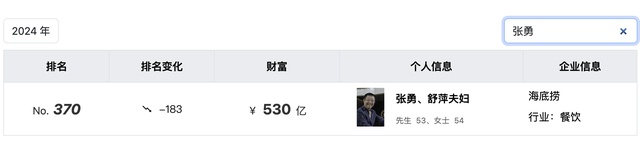
As a result, the net worth of Haidilao founder Daniel Zhang and his wife has also declined significantly. According to the 2024 Hurun Global Rich List, Daniel Zhang and his wife ranked 370th globally with a net worth of RMB 53 billion, down 183 spots from last year. Notably, in 2021, they ranked 38th globally with a net worth of RMB 245 billion. In other words, their net worth has evaporated by RMB 192 billion in just three years.
The "Aftermath" of Expansion
After Haidilao's IPO, Daniel Zhang ushered in a new era of expansion for the company.
The frenzied store openings coincided with a special period, and Daniel Zhang soon faced the biggest "blow" since the IPO—massive losses forced him to swallow the "bitter fruit" he had sown. Faced with the problems brought by expansion, he did not choose to tough it out but quickly admitted mistakes and made corresponding adjustments.
Therefore, from this perspective, Daniel Zhang's management skills are of a high standard.
Faced with a continuously declining stock price and huge losses, Yang Lijuan was appointed as Haidilao's CEO, replacing founder Daniel Zhang. She then led Haidilao through an unprecedented reform, ultimately pulling the company out of the mire.
During her more than two-year tenure, Yang Lijuan's report card has been nothing short of perfect.
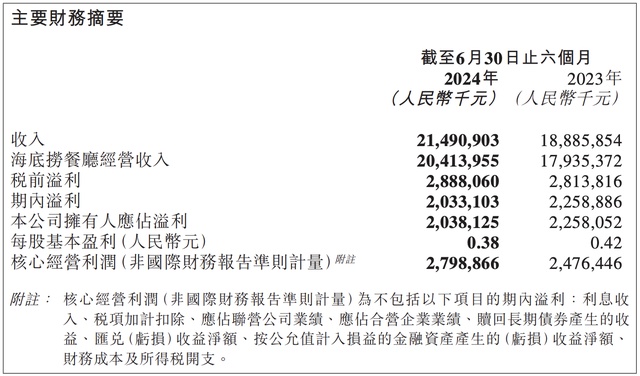
On August 27, Haidilao announced its 2024 interim results. The financial report showed that Haidilao achieved revenue of RMB 21.491 billion, a year-on-year increase of 13.8%; core operating profit reached RMB 2.799 billion, up 13% year-on-year; and net profit attributable to shareholders was RMB 2.038 billion, down 9.7% year-on-year.
Despite the continuously rising performance, the company's stock price has not been ideal. Data shows that although Haidilao's performance hit a record high in 2023, its stock price fell 36.76% for the year and has only risen 1% in 2024.
So, what is the market worried about?
The answer may lie in the sustainability of future performance growth.
The financial report shows that as of June 30, Haidilao operated 1,343 restaurants in Greater China, of which 1,320 were in mainland China and 23 in Hong Kong, Macau, and Taiwan. In the first half of the year, all restaurants in Greater China served over 200 million customers, with a table turnover rate of 4.2 times per day, close to the peak level of 2019.
In theory, the increase in table turnover rate reflects the improvement in Haidilao's store conditions, but the capital market may worry that a significant year-on-year increase in table turnover rate means limited growth space, making expansion inevitable going forward. However, in reality, as of the first half of the year, Haidilao opened 11 new stores and closed 43, resulting in a net closure of 32 stores.
In other words, the market remains 观望的态度 towards Haidilao's future expansion.
Another notable point is that Haidilao's per-customer spending has shown a continuous overall decline. According to the financial report, from 2019 to 2023, Haidilao's per-customer spending was RMB 110.1, RMB 104.7, RMB 104.9, and RMB 99.1, respectively. In the first half of 2024, this figure dropped further to RMB 97.4,接近 2017 levels.
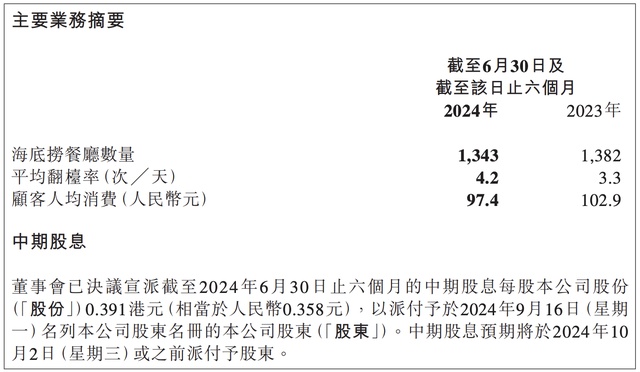
In response to the decline in per-customer spending, Haidilao explained that it was mainly due to adjustments in menu consumption structure and increased discounts.
Against this backdrop, Haidilao's growth will still rely on its store expansion strategy. Due to the failure of previous expansions, Haidilao has turned to franchising.
As the mastermind behind the scenes, Daniel Zhang's intention in placing Gou Yiqun as Haidilao's CEO is quite clear. After all, whether it's Yang Lijuan or Gou Yiqun, they are both steadfast executors of Daniel Zhang's plans.
Why Isn't the Market Buying It?
Gou Yiqun replacing Yang Lijuan itself sends a signal: money isn't easy to make anymore!
To address the above issues, Haidilao launched the "Pomegranate Plan," with its core being a multi-brand development strategy.
At the earnings briefing, Gou Yiqun admitted: "The ceiling and pressure of a single 赛道 are relatively high. To give more Haidilao employees 更多发展机会, we must create more growth points."
According to the financial report, in the first half of the year, Haidilao had five 创业 projects in operation, including brands like Xiao Hi Hotpot, Miao Shixiang Hotpot, and Yanqing Barbecue, covering formats such as hot pot, fast food, barbecue, and Chinese casual dining.
Gou Yiqun stated that although future development may not be smooth sailing, for brands like Yanqing Barbecue, the goal is to reach 400-500 stores within three years, which is already clearly planned under the Pomegranate Plan.开店 plans for other brands are also being continuously formulated.
Additionally, it's worth noting that aside from opening 加盟 and 孵化更多餐饮新品牌, Haidilao has also frequently been embroiled in controversy due to "service downgrades." These include beef cubes being moved from the condiment station to manual ordering,免费打印照片 being reduced to just one,水果零食小玩具 being less generously given away, and 部分美甲样式 starting to charge fees...
Behind all these changes lies the pressure on Haidilao's future performance growth. Moreover, diversified expansion could also weaken Haidilao's core competitive advantages.
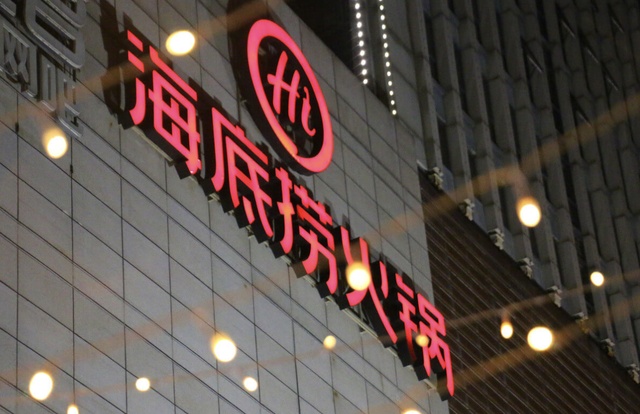
After Haidilao released its interim report, institutions were not particularly optimistic about the company's overall outlook.
Nomura released a report stating that Haidilao's first-half performance was mixed, with an increased dividend payout ratio. Revenue rose 14% year-on-year, 1% lower than market expectations, mainly due to slower-than-expected store openings; net profit fell 10% year-on-year, 5% lower than market expectations, mainly due to higher effective tax rates and non-operating expenses. Haidilao achieved impressive same-store sales growth of 15% year-on-year in the first half, outperforming peers like Jiudianjiu, mainly due to its greater exposure to lower-tier cities. Considering these factors, Nomura lowered Haidilao's target price from HKD 20.2 to HKD 15.1 but maintained a "buy" rating.
CLSA noted in a report that at the investor conference, Haidilao admitted the need to reduce employee expense ratios to improve restaurant margins. The company reaffirmed its store opening guidance, planning to open 40-50 new Haidilao stores in the second half, including 4-10 特许经营 stores. CLSA pointed out that developing the new barbecue brand "Yanqing Barbecue" is a key measure by the new CEO.
As a result, CLSA lowered Haidilao's target price from HKD 14.6 to HKD 14.3 but maintained its "outperform" rating.
Morgan Stanley released a report stating that Haidilao's overall seat occupancy rate in August was in line with expectations but rose to single digits month-on-month. Self-operated store openings remained slow, with only two new stores opened in August, bringing the total to 14 in the first eight months of 2024, compared to a full-year target of 61. Additionally, Haidilao's new brand "Yanqing Barbecue" accelerated its store openings, adding one store in Hangzhou in August, bringing the total to six since its launch in June. The bank stated that it remains bullish on Haidilao due to its resilient performance, strong execution on profitability, and commitment to shareholder returns. As a result, Morgan Stanley maintained Haidilao's target price of HKD 18 and an "overweight" rating.
CMB International noted in a research report that Haidilao's first-half performance was largely in line with expectations, albeit with lower margins. CMB International expects Haidilao to face certain pressures in the second half, including macroeconomic headwinds, high same-store sales comparables, and rising employee costs. It forecasts same-store sales growth of up to 5% in the second half, with the positive factors of improved gross margins and lower depreciation and amortization expenses in the first half expected to continue. Additionally, CMB International lowered its net profit forecasts for Haidilao in 2024, 2025, and 2026 by 7%, 1%, and raised by 4%, respectively, to reflect higher employee costs but improved gross margins. As a result, it lowered Haidilao's target price from HKD 21.52 to HKD 15.94 but maintained a "buy" rating.
The copyright of this article belongs to the original author/organization.
The views expressed herein are solely those of the author and do not reflect the stance of the platform. The content is intended for investment reference purposes only and shall not be considered as investment advice. Please contact us if you have any questions or suggestions regarding the content services provided by the platform.
