



After the capital environment becomes more accommodative, the IPO trading in Hong Kong stocks may usher in a turnaround.

With improvements in policy, capital flows, and fundamentals, the Hang Seng Index (HSI) experienced an unexpectedly strong rally around the National Day holiday. Although the market is currently showing some signs of correction and the future direction remains uncertain, it is clear that the environment of the Hong Kong stock market has undergone significant changes, with the most notable being the abundance of liquidity in its capital pool.
Compared to the A-share market, the Hong Kong market has historically been characterized by low turnover and low volatility, with liquidity more noticeably affected by exchange rates and overseas fluctuations. With the Federal Reserve cutting interest rates and global capital focusing on the Chinese market, the replenishment of liquidity in Hong Kong will be reflected in all aspects of trading. In this environment of ample capital, the previously dry IPO scene in Hong Kong may see some improvement.
01
IPO Enthusiasm Persists in Hong Kong, Improved Capital Flows May Boost Returns
As of October 9, there have been 48 IPOs in the Hong Kong market this year, but under previous market conditions, the returns from these IPOs were not impressive. According to Wind data, 39.58% of new listings fell below their issue price on the first trading day, while only about 35.42% achieved a positive return of over 10%. Looking at year-to-date performance, as of October 9, only about 22 stocks (45.8%) had positive gains.
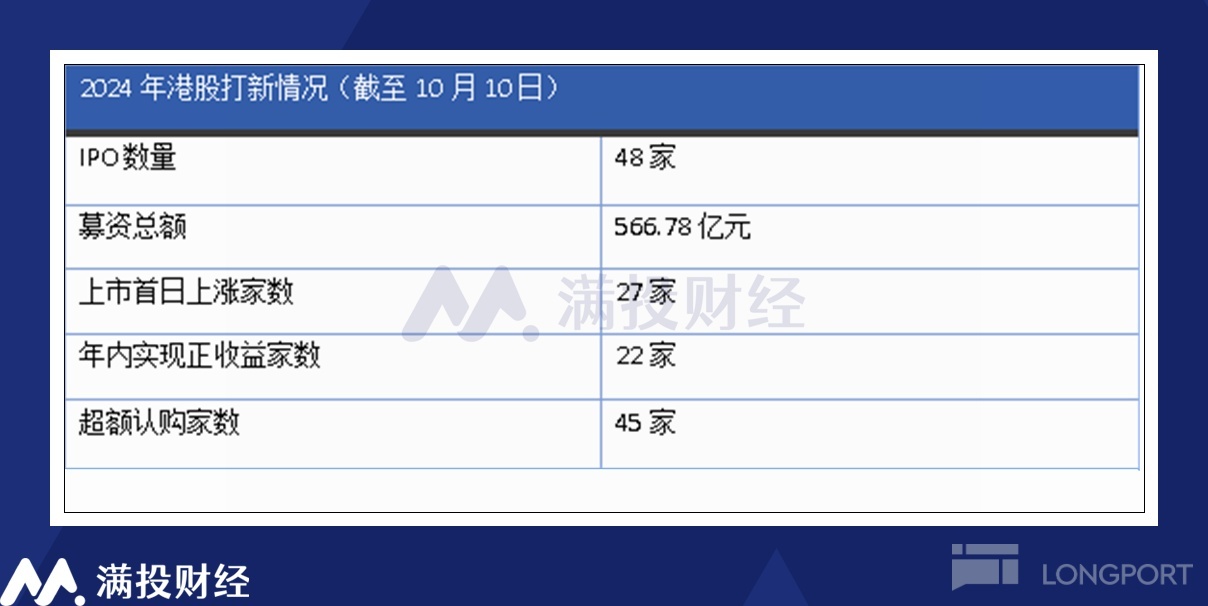
The 48 Hong Kong-listed companies raised a total of HKD 57 billion, surpassing last year's figures. A significant portion of this fundraising was driven by the secondary listing of Midea Group (00300.HK). While the listing of such large-cap companies has eased IPO sentiment in Hong Kong, excluding Midea Group, the IPO scale in 2024 has been disappointing, with only seven companies raising over HKD 1 billion.
Excluding Midea Group, the top five companies by fundraising were ChaPanda (02555.HK), Xirui (02507.HK), RoboSense (02498.HK), Ruqi Mobility (9680.HK), and Lao Feng Xiang (06181.HK). However, from a year-to-date profit perspective, only Lao Feng Xiang doubled its issue price, while the other four stocks posted negative returns.
Despite the lackluster market performance, the fundraising scale of Hong Kong IPOs has actually improved compared to last year. With recovering market confidence, the IPO environment in Hong Kong is expected to improve. Currently, around 100 companies are queuing for IPOs on the Hong Kong Exchange, including well-known names like China Resources Beverage (parent company of C'estbon), Xiaocaiyuan, Green Tea Restaurant, and Tongrentang Medical Care.
In terms of subscription enthusiasm, the Hong Kong market in 2024 has not been bad. Most new listings were oversubscribed, with some like UB Group Holdings and Lao Feng Xiang seeing astonishing multiples. According to Wind data, 33 IPOs achieved oversubscription multiples of over 10x.
It is foreseeable that with the recovery of capital flows, the IPO environment for Hong Kong investors will warm up. Although the market is currently in a correction phase, the author believes that with the Fed's rate cut expectations solidifying, overseas interest in Hong Kong IPOs may increase. Looking ahead to the rest of 2024, the returns from high-quality IPOs could be promising.
02
Domestic Capital Pool Continues to Drive Growth, Focus on the 'Chinese-Style' Changes in Hong Kong Trading
Over the past decade, the linkage between the Hong Kong and A-share markets has grown closer through continuous policy iterations. The launch of Stock Connect has facilitated cross-border capital flows, while the gradual relaxation of foreign investment restrictions and the establishment of the Mainland-Hong Kong market linkage mechanism have made Hong Kong a preferred listing destination for many companies.
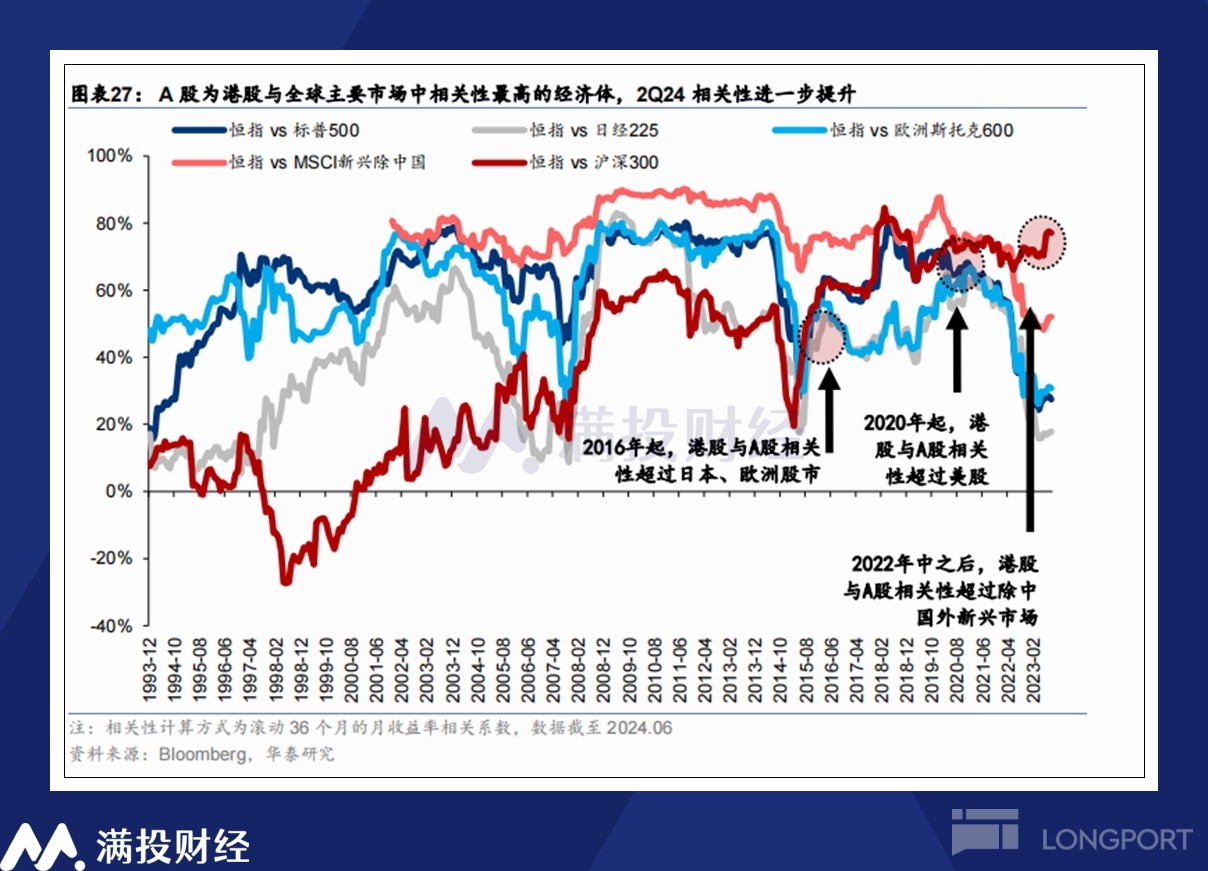
Historically, the Hong Kong market has been characterized by "short bears and long bulls," with higher internationalization and institutionalization leading to greater maturity and long-term upward trends. However, with the deepening of market linkages, the correlation between A-shares and Hong Kong stocks has risen rapidly, and their characteristics are gradually converging. Since 2021, the trend has been more about Hong Kong aligning with A-shares.
Despite the convergence in trends, Hong Kong and A-shares still differ in trading mechanisms. Hong Kong adopts a T+0 system with no price limits (only cooling-off periods for rapid fluctuations) and flexible margin trading, offering greater trading freedom. In contrast, while A-shares have gradually widened price limits to 20% and adjusted delisting mechanisms, their trading rules remain relatively conservative.
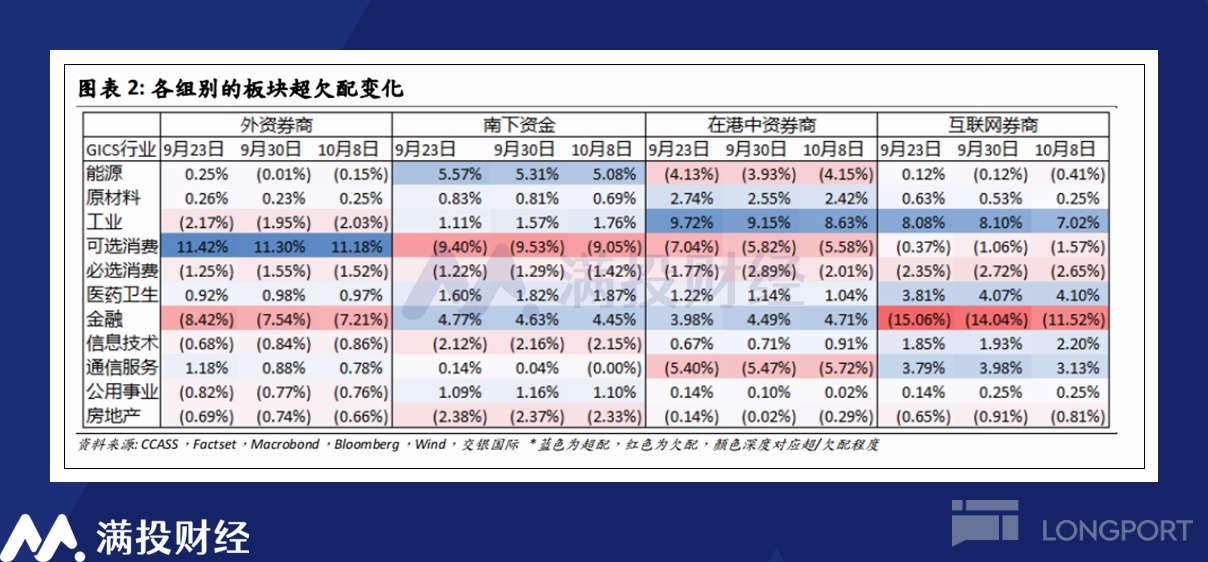
As domestic capital's influence in Hong Kong grows, the market may increasingly reflect "Chinese-style" characteristics in sector rotation and IPO enthusiasm. According to BOCOM International, Chinese investors are generally overweight on financials and underweight discretionary consumer stocks, while foreign investors show the opposite preference. In future IPOs or sector rotations, the preferences of Chinese investors may become more pronounced. Thus, even Hong Kong-focused investors cannot afford to ignore domestic policy and economic trends.
Looking ahead, data validation will serve as a catalyst for both Hong Kong and A-share markets. After the central bank's RRR and rate cuts and further easing of property purchase restrictions, October's real estate data will be crucial. The recovery in holiday consumption data may also improve valuations for Hong Kong consumer stocks. Further fiscal support for consumption may be introduced, though its scale and form remain to be seen.
On the policy front, last Saturday's Ministry of Finance meeting unexpectedly signaled debt resolution measures, ensuring sufficient central leverage space and explicitly supporting land reserve policies. Talk of raising the deficit ratio further expands the macro environment for financial easing. While few specific figures were promised, the consistent policy direction—especially in promoting local fiscal easing—could lay the groundwork for fundamental improvements.
Moving forward, the late October NPC Standing Committee meeting will be the next policy milestone, with its potential to sustain policy support and boost risk appetite being key to the continuation of the domestic rally. Overseas, the U.S. election in early November will also impact Hong Kong. Overall, the author remains optimistic about the market's future performance, expecting further bright spots to aid economic recovery.
$Hang Seng Index(00HSI.HK) $MIDEA GROUP(00300.HK)
The copyright of this article belongs to the original author/organization.
The views expressed herein are solely those of the author and do not reflect the stance of the platform. The content is intended for investment reference purposes only and shall not be considered as investment advice. Please contact us if you have any questions or suggestions regarding the content services provided by the platform.
