


Top influencers on Douyin keep failing, and influencer livestream shopping has entered the 'garbage time'.

If we were to describe the current state of Douyin (TikTok) as "an eventful autumn," it might be all too fitting.
Not long ago, many livestreaming hosts faced setbacks. The aftermath of Crazy Yang Brothers had yet to settle when Northeast Rain Sister became embroiled in a scandal over fake sweet potato starch content. Some netizens visited her filming base in Benxi, Liaoning, only to find it deserted. In the end, Northeast Rain Sister was fined 1.65 million yuan for false advertising.
Shortly after, Xiaoying's family, who gained popularity by portraying a poor lifestyle, was also caught in a 造假 (fraud) controversy. Netizens discovered that Xiaoying was not just a rural woman on camera but also the chairman of a company. According to Jiupai News, over the past year, Xiaoying hosted over 200 livestreams, with sales exceeding tens of millions of yuan.
Many netizens lamented that this was not "recording a beautiful life" but rather "performing a beautiful life."
Then, Douyin launched "Tingquan Appraisal," which gained millions of followers in a short time but was soon exposed for questionable academic credentials,疑似 (suspected) appearance of museum artifacts in livestreams, and 疑似 (suspected) tomb raiders requesting appraisals. Some of its affiliated shops have since ceased operations.
The Tingquan Appraisal account has been offline for a week. The host never opened livestream sales and, before stopping, urged everyone not to idolize him excessively, emphasizing he was just an ordinary person.
Recently, the popular 带货主播 (livestreaming host) K 总 (K Boss) gained nearly 10 million followers in a month but was mysteriously banned three times during a livestream on October 13, affecting both his main and backup accounts. K Boss then announced a temporary hiatus for unknown reasons.
The speed at which 流量 (traffic) shifts from "creating idols" to "destroying idols" has accelerated to a daily cycle, revealing the state of Douyin's livestreaming and content ecosystem.
With public trust eroding, the efficiency of 网红主播 (influencer hosts) continues to decline. During this year's 618 shopping festival, some noticed that the performance of Douyin's top beauty hosts was halved compared to last year. The top influencer, Guangdong Couple, saw a significant drop in sales, while the new top influencer,贾乃亮 (Jia Nailiang), lacked their explosive appeal.
This Double 11, will 网红主播 (influencer hosts) recreate the "traffic 神话 (myth)" or burst the "traffic 泡沫 (bubble)"?
Livestreaming 带货 (sales) has entered 垃圾时间 (garbage time).
During this year's 618, renowned e-commerce KOL Ni Shu wrote on his public account: "China's e-commerce industry has gradually 沦为 (degenerated into) a third-rate industry, reaching a point where change is inevitable."
Ni Shu mentioned that many top hosts saw a 70% drop in performance. Past successes were propped up by brands investing in traffic, but now brands can no longer afford such losses.
This observation was validated by the performance of Douyin's top hosts during this year's Double 11.
This year's Double 11 started earlier than ever. While Taobao and 京东 (JD.com) began sales on October 14, Douyin's top hosts started 抢跑 (jumping the gun) right after the National Day holiday.
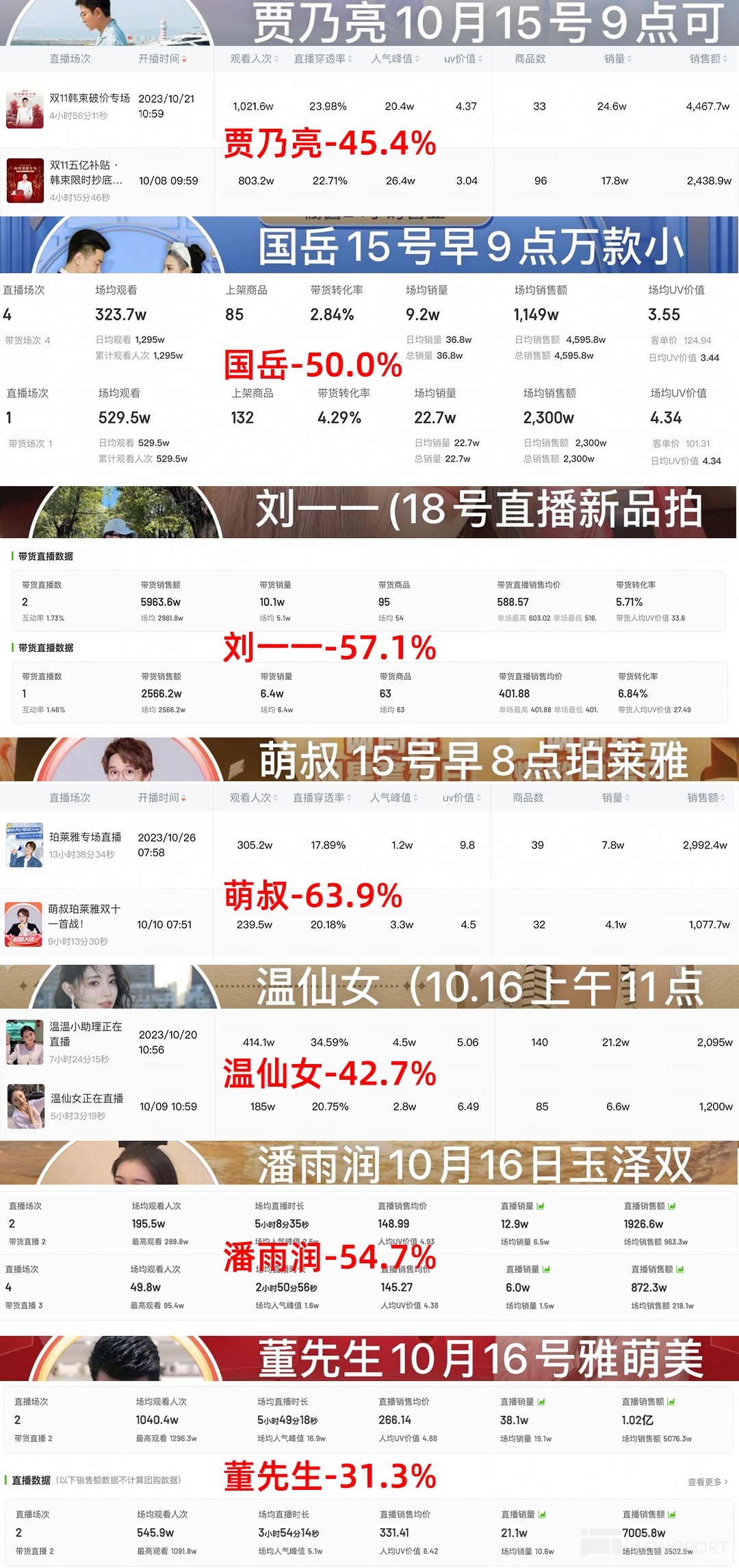
But 抢跑 (jumping the gun) didn’t fire the first shot—it 更像 (more like) a stumble. E-commerce media noted that Double 11 performance declined even further.
(Reposted from "E-commerce Industry")
After 抢跑 (jumping the gun), many top hosts' performance fell short of their 2023 Double 11 debut and even lagged behind this year's 618, which lacked platform promotions.
Mr. Dong grew rapidly from 618 onward, showing potential as a new top host, but stumbled with Blue Moon. In May, Blue Moon collaborated with Mr. Dong on a 预热 (pre-launch) ad with the tagline "Mom, you try it first," which drew backlash from women tired of unequal household burdens.
Analyzing the 本质 (essence) of livestreaming 带货 (sales), the downfall of Crazy Yang Brothers and Northeast Rain Sister was inevitable. Similarly, the plummeting sales of hosts like Mr. Dong were predictable.
Livestreaming 带货 (sales) gained traction because it aggregated 活跃流量 (active traffic), especially from content creators with 先天优势 (inherent advantages). This 流量 (traffic) is unmatched by traditional e-commerce players.
Douyin's 抢跑 (jumping the gun) led to a disastrous start, toppling the first domino in its 流量困局 (traffic dilemma). The 流量假象 (traffic illusion) it built will continue to collapse.
Core Categories Falter: Does Livestreaming 带货 (Sales) Have a 护城河 (Moat)?
On October 8, Douyin Mall launched its "Double 11 Early Shopping Festival."
From the host lineup and product categories, Douyin placed heavy bets on 抢跑 (jumping the gun). It started 最早 (earliest) on October 8 and assembled a strong 阵容 (lineup).

The first 预告 (preview) featured Douyin's beauty "king"贾乃亮 (Jia Nailiang) and 韩束 (Hanshu), the benchmark for beauty sales—a 王炸 (winning combo) in Douyin's strongest category.
But 仔细分析 (upon closer inspection), only 超级头部 (super top) hosts or those with 明星光环 (celebrity appeal) were featured. Others, like 东方甄选 (Dongfang Zhenxuan) and 黄奕 (Huang Yi), were overshadowed.
This move revealed Douyin's intent to leverage its best resources for a 梦幻开局 (dream start). Its fate rested on these 超级头部 (super top) hosts.
Yet, their performance was underwhelming.
During the 预售期 (pre-sale period), over half of the "big shows" saw year-on-year declines in sales, with beauty and apparel hit hardest.
贾乃亮 (Jia Nailiang) and 韩束 (Hanshu)'s combo was supposed to be a 自信 (confident) opener but turned into a 哑炮 (dud).
E-commerce bloggers on Xiaohongshu shared 第三方数据 (third-party data): the livestream generated 23.52 million yuan in 4 hours and 15 minutes, nearly 10 million yuan less than their 618 performance (33.37 million in 3 hours and 49 minutes) and far below last year's Double 11 专场 (special session) (45.389 million).
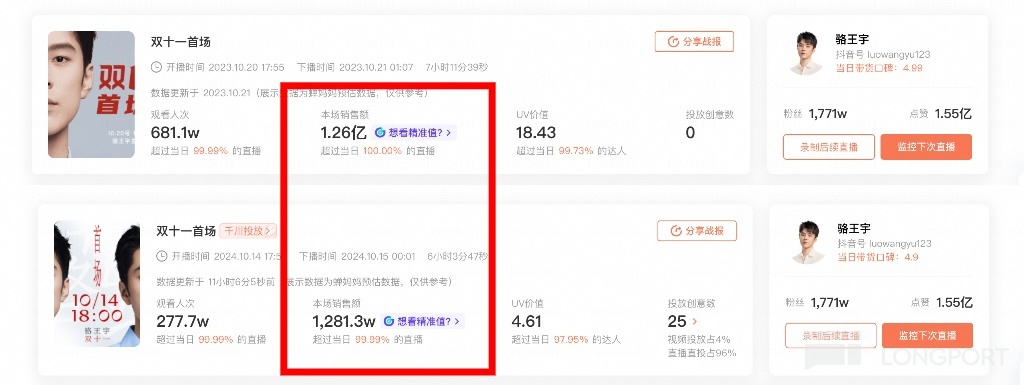
Some hosts vanished from rankings. Luo Wangyu announced his return months after 退网 (quitting), but viewers weren’t buying it—his daily sales dropped off the charts.
On Double 11's debut night, Luo's livestream drew 2.7 million views, peaked at 32,000 viewers, and sold 59,000 orders (12.7959 million yuan GMV). Notably, he lost 7,000 followers (from 17.718 million to 17.711 million).
Overall,蝉妈妈 (Chanmama) data showed Luo's sales plummeted from 126 million yuan last year to 12.813 million—a 90% drop.
If beauty hosts' struggles were an 意外 (accident), other categories fared no better.
Liu Yiyi, Douyin's apparel "queen," saw sales shrink by 60%—even after Douyin relaxed 低价 (low-price) policies for 非标品 (non-standard products) like clothing and increased subsidies.
If beauty and apparel struggled, other categories fared worse.
Douyin's 抢跑 (jumping the gun) didn’t deliver a 梦幻开局 (dream start)—it exposed deeper issues.
Traffic Model Fails: What Is Livestreaming 带货 (Sales)'s 核心竞争力 (Core Competency)?
Douyin's recent problems reflect its 流量生意 (traffic business) entering decline.
In August, Nomura Securities highlighted Douyin's slowing growth: Q2’s year-on-year growth fell below 25% (vs. Q1’s 55%), jeopardizing its 30% GMV target for 2024.
Reasons for slowdown: (1) Traffic plateau; (2) Diminishing returns from 低价 (low-price) 策略 (strategies), even backlash.
Since H1 2024, Douyin's DAU and video views stagnated, while live-streaming 剪辑 (clips) declined year-on-year.
低价 (Low-price) tactics boosted user numbers but hurt order values. July’s MAC rose 23% year-on-year, but AOV fell 10%. Strict 低价 (low-price) policies squeezed 商家 (merchants)' profits, fueling resentment.
Ni Shu noted during 618: brands now refuse to slash prices or invest in 投流 (traffic buys). What seemed like hosts' appeal was actually 商家 (merchants) funding the hype.
Relying solely on 流量 (traffic) and 投流 (traffic buys) without building brand awareness will doom Douyin livestreaming. This year’s 天崩开局 (disastrous start) is just the beginning.
Douyin’s beauty segment, its pride, now exposes its 流量困局 (traffic dilemma).
Beauty thrived on 流量 (traffic), which is 生命线 (its lifeline). How do 商家 (merchants) get 流量 (traffic)? Simple: pay for it.
The rise of "Xiamen Gang" in beauty exemplifies this.
Take Dr. Wen, a standout in the Xiamen Gang, as an example of how 投流 (traffic buys) enable 韭菜收割 (exploiting naive investors).
Dr. Wen’s parent company, Haini Group, told media: "A single brand’s biggest cost on Douyin is 投流费 (traffic buy fees)."
Industry sources estimate 投流费 (traffic buy fees) can reach 60–70% of sales for 某些品类 (some categories). With single-digit margins, profits rely on Douyin’s ad rebates.
Chanmama data estimates Dr. Wen’s 投流费 (traffic buy fees) at tens of millions. Yet Haini Group doubled down, using 淘宝 (Taobao) and 京东 (JD.com) to maximize 流量效用 (traffic utility).
白牌 (White-label) brands spend over 80% of sales on 投流 (traffic buys). By July,商家 (merchants) reported 投流成本 (traffic buy costs) tripling since late May. Brands survive on 自然流量 (organic traffic), but 白牌 (white-label) players must exit.
Even top hosts recognize this.广东夫妇 (Guangdong Couple), who partnered with 贾乃亮 (Jia Nailiang) last Double 11, now sell 洗衣粉 (detergent). But their September 24 专场 (special session) barely cleared 10 million yuan.
Clearly, Douyin’s beauty ecosystem is a 骗局 (scam) of 虚假宣传 (false advertising). Many enter, but few survive. Douyin’s decline began here.
As "投机 (speculation)" and "投流 (traffic buys)" escalate, Douyin’s 流量生意 (traffic business) hits a dead end.
Per《中国企业家》(China Entrepreneur), Dr. Wen’s biggest cost is 投流费 (traffic buy fees).商家 (Merchants) spend 60–70% of sales on 投流 (traffic buys), leaving profits reliant on ad rebates.
Beyond 投机 (speculation) and 投流 (traffic buys), Douyin’s content-platform nature clashes with e-commerce,反噬 (backfiring) on user experience.
As users vote with their feet and 流量池 (traffic pools) stagnate, Douyin’s 流量生意 (traffic business) reaches its 尽头 (end).
Business boils down to 人性 (human nature) and 常识 (common sense).
This Double 11, Li Jiaqi seems back on track. By 6 PM on the 14th, his 预售加购 (pre-sale orders) rose over 20% year-on-year.
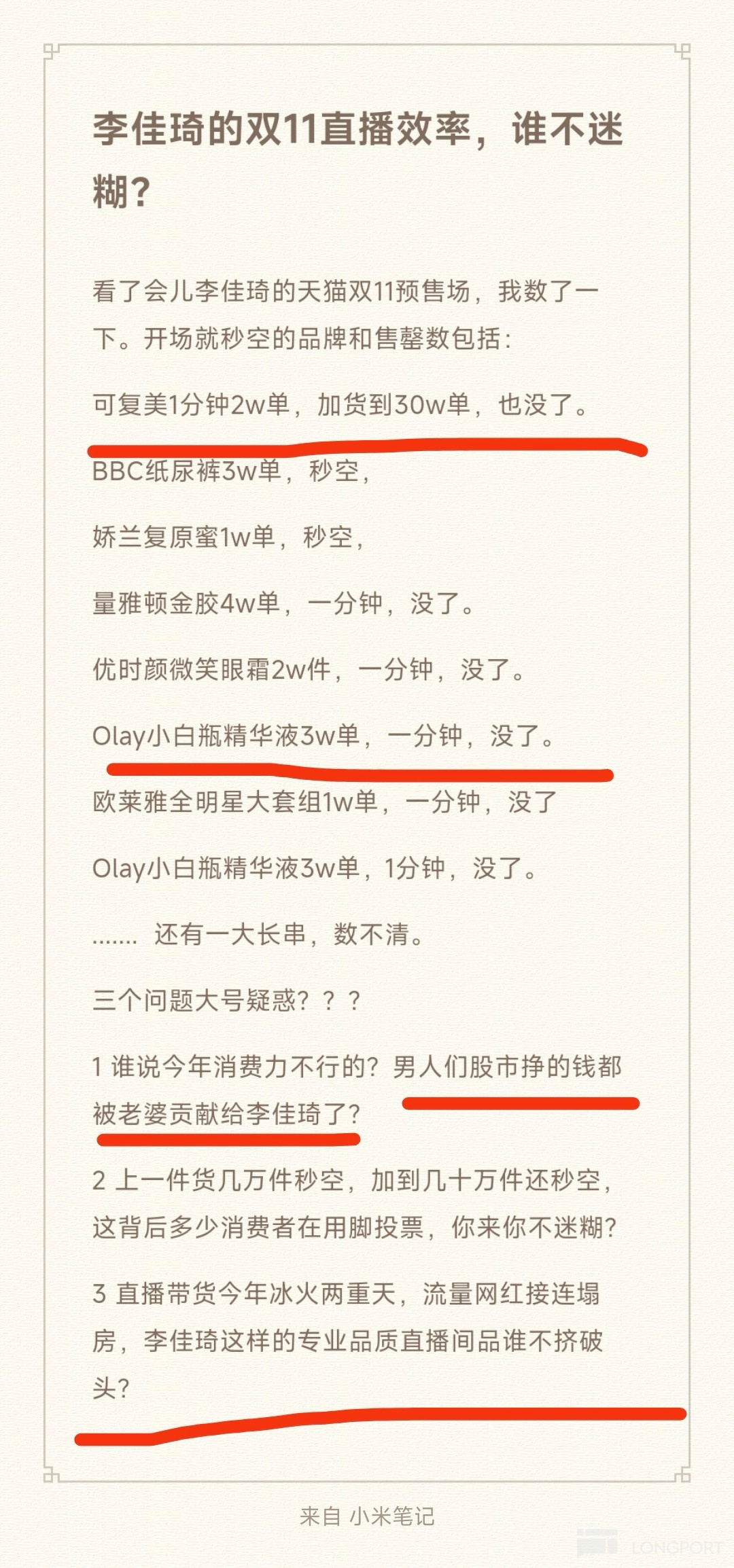
Qingyan Intelligence’s data aligns: 259 products surpassed 10 million yuan GMV (up 21.6% year-on-year), and 21 brands exceeded 100 million yuan (up 16.7%).
Amid 消费下行 (slumping consumption), user growth has stalled. Li’s gains suggest 直播间 (livestream) shoppers are migrating to him.
After all, he’s among the few top hosts with no quality scandals or 虚假宣传 (false advertising).
His products are 旗舰店 (flagship store) items. Brand recognition and store 背书 (endorsements) lower 决策成本 (decision costs). He doesn’t need hype—just clarity on 机制 (mechanisms) and products, leveraging his 专业特长 (expertise).
Business isn’t about "having it all." Platforms must focus on core operations.$Alibaba(BABA.US) $JD.com(JD.US)
The copyright of this article belongs to the original author/organization.
The views expressed herein are solely those of the author and do not reflect the stance of the platform. The content is intended for investment reference purposes only and shall not be considered as investment advice. Please contact us if you have any questions or suggestions regarding the content services provided by the platform.
