


 Rate Of Return
HK IPO: Analysis of China Resources Beverage's IPO

This year, I mainly subscribed to Lao Feng Xiang Gold, Midea, and Carote. China Resources Beverage was something I was particularly looking forward to, and it is very likely to be the fourth major IPO subscription.
But now the subscription strategy has changed.
The main reasons are as follows:
1. Competitive Landscape.
Many people don’t have a concrete impression of China Resources Beverage. But if we mention "C'estbon" bottled water, everyone should be familiar with it. Here’s an image.
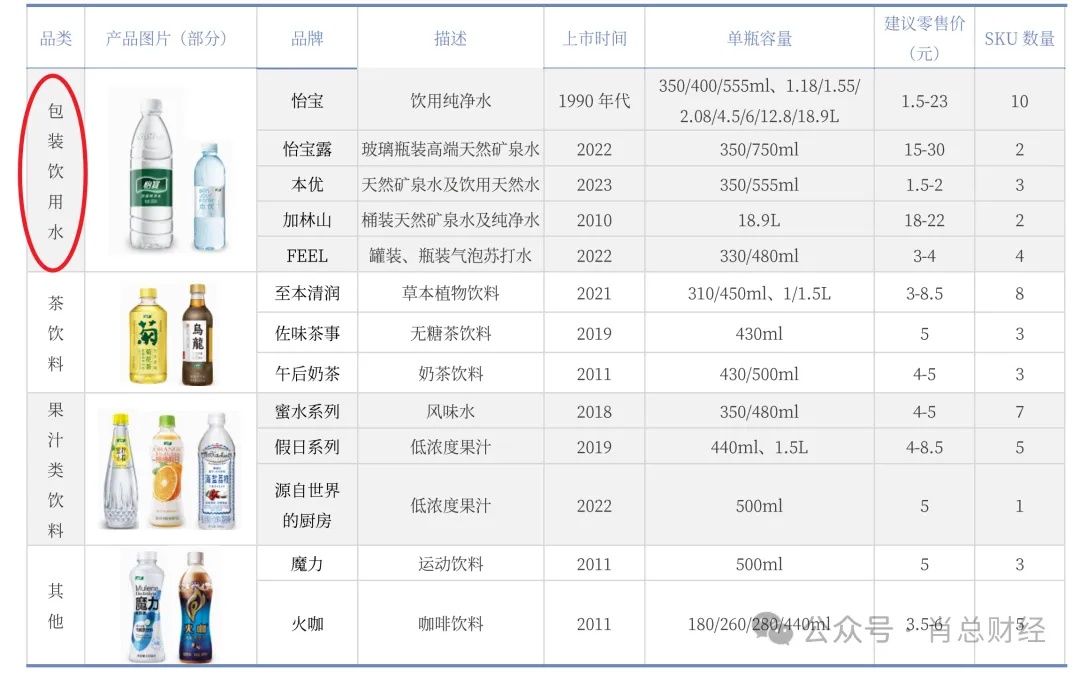
Simply put, China Resources Beverage is the company selling the products shown in the image above. The main product is the "packaged drinking water" circled in red.
The market for "packaged drinking water" is highly homogeneous and competitive. By the end of 2023, there were over 15,000 purified drinking water manufacturers in China.
China Resources Beverage holds an 18.4% market share in packaged drinking water, ranking second nationwide. The leader is Nongfu Spring, with a 23.6% market share.
However, China Resources leads in the purified drinking water segment with a 32.7% market share. Purified drinking water refers to the commonly seen "C'estbon" series.
Over 90% of China Resources Beverage’s revenue comes from "packaged drinking water," with the core business being the "C'estbon" purified water series.
Therefore, we focus on analyzing China Resources’ "C'estbon purified water" business.
The reason China Resources achieved a leading 32.7% market share in purified water is largely because Nongfu Spring’s product focus isn’t on the "purified water" niche.
However, in the first half of this year, Nongfu Spring launched its "green bottle" purified water series, a direct competitor to China Resources’ "C'estbon."
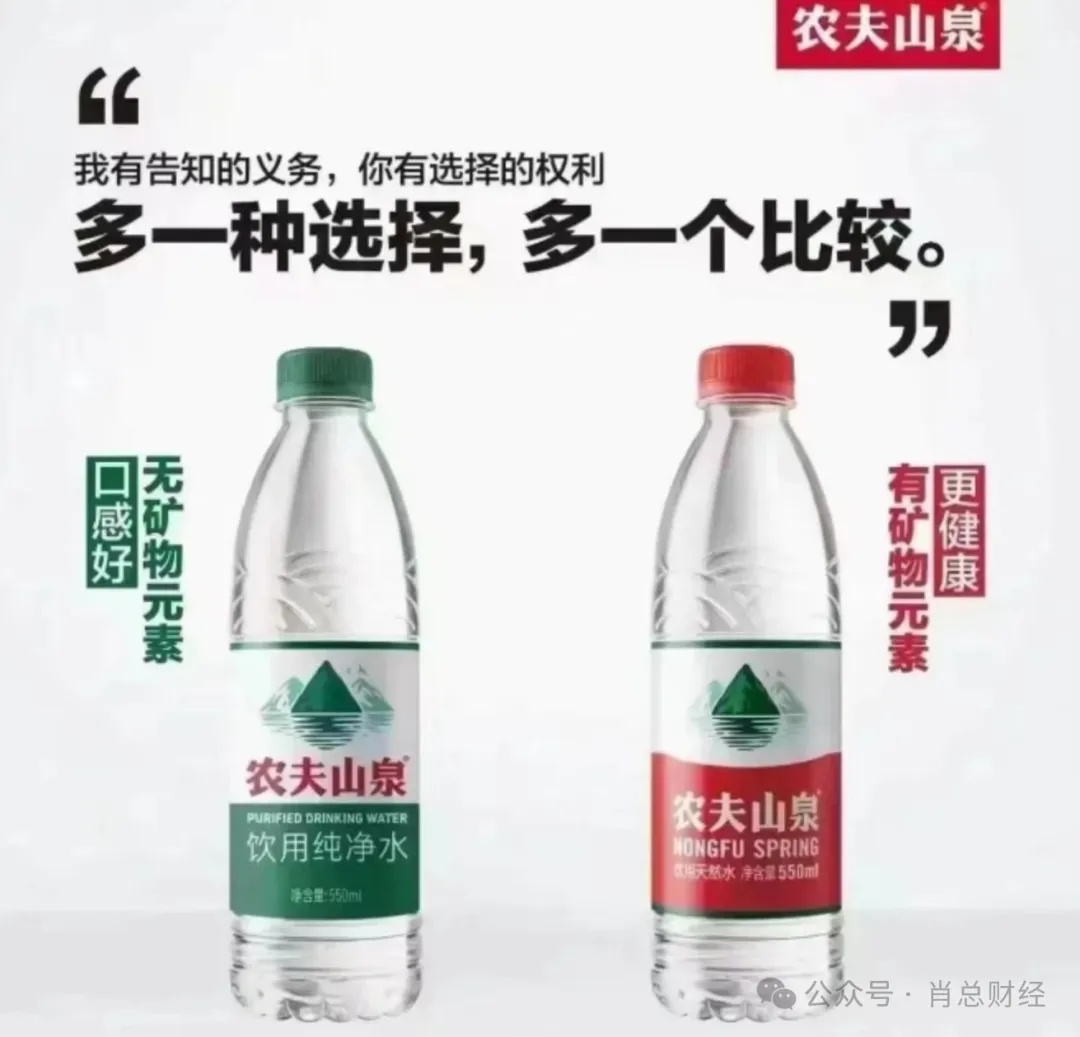
Compared to "C'estbon," the green-bottle Nongfu Spring is priced lower, with a retail price difference of about 0.5 yuan. With the competition from Nongfu’s "green bottle," "C'estbon’s" market share in purified water will inevitably be eroded. To maintain market share, price wars may be necessary, which would sacrifice some profits.
If the leading position in purified water is threatened, China Resources will need to strengthen its competitiveness in the beverage market. Beverages currently account for about 10% of total revenue, leaving significant room for growth.
However, the beverage market is even tougher for China Resources. Not only is it hard to compete with the leader Nongfu Spring (e.g., Tea π, Oriental Leaf), but even brands like Master Kong and Wahaha outperform China Resources. Newcomers like Heytea and Genki Forest add to the competition.
Apart from the "Zhiben Qingrun" chrysanthemum tea series launched in 2021, China Resources’ other beverage products are barely known.
Of course, one of the main purposes of this IPO is to enhance the competitiveness of its beverage product line. The downside is its current weak position, but the upside is the potential for significant improvement.
2. Financial Fundamentals.
In terms of scale, China Resources lags behind Nongfu Spring in revenue, gross margin, and net margin.
First, revenue.
From 2021 to 2023, Nongfu Spring’s revenue was 29.7 billion yuan, 33.2 billion yuan, and 42.7 billion yuan.
China Resources’ revenue was 11.3 billion yuan, 12.6 billion yuan, and 13.5 billion yuan.
Next, gross margin.
From 2021 to 2023, Nongfu Spring’s gross margin was 59.5%, 57.5%, and 59.5%.
China Resources’ was 43.8%, 41.7%, and 44.7%.
Finally, net margin.
From 2021 to 2023, Nongfu Spring’s net margin was 24%, 25.5%, and 28.3%.
China Resources’ was 7.6%, 7.8%, and 9.8%.
The revenue gap is understandable, mainly because China Resources’ product lineup is relatively singular, relying heavily on the "C'estbon" purified water series. Nongfu Spring, on the other hand, has a more diversified product range, including its red-bottle natural drinking water and a significant beverage portfolio.
The main explanation for the profit margin gap lies in their corporate structures. China Resources is a state-owned enterprise (SOE), while Nongfu Spring is privately owned. SOEs tend to be more "comfortable," sometimes lagging in efficiency.
Facing intensified market competition in recent years, China Resources Beverage has increased capital expenditures to expand its own production capacity.
National expansion requires supporting production capacity. Unlike Nongfu Spring, which produces in-house, over 65% of China Resources’ packaged drinking water output relies on outsourced manufacturing, meaning part of the profits is deducted as outsourcing fees. The acceleration of in-house capacity construction has significantly increased capital expenditures.
3. Shareholding Structure.
The IPO price is set at HKD 13.5–14.5 per share, with 200 shares per lot. A total of 348 million shares are being issued, with 11% for public offering and 89% for institutional placement. The market capitalization at issuance is HKD 31.7–34 billion, raising HKD 4.7–5.04 billion.
The public offering is expected to be oversubscribed by 130x, triggering a 40% clawback. Cornerstone investors account for about 50%, leaving only 10% for institutional placement.
The 40% clawback in the public offering amounts to roughly HKD 2 billion. For comparison, Midea’s public offering was only HKD 1.35 billion.
Given the current market conditions, selling pressure is high.
As for institutional placement, the data isn’t public. Rumors suggest it’s already oversubscribed by 18x, but from what I’ve heard, it’s not as hot as the market claims.
China Resources passed its hearing on September 25. The subscription period was originally set for early October but was delayed by over a week, partly due to pricing issues. During the inquiry, the market was favorable, and they aimed to raise HKD 8 billion, but many institutions weren’t interested, so they settled for HKD 5 billion.
After finalizing the price, the market started declining again...
Fortunately, China Resources’ fundamentals are relatively straightforward to analyze, and there’s a comparable peer in Nongfu Spring. Nongfu’s current PE is around 24x. If calculated based on 2023, China Resources’ PE is 22x, leaving little room. Based on 2024, it’s 18x, offering some upside.
Of course, valuation is somewhat subjective. In a bullish market, valuations rise; in a bearish one, they’re suppressed.
From a shareholding perspective, the public offering’s 130x oversubscription for such a large stock can’t be entirely from retail investors. Institutions unable to secure shares in the institutional placement likely turned to the public offering.
Many brokers also offered ample financing. One even increased the collateral requirement from 30% to 70%. Brokers have their own risk control systems, and the higher collateral suggests they see limited risk of the stock falling below the IPO price.
Initially, I planned to subscribe heavily with my main funds but decided to wait for the gray market. If the price drops more than 5%, I might buy in; otherwise, I’ll pass. The upside is that this stock should be relatively stable, likely fluctuating between -10% and +10%.
Based on current data, the lottery success rate for one lot is around 50%. A "B-head" might get about HKD 120,000.
Everyone should decide based on their risk appetite. Usually, I don’t write analyses for IPOs I don’t subscribe to. But since I previously mentioned it might be a major subscription, and now I’ve changed my strategy, I didn’t want to mislead my followers. With the subscription deadline tomorrow, I thought it best to share my thoughts quickly.
From a short-term arbitrage perspective, there’s some upside but not much. Long-term, I’m very pessimistic about the competitive landscape. In short, lower your expectations significantly!
The copyright of this article belongs to the original author/organization.
The views expressed herein are solely those of the author and do not reflect the stance of the platform. The content is intended for investment reference purposes only and shall not be considered as investment advice. Please contact us if you have any questions or suggestions regarding the content services provided by the platform.
