


 Rate Of Return
Tesla 2024 Q3 earnings report interpretation - electric vehicles are about to bottom out and rebound


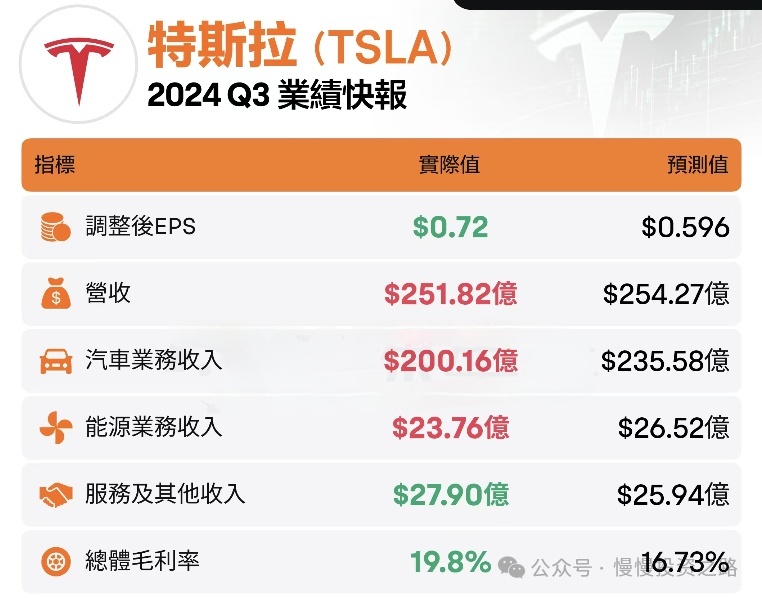
After the U.S. stock market closed yesterday, $Tesla(TSLA.US) released its Q3 2024 earnings report. The profit side exceeded market expectations, while the revenue side actually fell short of expectations. Since the delivery data was already known, the revenue gap wasn’t significant. The gross margin improved sharply to 19.8%, and net profit grew by 8%.
After the earnings release, Tesla's after-hours stock price surged by 12%, which was beyond my expectations. While the report was slightly better than expected, it wasn’t as exaggerated as Nvidia or Pinduoduo’s earnings, where net profits exceeded expectations by billions, easily justifying a 10% surge. Tesla’s earnings likely signaled that its core electric vehicle (EV) business has bottomed out and is rebounding. While AI and FSD (Full Self-Driving) are still being validated, the EV business has emerged from its slump. The 12% gain seems to reflect optimism about the EV segment!
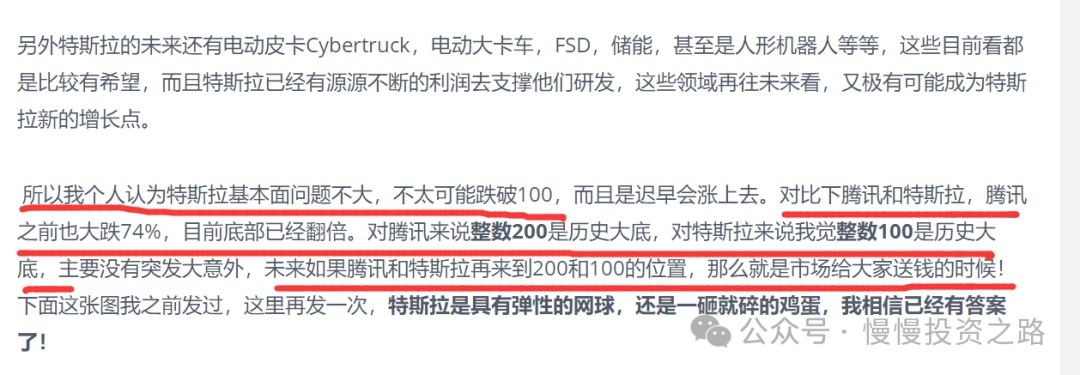
I’ve been tracking Tesla’s earnings for a long time and have written extensively about them, from when the stock was at $100 to $300. My core view remains unchanged: Tesla’s business is diversified. $100 was the historical bottom, $150 was undervalued, and anything above $150 reflects premiums for FSD, AI, and other new ventures—valuations that are hard to pin down accurately and rely heavily on imagination. I personally bought Tesla at $125 and $150 three times and sold around $200. While I missed gains above $200, I felt more comfortable holding at the bottom. Check out my previous articles if you’re interested:
Tesla Q1 2024 Earnings Breakdown—Buy on Divergence, Sell on Consensus
Tesla Q4 2023 Earnings Breakdown—The Fall of the EV Growth Myth and the Need for Revaluation
Is It Time to Bottom-Fish Tesla After the Big Drop?

Tesla—The Alpha Play in EVs: Tesla Q4 Earnings Preview
Tesla Q4 2022 Earnings Breakdown—The Answer to Tennis Ball or Egg
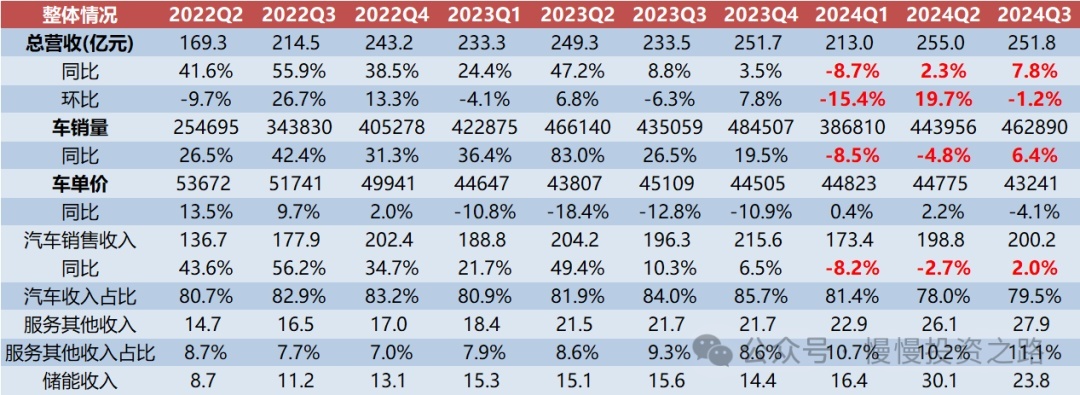
Let’s dive into Tesla’s earnings data for reference.
I. Overall Earnings Highlights
1. Revenue—Auto Revenue Growth Turns Positive, EV Business Nearing a Bottom
Tesla’s Q3 revenue was $25.18 billion, up 7.8% YoY—the highest growth in the last four quarters, just shy of double digits.
By segment, core auto revenue grew 2%. While a meager 2%, it’s finally back in positive territory. Despite no new models, deliveries grew 6.4%. While Tesla’s valuation isn’t heavily tied to EVs, they remain the foundation—auto revenue accounts for 79.5% of total revenue. Future growth in FSD and AI hinges on EVs. A 5% swing may not matter much, but 10% growth would be noticeable.
Before this quarter, Tesla’s EV business was under pressure: deliveries fell for two straight quarters, new models were delayed, Cybertruck volumes were low, and robotaxis were pushed to 2026. This quarter, deliveries rebounded, Cybertruck margins turned positive, and new models are on track for 2025. Musk said on the call: EV deliveries could grow 25%-30% in 2025. This suggests the EV business has bottomed out.
2. Margins—Gross Margin Improves Significantly
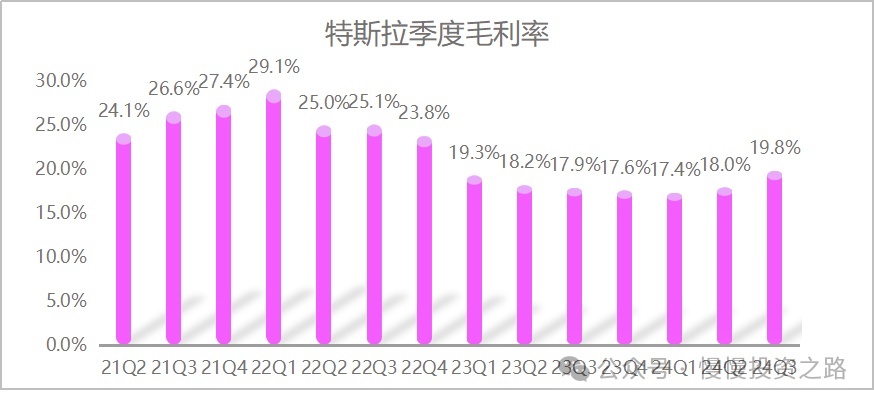
Tesla’s Q3 gross margin was 19.8%, up nearly 2% YoY. Excluding $739 million in regulatory credits, it was 17.1%, up from 14% last quarter—a clear improvement.

3. Net Profit—Growth Turns Positive After Four Quarters of Decline
Tesla’s Q3 non-GAAP net profit was $2.51 billion, up 8.1% YoY—the first positive growth after four quarters of declines, likely signaling a bottom.
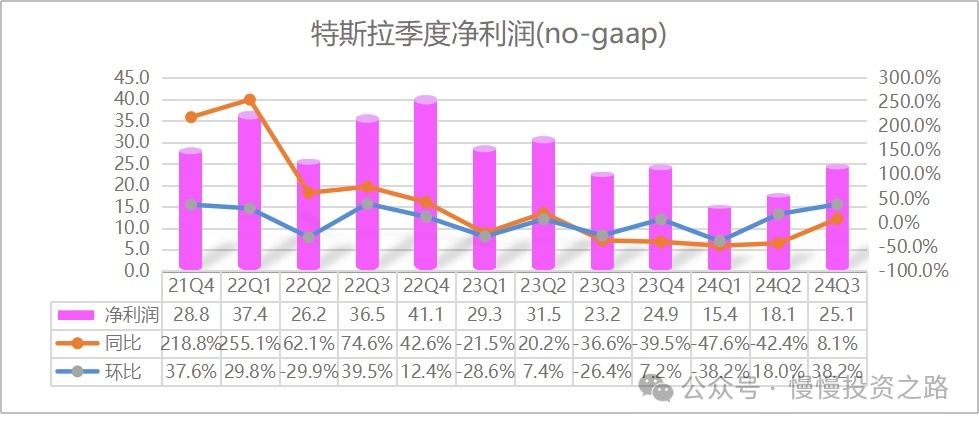
4. Expenses
Tesla’s Q3 total expenses were $2.28 billion, down 5.4% YoY, including R&D cuts.
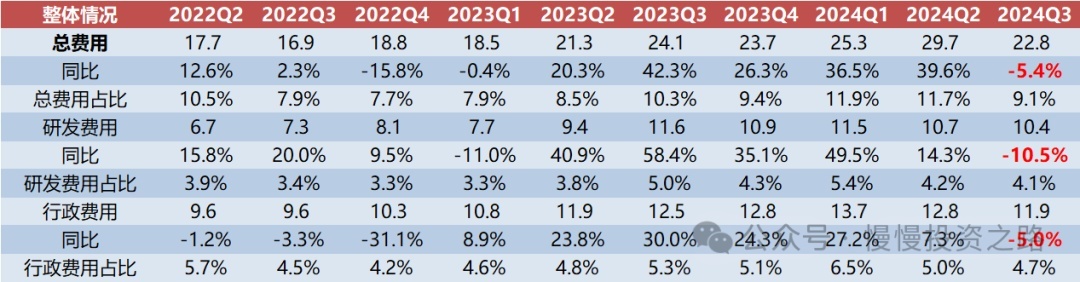
II. Key Takeaways from the Earnings Call
The numbers aren’t the most important—many were roughly in line, especially since delivery data was pre-released. “Beats” and “misses” are Wall Street’s game. Tesla’s earnings calls, where Musk speaks, are the real focus. Last quarter, his AI vision sparked a rally. Here are key call highlights:
1. New Models:
1) Cybercab: Could enter production in 2026, targeting 2-4 million units annually.
2) $25K Model: Possible launch in H1 2025.
3) Semi: All deliveries (~200 units) have FSD. Mass production starts in 2025, with a new factory likely in 2025 and full production in 2026.
4) Roadster: Design nearly complete, but lower priority.
2. FSD:
1) Upgrades: FSD v13 coming soon, with 5-6x longer intervention intervals than v12.5. By Q2/Q3 2025, FSD safety could surpass humans. End-to-end optimizations and hardware upgrades will be visible from January 2025.
2) Current Models: Model 3/Y software will see major improvements.
3) Marketing: Another 30-day trial will boost adoption.
4) Robotaxi: Launching in Texas in 2025, possibly California by late 2025, with a mix of Tesla-owned and owner-deployed fleets.
5) Unsupervised FSD: Expected approval in California and Texas in 2025 for HW3.0/4.0. Federal compliance is likely.
6) Hardware: HW3 may not meet unsupervised FSD safety standards. Tesla will upgrade HW3 FSD buyers to HW4 for free.
3. Compute: We’re expanding AI training for FSD and robots. No compute constraints—critical. We’ve begun using Austin’s GPU cluster and will deploy 50,000 more GPUs in Texas by month-end.
4. 4680 Batteries: Made progress on production lines, produced 100 million cells in Q3, and improved dry-coating tech. U.S.-made 4680 packs are cost-competitive post-incentives/tariffs. We won’t rely solely on in-house production.
5. Robots: Tesla has the most advanced humanoid robot, with all core elements (AI brain, mass production) unmatched by rivals. Optimus could become Tesla’s most valuable product.
III. Closing Thoughts
Tesla’s earnings showed profit upside, but numbers are Wall Street’s game. For investors, the key takeaway is that the EV business, after quarters of weakness, may have bottomed—a positive signal. Tesla has held its ground despite no new models amid fierce competition. With deliveries rebounding and new models coming in 2025, EV growth seems assured.
That said, EVs alone can’t justify Tesla’s 60x P/E. At least half the valuation premiums AI and FSD. Tesla is more than an EV company—it’s about when to buy, not if. Personally, $300 wouldn’t surprise me, but I wouldn’t buy above $200 given the AI/FSD premium. My ideal entry is ~$150 (maybe $180). Below is my unchanged view from prior earnings:
Pre-earnings delivery data makes results predictable. Small misses/beats are noise. Investing in Tesla requires looking beyond EVs—their numbers are known, and the business is mature. At 30x $8B earnings, EVs justify ~$240B. The rest? AI, FSD, Robotaxi, robots, and energy. FSD adoption is nascent but will grow. Robotaxi leadership is Tesla’s to lose—far ahead of rivals like Baidu’s Apollo Go. Robots are long-term. Roughly, $150 = EVs + energy + pre-breakout FSD. Above $150 = AI dreams. $150 is cheap; $200+ requires faith!
Disclaimer: This is personal opinion, not investment advice. Original content—likes and follows are the best support!
The copyright of this article belongs to the original author/organization.
The views expressed herein are solely those of the author and do not reflect the stance of the platform. The content is intended for investment reference purposes only and shall not be considered as investment advice. Please contact us if you have any questions or suggestions regarding the content services provided by the platform.
