


The stock price fell below the IPO price, with a loss of 1.238 billion yuan in the first half of the year, further demystifying AI drug development for XtalPi.

Perhaps "escaping" AI drug development is the better choice?
Source|Pharmaceutical Research Society
Regarding AI drug development, the capital market is torn between expecting it to revolutionize the industry and maintaining a conservative, hesitant stance. This isn’t contradictory—after all, there’s still a lot of bubble in the AI drug development field. "Cautious optimism and learning to demystify" might be the lower-risk choice.
Moreover, the current state of related companies continues to warn investors of risks. Take XtalPi, the "first AI drug stock," as an example. As of November 19, XtalPi’s stock price closed at HKD 4 per share, below its IPO price of HKD 5.28.
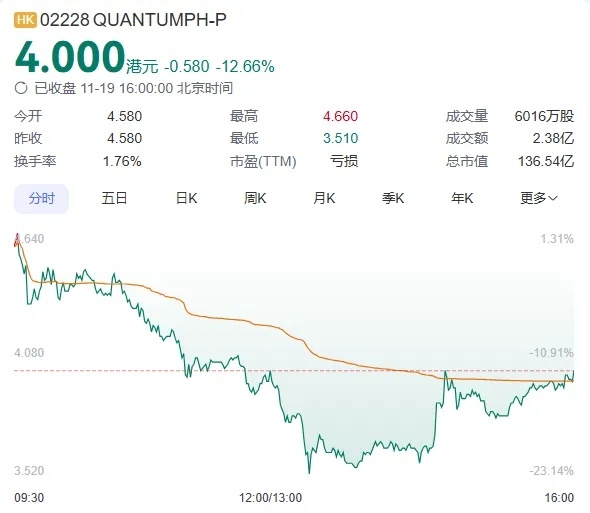
Clearly, XtalPi has fallen below its IPO price. So, what hidden risks exist in the company’s development? Where is AI drug development headed in the future?
I. Is the Value of AI Drug Development About "Cost Reduction and Efficiency Improvement"?
In the primary financing market, AI drug development is indeed a hot concept.
According to Zhiyaoju data, in Q3 2024, 33 AI drug-related companies globally completed new rounds of financing, with a total disclosed amount of approximately $1.327 billion (about RMB 9.312 billion).
Focusing on XtalPi, after years of development, it has completed 8 rounds of financing from Pre-A to Series D, raising a total of $732 million (about RMB 5.29 billion). Backers include Tencent Investment, Sequoia China, China Life Private Equity, and CITIC Capital, among others.
Why is AI drug development so popular? The reason is simple—it boils down to "technological value."
Specifically, drug development isn’t easy. Bringing a new drug to market requires massive investments in manpower, resources, and capital, along with a long waiting period for results—with no guarantee of 100% success. In this context, AI’s value in "cost reduction and efficiency improvement" becomes evident.
According to NVIDIA’s public data, AI technology can shorten early-stage drug discovery time to 1/3 and reduce costs to 1/200. Based on this, the commercial prospects of AI drug development are vast. McKinsey Global Institute (MGI) estimates that generative AI could bring $60-110 billion in annual economic value to the pharmaceutical and healthcare industries.
But these are optimistic projections. Only companies truly in the AI drug development space know how hard it is to unlock growth.
II. Unstoppable Losses Reveal the "Reality" of AI Drug Development
XtalPi is a prime example. According to financial reports, from 2021 to 2023, the company’s revenue was RMB 627.99 million, RMB 1.33 billion, and RMB 1.74 billion, respectively. Net losses were RMB 2.137 billion, RMB 1.439 billion, and RMB 1.906 billion, totaling RMB 5.48 billion in cumulative losses.
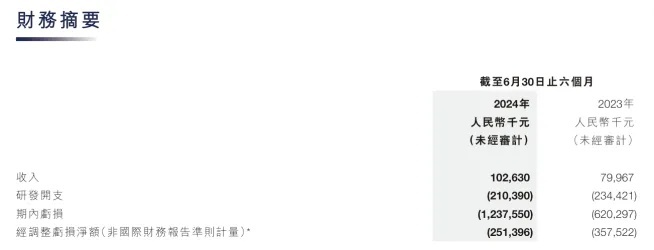
In the first half of 2024, XtalPi’s revenue reached RMB 1.03 billion, up 28.3% YoY, while losses hit RMB 1.238 billion, nearly doubling from the same period last year. The poor performance reveals the "tip of the iceberg" in AI drug development.
Globally, companies focused on "AI drug development" fall into three categories: AI Biotech, AI SaaS, and AI CRO. XtalPi belongs to the third category, primarily using AI to provide drug discovery solutions and intelligent automation solutions for traditional pharmaceutical companies. This business model carries some unavoidable risks.
First, AI drug development is still in its early commercial stages, with immature technology. To gain customer trust, companies must continuously increase R&D investment to build competitive barriers.
XtalPi’s R&D expenses have remained high in recent years. Reports show that from 2021 to 2023, R&D expenses were RMB 2.13 billion, RMB 3.59 billion, and RMB 4.81 billion, accounting for 338.5%, 269.2%, and 275.6% of revenue, respectively, and about 52.4%, 53.5%, and 49.8% of total operating expenses—squeezing profit margins.
Second, CRO companies are affected by the innovation drug industry’s cyclicality. In the first half of 2024, the industry’s momentum wasn’t strong.
Yaozhi data shows that in Q1 2024, there were 57 financing events in China’s new drug sector, totaling RMB 9.401 billion—a significant drop compared to previous years. With limited "ammunition," innovation drug companies struggle to advance R&D, inevitably reducing outsourcing demand for CRO firms.
Third, competition in the AI CRO space is fierce. On one hand, a wave of AI drug startups is emerging, while traditional CRO players like WuXi AppTec and Medicilon are integrating AI into their businesses. On the other hand, tech giants like Microsoft, Oracle, NVIDIA, and Amazon are eyeing a slice of the AI CRO pie. In this tense environment, XtalPi faces significant challenges in market expansion.
Overall, under multiple pressures, XtalPi remains in the early stages of commercialization. To survive the shakeout, the company has had to make new choices.
III. The Next Step: "Escaping" AI Drug Development?
Currently, XtalPi’s clear move is entering the new energy sector.
According to its financial report, in August 2024, XtalPi signed a five-year strategic R&D cooperation agreement with GCL Group. The collaboration includes joint R&D in new energy materials, AI large models for the new energy sector, and robotic automation systems.
XtalPi stated, "This partnership will combine our unique AI expertise with GCL’s technical R&D strengths, focusing on perovskite, lithium-ion batteries, cathode materials, and carbon-silicon materials. Leveraging advanced language models and multi-agent systems, we aim to create customized large models + automation platforms to drive industrial intelligence and paradigm upgrades in AI-powered new energy R&D."

For XtalPi, this expansion could help it escape the losses of AI drug development and find new growth. However, the company initially attracted investors by riding the AI drug wave. Now, as the "first AI drug stock" shifts direction, it sends a somewhat pessimistic signal of "escaping" AI drug development.
As AI drug companies return to reality, the investment market may decisively enter a "bubble-squeezing" phase.
The copyright of this article belongs to the original author/organization.
The views expressed herein are solely those of the author and do not reflect the stance of the platform. The content is intended for investment reference purposes only and shall not be considered as investment advice. Please contact us if you have any questions or suggestions regarding the content services provided by the platform.
