


The decline in both revenue and profit has led major institutions to lower their target prices. Does Sino Biopharmaceutical still have a 'paddle to ferry'?

The commercial value of the group's new drug R&D is still difficult to fully realize at this stage.
Source|Pharmaceutical Research Society
Recently, the performance of CSPC Pharmaceutical Group has been the focus of attention in the pharmaceutical industry. Core data shows the company has entered a clear slowdown period.
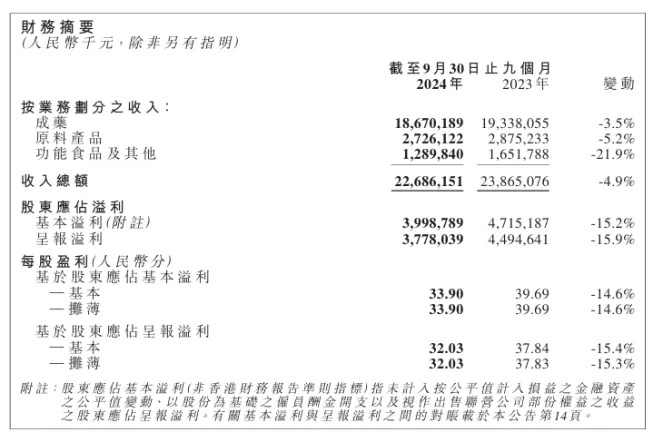
Financial reports show CSPC Pharmaceutical Group's revenue for the first three quarters was 22.686 billion yuan, down 4.9% YoY; net profit attributable to shareholders was 3.778 billion yuan, down 15.9% YoY.
After the earnings release, major financial institutions expressed pessimism. Goldman Sachs adopted a cautious view on CSPC's products, lowering its H-share target price from HK$9.85 to HK$9.17; Citigroup cut its 2024-2026 revenue forecasts by 6.1%, 8.5% and 8.8% respectively, with EPS forecasts down 9.9%, 17.7% and 18.2%, reducing the target price from HK$10 to HK$9.
Clearly, CSPC's declining performance has significantly impacted market expectations. So what are the chances for CSPC to break through?
I. The Chill of "Weak Drug Sales"
Behind the overall decline, all major revenue segments of CSPC showed weakness.
Financial reports show that in the first three quarters, revenue from CSPC's three main businesses declined: pharmaceutical products down 3.5% to 18.67 billion yuan, raw material products down 5.2% to 2.726 billion yuan, and functional foods & others down 21.9% to 1.29 billion yuan.
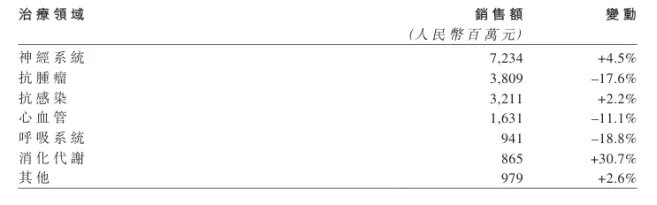
The instability of the pharmaceutical business, the main revenue driver, significantly impacted growth. By therapeutic area, only digestive/metabolic drugs showed clear growth while others underperformed. This may relate to the following factors.
First, downstream procurement demand has contracted. For example, hospitals controlling medical expenses affects drug sales volume. CSPC noted significant Q3 sales declines for NBP (Butylphthalide Soft Capsules and Butylphthalide Sodium Chloride Injection) due to strict controls on high-volume drugs.
Second, products entering centralized procurement. While boosting awareness, centralized procurement requires price concessions. In the Beijing-Tianjin-Hebei alliance procurement, prices for Pegylated Recombinant Human Granulocyte Colony-Stimulating Factor Injection (Jinyouli) and Doxorubicin Hydrochloride Liposome Injection (Duomeisu) were cut ~58% and 23% respectively.
Following implementation, Q2 and Q3 sales for these products declined significantly.
Additionally, competition introduces uncertainty. Take star product NBP - CSPC's revenue pillar for acute ischemic stroke treatment. As China's first Class 1 new drug for cerebrovascular diseases in 2005, it built CSPC's competitive moat in stroke treatment.
However, NBP's injection and capsule patents have expired. While a composition patent lasts until 2032 delaying generic competition, CSPC still faces pressure as rivals eye this market.
Thus, the market hopes CSPC can commercialize more innovations to drive growth. Can R&D boost confidence?
II. Where Is the Next Revenue Pillar?
CSPC shows strong R&D momentum.
In the first three quarters, R&D expenses reached 3.88 billion yuan (+5.5% YoY), ~20.8% of pharmaceutical revenue. Over 60 key pipeline drugs are in clinical or registration stages, including 6 under NDA review and 24 in registration trials (30 indications).

The pipeline covers promising areas like ADC and mRNA. Frost & Sullivan predicts the global ADC market will reach $15.9 billion by 2025 (31.5% CAGR 2020-2025).
CSPC has advantages here with strong branding and innovation capabilities. Its ADC platform, developed by US subsidiary Alphamab, uses enzyme conjugation for stability and homogeneity.
However, with long R&D cycles, CSPC's next revenue driver remains uncertain. High R&D also pressures margins. Thus, licensing may be crucial - a strategy CSPC is pursuing.
For example, on October 7, CSPC granted AstraZeneca exclusive global rights to develop, manufacture and commercialize lipoprotein inhibitor YS2302018. CSPC receives $100 million upfront, up to $370 million in development milestones, up to $1.55 billion in sales milestones, plus tiered royalties.
In summary, CSPC's new drugs have yet to fully realize commercial value. During this transition, the company must find other "oars" to reach shore.
The copyright of this article belongs to the original author/organization.
The views expressed herein are solely those of the author and do not reflect the stance of the platform. The content is intended for investment reference purposes only and shall not be considered as investment advice. Please contact us if you have any questions or suggestions regarding the content services provided by the platform.
