


Kuaishou's Q3 earnings review: Performance exceeds expectations, operational trends improve.

1. Overall Performance Summary
After the Hong Kong market closed on November 20, Kuaishou released its Q3 2024 financial report. Revenue for the quarter reached 31.1 billion yuan, up 11.4% YoY, exceeding Bloomberg's consensus estimate of 31 billion yuan. Non-GAAP net profit was 3.95 billion yuan, a 24.6% YoY increase. Earnings per share stood at 0.75 yuan, far surpassing the Bloomberg consensus estimate of 0.67 yuan.
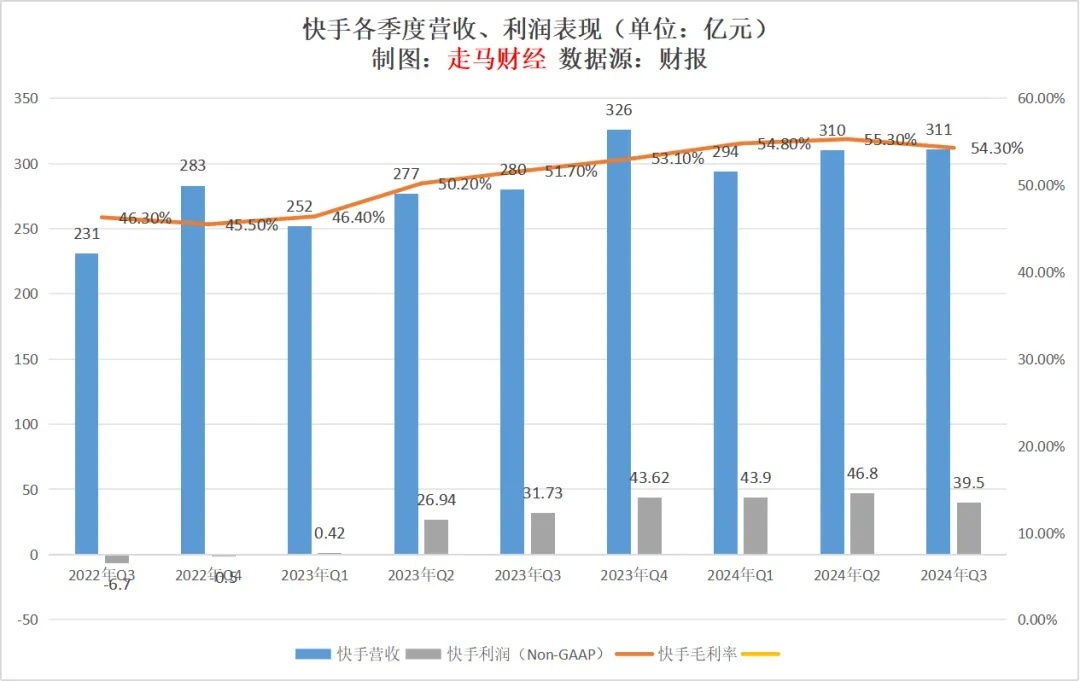
At first glance, the financial data appears somewhat flat, similar to the overall performance of Chinese internet companies in Q3—"revenue in line, profits above expectations." However, when considering Kuaishou's market performance and industry environment around its Q2 report, this quarterly report hides pleasant surprises beneath its seemingly ordinary surface:
Given the substantial scale of its e-commerce business, Kuaishou's performance is highly correlated with it. Q2 is typically the industry's peak season, yet its GMV only grew 6% QoQ. Coupled with macroeconomic headwinds and tighter regulations on top influencers, Kuaishou's stock performance around its Q2 report was sluggish, and market expectations for Q3 results and e-commerce performance were cautious.
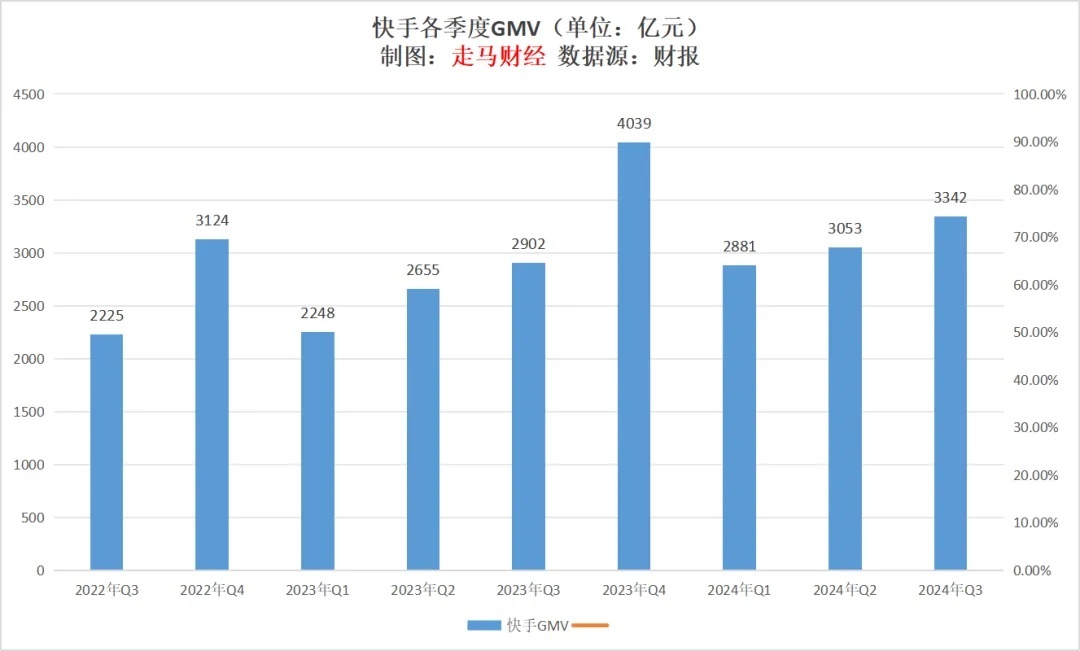
However, Q3 results showed Kuaishou's GMV reached 334.2 billion yuan, with YoY growth stabilizing above 15%—more than triple the industry average (4.5% according to NBS data). As Q3 is typically a slow season for e-commerce, this performance far exceeded market expectations.
Looking ahead to Q4, the recently concluded Double 11 period saw Kuaishou's performance significantly outperform the industry average, according to tracking data from multiple institutions. The company continues to gain market share, as corroborated by its disclosed data and NBS figures.
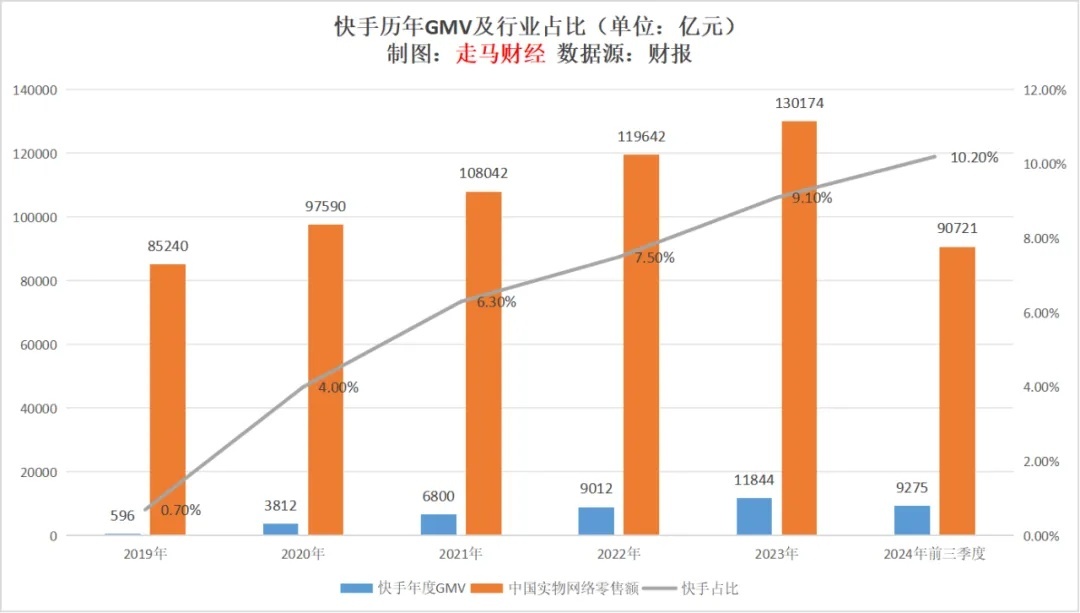
While quarterly market performance may fluctuate, Kuaishou's share of the physical e-commerce market has been steadily increasing on an annual basis. In the first three quarters of 2024, its market share reached 10.2%, up 1.1 percentage points from full-year 2023. Though these figures may not be precise, the trend remains highly indicative.
E-commerce is a critical component of Kuaishou's commercialization ecosystem, and its performance—both short-term and long-term—depends on the healthy development of its user ecosystem.
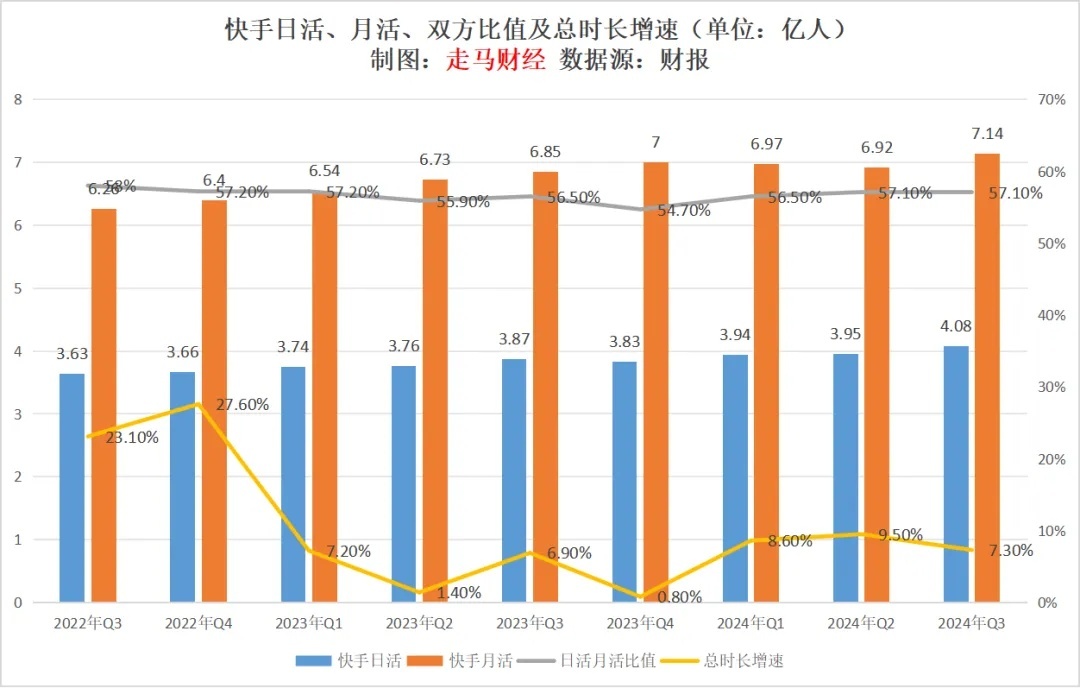
In Q3, Kuaishou's DAU hit a record 408 million, while MAU also reached a new high of 714 million. The DAU/MAU ratio remained at a historically high level of 57.1%, indicating highly active users. Average daily time spent per user was 132.2 minutes, with total user time growing 7.3% YoY—all metrics at their best levels ever. While the Olympics contributed partially, the more significant factor is likely Kuaishou's community ecosystem and platform attributes gaining stronger recognition among its core users.
During its early user acquisition phase, the market worried about Kuaishou's high marketing spend ratio and potential stagnation if spending slowed. However, over the past two years, its marketing spend ratio has gradually declined while user growth momentum has continued.
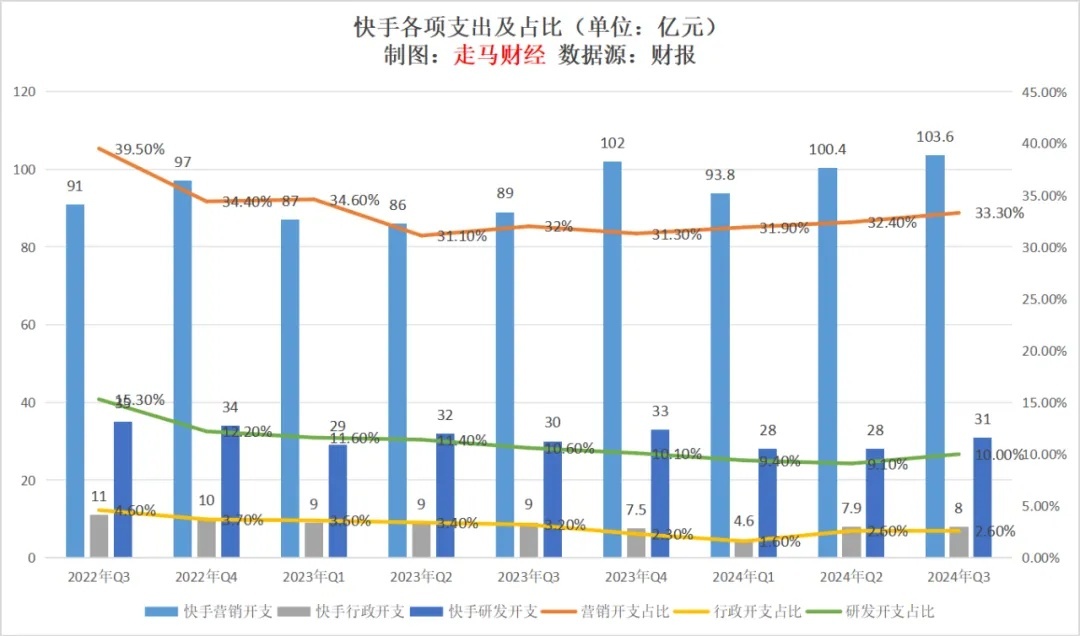
Over the past nine quarters, Kuaishou's marketing expense ratio has dropped 6.2 percentage points, while R&D and administrative expenses combined have fallen 7.3 percentage points—a total reduction of 13.5 percentage points across these three items. This has been the supercharger behind Kuaishou achieving breakeven and then scalable profitability. Long-term, we believe this trend will continue as operational leverage from scale expansion kicks in.
Short-term, in Q3, both marketing and R&D expense ratios increased slightly by 0.9 percentage points each QoQ. Per management's discussions with institutions, this was due to three factors: 1) increased subsidies for e-commerce users, 2) higher subsidies for mini-drama viewers, and 3) above-average spending on large model R&D personnel. However, e-commerce consumer subsidies as a percentage of total GMV remain below industry averages, while mini-drama subsidies were made based on high ROI benchmarks—meaning they're actually profitable. Though absolute R&D spending and its ratio have risen, they should normalize as revenue leverage improves, with all three expense ratios expected to decline QoQ in Q4.
Beyond controllable operating expenses driving margin expansion, gross margin improvement has also been key to Kuaishou's profitability growth.
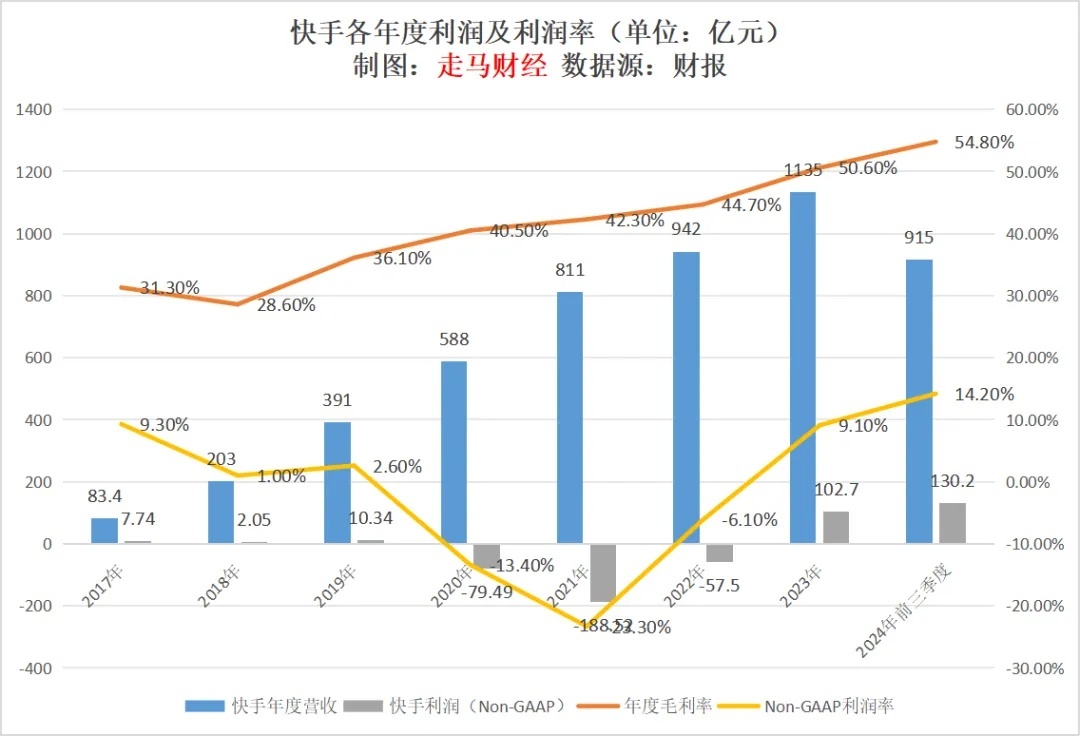
Annually, gross margin improved another 4.2 percentage points in the first three quarters of 2024, while net profit margin expanded 5.1 percentage points.
The gross margin improvement stems from revenue mix shifts—higher-margin advertising and e-commerce-led "other services" are growing as a percentage of total revenue, while lower-margin livestreaming revenue declines.
2. Segment Business Review
Starting in Q3, Kuaishou grouped advertising and e-commerce-led "other services" together as core commercial revenue. These revenues are essentially part of the same commercialization ecosystem. Kuaishou's advertising business includes both outbound-loop (brand, app download ads) and inbound-loop (ads placed by merchants/influencers for e-commerce/local services). "Other services" mainly comprise e-commerce commission fees. Combined, these resemble Alibaba's customer management revenue (ads + commissions), totaling 21.79 billion yuan in Q3—up nearly 20% YoY, far outpacing industry averages.
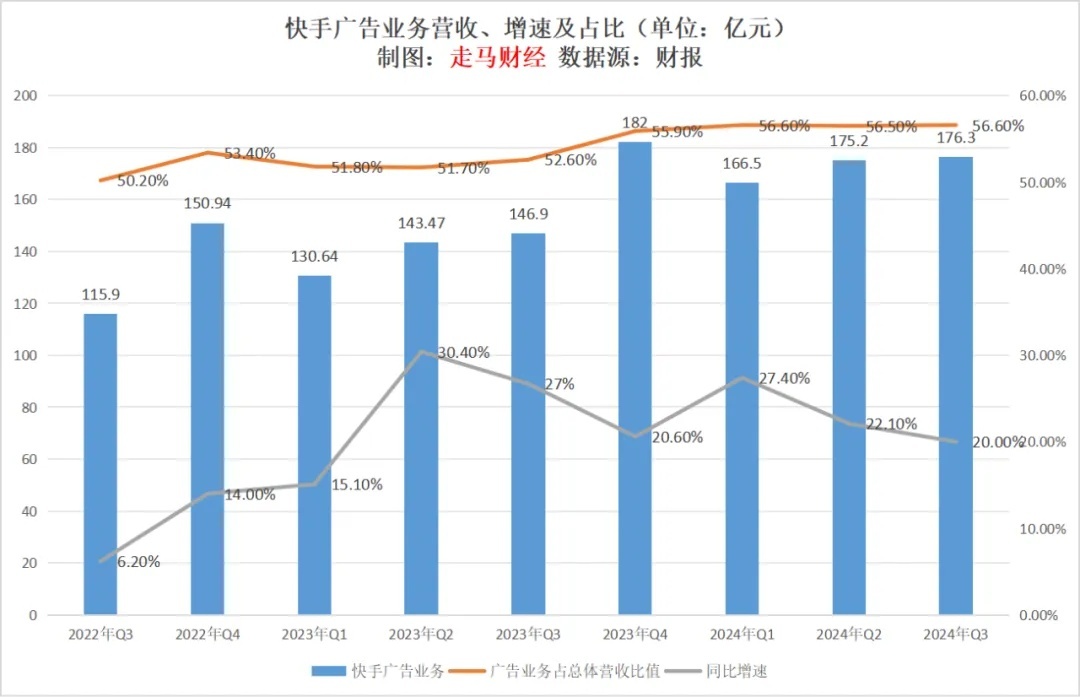
Advertising revenue reached 17.63 billion yuan (+20% YoY), accounting for 56.6% of total revenue. Outbound-loop ads were the main driver, fueled by strong demand from mini-dramas, platform e-commerce, and local services sectors, while inbound-loop growth remained steady.
Per management, daily ad spend on mini-dramas peaked at 40 million yuan in Q3, with total mini-drama ad revenue surging over 300% YoY. As this super-category's IAP (In-App Advertising—unlocking content via ads) and IAA (In-App Purchase—unlocking via payments) models mature, healthy rapid growth should sustain.
Thanks to Kuaishou's unique private-domain community DNA, it's achieved differentiation in traffic allocation, user operations, and content supply. Management explicitly stated this differentiated strategy will continue—an approach we view as both validated and sustainable. The spiritual divergence between content platforms is a long-term trend. Against this backdrop, while further penetration gains industry-wide may be challenging, Kuaishou's user growth should remain durable.
Expanding user scale lays the foundation for advertising market share gains. As Kuaishou's presence strengthens in lower-tier cities and brands extend reach there, its share of brand budgets should grow more elastic. During the Olympics (where Kuaishou was an official short-video partner), it added 60+ brand clients. Post-Olympics in Q4, it secured another global mega-brand—validating its user growth strategy.
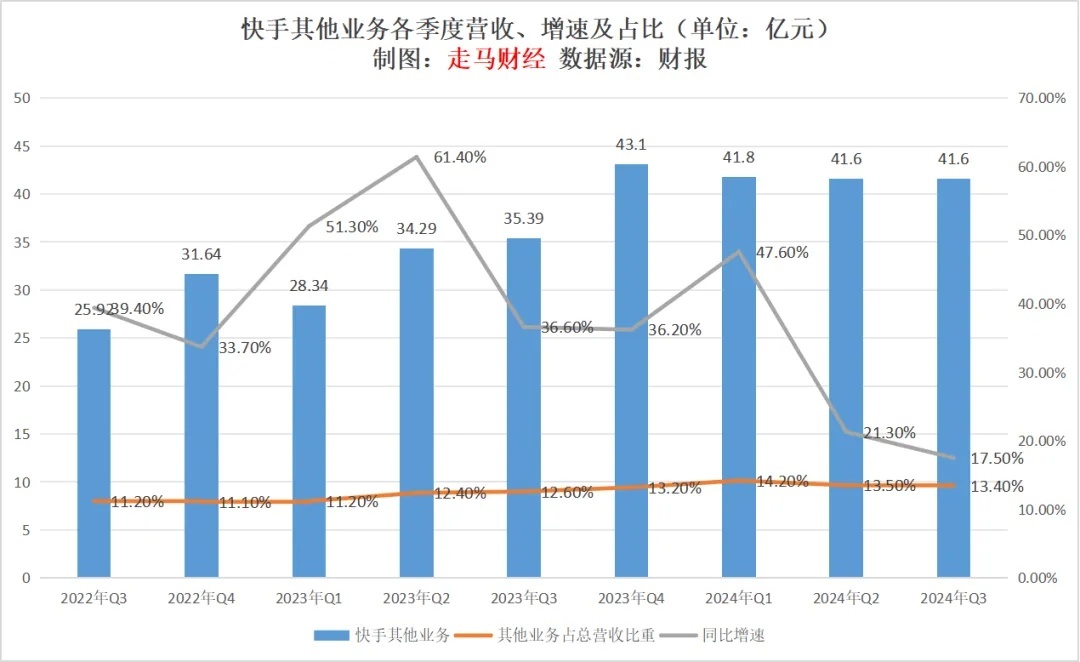
"Other services" grew 17.5% YoY, maintaining a 13.4% revenue share QoQ. As e-commerce scales—especially with rising contributions from discovery-based formats—Kuaishou's take rate still has significant upside. By Q3, discovery-based e-commerce reached 27% of total GMV, with live-stream clips, short-video shopping tabs, and search showing strong momentum. Meanwhile, refined operations strategies tailored to merchants/influencers at different growth stages should further improve traffic allocation efficiency and ecosystem richness.
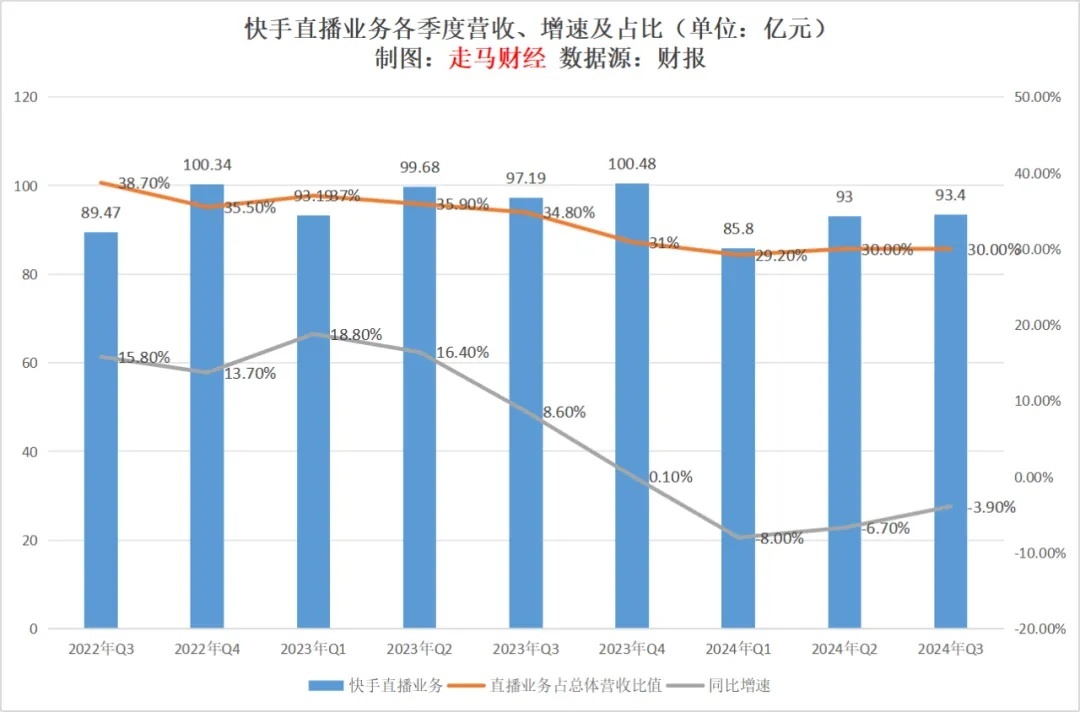
Livestreaming revenue totaled 9.34 billion yuan, edging up QoQ but still declining YoY due to industry headwinds—though the pace of decline has narrowed for two straight quarters, suggesting stabilization.
Overseas operations made progress in Q3, mainly from e-commerce ecosystem development in Brazil. Non-GAAP losses narrowed to 75 million yuan—on the cusp of profitability. Given Brazil's unique market environment, Kwai could deliver upside across ads, e-commerce, and financial services.
3. Summary and Outlook
Kuaishou's Q3 report demonstrated resilience amid adversity, though we must monitor these risks:
Domestic consumption headwinds persist near-term, requiring time for both brands and consumers to adjust;
Trade war risks may re-emerge under Trump, increasing RMB volatility while export pressures could squeeze manufacturers—potentially impacting employment and brand budgets;
Short-video and e-commerce competition remains uncertain.
Overall, we remain optimistic about Kuaishou because:
Financially, we expect its revenue growth, gross margin, and net margin expansion narratives to continue, as the dual drivers—higher-margin business mix and operating expense leverage—still have room to run. If both trends persist simultaneously, profit growth could further surprise.
Meanwhile, overseas business risks are largely priced in, with profitability likely ahead.
Operationally, we're bullish on Kuaishou's efficiency improvements and ecosystem synergies, considering:
First, the global AI wave naturally favors short-video platforms. Recommendation systems are half-AI by nature (information finding people), making them inherently agile in AI R&D—explaining why short-video players lead in AI adoption.
Product-wise, Kuaishou's Kling has garnered positive industry feedback. Its large models already empower content understanding, distribution, and creation across the ecosystem—creators, merchants, brands, and consumers alike.
"In Q3 2024, daily AIGC marketing material consumption from advertisers exceeded 20 million yuan."
Per management: "Smart marketing products and algorithm optimizations still have ample room for improvement. We're also seeing early benefits applying large models to ad recommendations—boosting client ROI. Thus, we're very confident in steadily gaining online marketing service market share."
Second, short-video's natural fusion of content and commercialization (products as content, content as ads, ads as products)—especially in mini-dramas, novels, and games where boundaries blur—allows Kuaishou to leverage its trifecta platform attributes (content, e-commerce, ads) for greater commercialization potential and resilience.$KUAISHOU-W(01024.HK)
The copyright of this article belongs to the original author/organization.
The views expressed herein are solely those of the author and do not reflect the stance of the platform. The content is intended for investment reference purposes only and shall not be considered as investment advice. Please contact us if you have any questions or suggestions regarding the content services provided by the platform.
