


Tianrun Rongtong partners with Zhida Technology: AI technology reshapes customer service experience


Business is booming, but customer service can't keep up. What to do?
Zhidatech, a leader in smart charging, once faced this issue. Let's see how they solved it.
Since 2010, China's new energy vehicle market has entered a period of rapid development. As an important accessory for new energy vehicles, the sales of home smart charging piles have also surged.
As a leading brand in the market, Zhidatech has cumulatively shipped 900,000 home EV charging piles globally and 800,000 in China from January 2021 to September 2023. During the same period, they completed a total of 600,000 installations and after-sales services. As of September 30, 2023, their service network covers 360 cities across China, with installation and after-sales services available in all rural areas. From January 2021 to September 2023, Zhidatech held a 20.5% market share in China and 12.2% globally in terms of home EV charging pile sales.
However, while business grew rapidly, the early customer service system struggled to cope with the massive influx of new users. During peak periods, the 400 hotline often became too busy for users to get through, leading to poor service experiences.
Against this backdrop, to improve customer service efficiency and create a better experience, Zhidatech partnered with Tianrun Rongtong to upgrade the traditional customer service system with AI technology.
Today, we take Zhidatech as an example to see how they transformed their traditional customer contact platform with AI to provide quality service to millions of users and drive sustained sales growth—without significantly increasing staff.
I. Challenges and Innovation: Zhidatech's Customer Service Transformation
Zhidatech was founded in 2010, and its customer service system was initially manual-based.
Now, as Zhidatech's business continues to grow, issues like after-sales installation, repairs, and partnership inquiries have also increased, making the old system inadequate.
For example, during peak hours (10–11 AM), the 400 hotline often faced long queues, leaving many users unable to get through.
Among these inquiries, about 50% were repetitive questions, such as installation progress checks, repair status inquiries, and service requests. These could be resolved directly via the internal ticketing system.
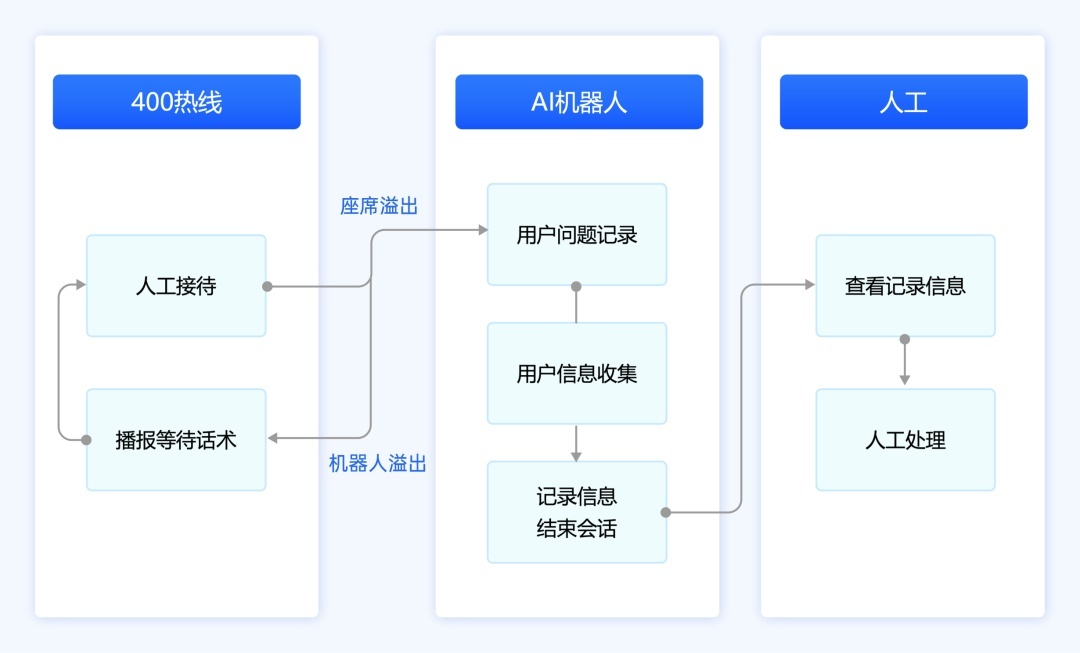
▲Zhidatech's early customer service system architecture
Given Zhidatech's situation, Tianrun Rongtong integrated AI-powered inbound robots into their existing system to alleviate pressure on human agents.
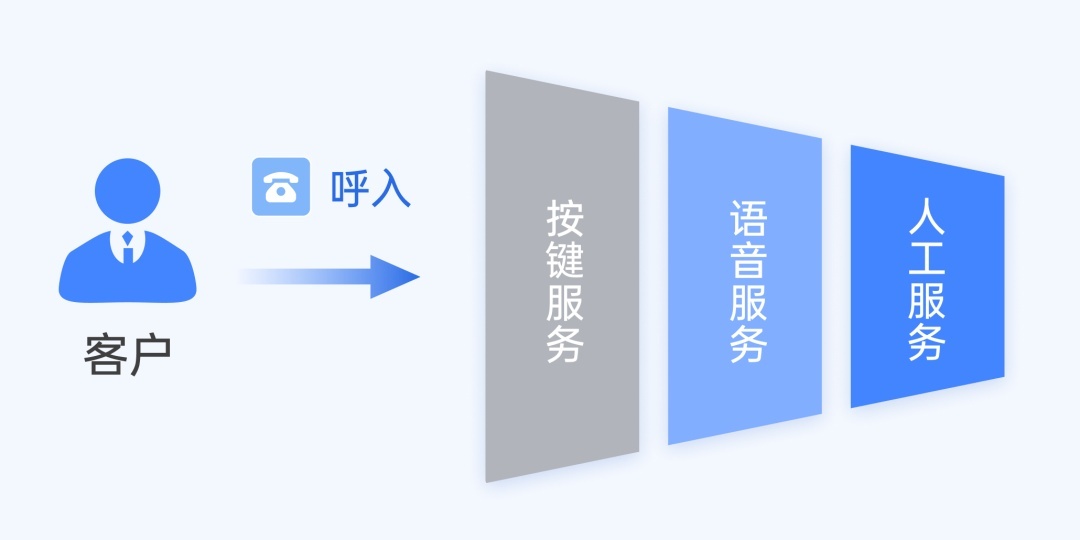
The new system adopts a three-tier funnel design: IVR navigation, AI interaction, and human response layers.
After the upgrade, when customers call the 400 hotline, they first go through voice navigation to clarify their needs.
This step filters out wrong calls or irrelevant inquiries.
Simple, standardized questions (e.g., installation inquiries, progress checks, service requests) are routed to the AI layer. Only complex, non-standard issues (e.g., complaints, partnership inquiries) reach human agents.
The three-tier funnel design reduces pressure on human agents through layered filtering.
Unlike human agents, AI robots can answer calls instantly and continuously, improving call connection rates. Statistics show that AI robots working alongside human agents during off-hours increase connection rates by about 35%.
One month after deployment, the new system achieved a 97% call connection rate for installation and repair queues, peaking at 98.78%. The four concurrent AI robots contributed 13.55% of calls, with a peak contribution of 31.85%.
Zhidatech's 400 hotline supervisor said: "An excellent platform with fast response times. There's a dedicated liaison and project-specific groups with specialists to meet our immediate, high-efficiency needs."
II. Technological Breakthrough: Transforming Traditional Customer Service with AI
However, AI inbound robots have long faced a problem: difficulty accurately understanding customer needs, leading to irrelevant or nonsensical responses.
These flaws not only fail to resolve issues but can also escalate conflicts.
To address this, Tianrun Rongtong revamped traditional robots using AI models, achieving breakthroughs in intent recognition and smart interruption to overcome these limitations.
First, intent recognition.
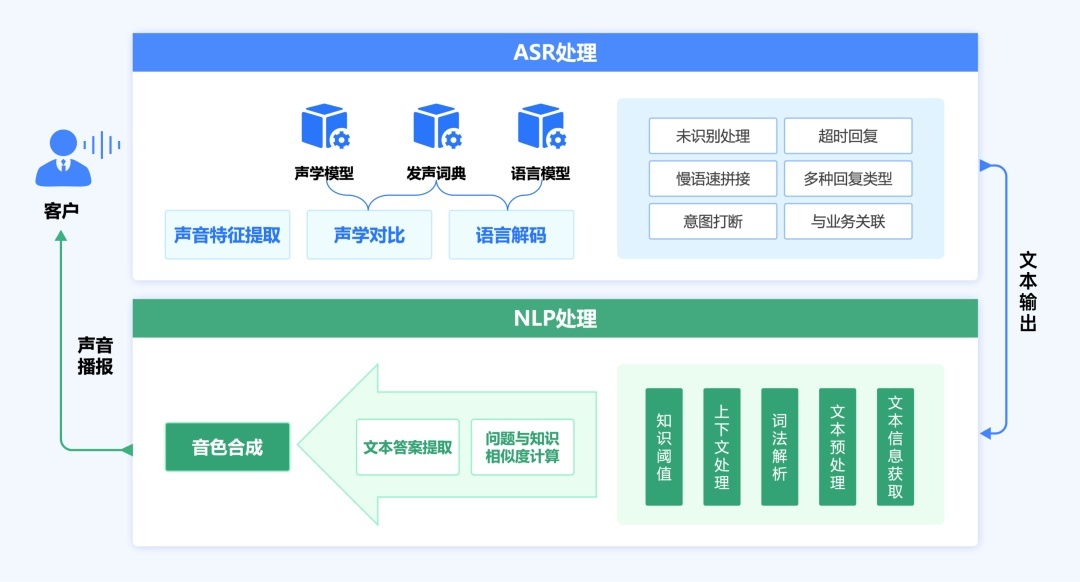
Tianrun Rongtong's AI robots combine ASR (Automatic Speech Recognition) and NLP (Natural Language Processing) to enable personalized human-machine dialogue, efficient speech recognition, and deep semantic understanding. This allows them to grasp user intent quickly and collect feedback accurately, significantly improving service efficiency.
Tianrun Rongtong's ASR accuracy and emotion classification correctness exceed 95%.
Second, smart interruption.
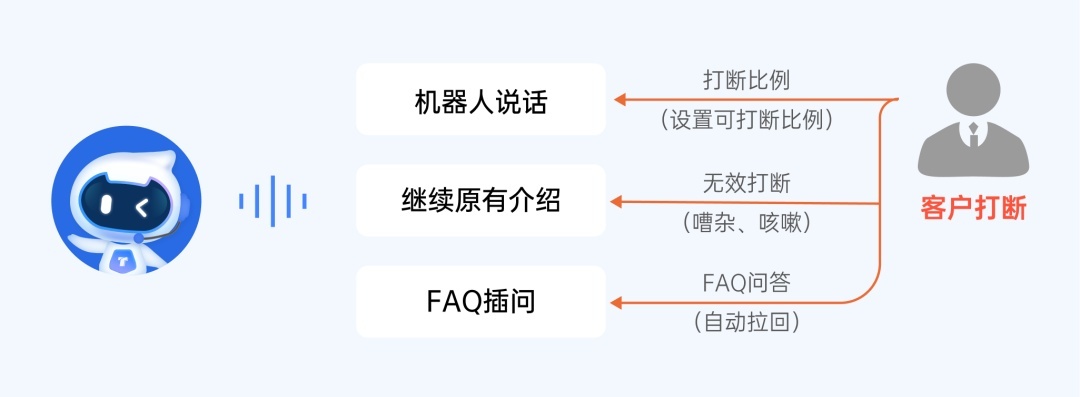
Smart interruption has two parts: interrupting the robot's speech and the robot proactively interrupting the customer.
The challenge is for the robot to understand dialogue like a human, deciding when and whether to interrupt while ignoring irrelevant sounds (e.g., background noise, coughing).
Tianrun Rongtong's industry-leading VAD (Voice Activity Detection) algorithm detects sound at millisecond-level precision, identifying silence boundaries to distinguish valid from invalid interruptions.
With this technology, the robot can be interrupted based on customer speech or ignore background noise. When customers mention new FAQ keywords, it automatically initiates a new dialogue.
These improvements enable Tianrun Rongtong's robots to achieve near-human conversational flow, ensuring service quality.
Beyond Zhidatech, Tianrun Rongtong's AI robots are now used in marketing, external services, and internal shared service centers.
Moving forward, Tianrun Rongtong will continue exploring AI and large-model applications in customer service, launching more AI-native products to help businesses improve efficiency and drive revenue growth.
The copyright of this article belongs to the original author/organization.
The views expressed herein are solely those of the author and do not reflect the stance of the platform. The content is intended for investment reference purposes only and shall not be considered as investment advice. Please contact us if you have any questions or suggestions regarding the content services provided by the platform.
