



Pinduoduo deliberately "played dumb"

$PDD(PDD.US)
Source | Dongge's E-commerce Insights
Author | Jin Shan
Pinduoduo hits the brakes on its own.
Before the U.S. market opened on November 21, Pinduoduo released its Q3 2024 earnings report. Both revenue and profits fell short of market expectations.
The financial report shows that Pinduoduo's total revenue reached 99.4 billion yuan, a 44% year-on-year increase, but below Bloomberg's consensus estimate of 102.8 billion yuan. Non-GAAP net profit was 27.5 billion yuan, up 61% year-on-year, but below Bloomberg's consensus estimate of 29.2 billion yuan.
Pinduoduo has missed market expectations for two consecutive quarters and has adopted a "lying flat" attitude in public opinion, showing no intention to support its stock price.
"In the long run, our profitability may fluctuate slightly or even decline," said Liu Jun, Pinduoduo's financial vice president, during the subsequent earnings call. Co-CEO Zhao Jiazhen added, "A slowdown in revenue growth is inevitable."
Naturally, the stock price fell. On November 22,$PDD(PDD.US) closed at $100.07, down 3.9% year-on-year.
Some investors directly stated that Pinduoduo is the company that lost the most money this year. Former major bulls like Hillhouse and Jinglin chose to reduce their holdings in Q3. Hillhouse cut its stake by 46%, downgrading Pinduoduo from its top holding to its third-largest. Jinglin also sold nearly 700,000 shares.
Why did Pinduoduo underperform? Why is it "intentionally slacking off"?

High revenue and profit growth, but below expectations
In fact, Pinduoduo's revenue grew 44% year-on-year, and profits grew 61%. In the entire internet and e-commerce industry, it remains a high-growth company. However, due to domestic and international competition, overall performance still fell short of market expectations.
Total revenue was 99.3544 billion yuan, up 44% year-on-year. The shortfall was mainly in commission income, related to Pinduoduo's recent fee reduction policy. Online marketing services and other revenue (advertising) reached 49.351 billion yuan, up 24%. Transaction service revenue (commissions) was 50.0034 billion yuan, up 72%.
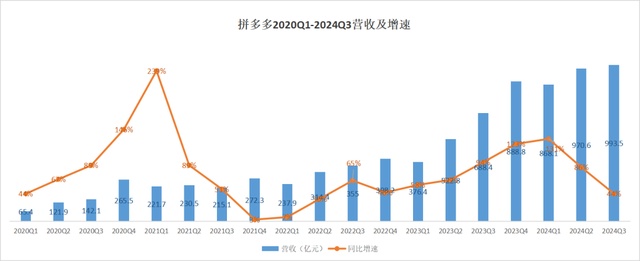
Pinduoduo's revenue structure is hard to break down. Some investors estimated domestic e-commerce growth at 23% year-on-year and overseas e-commerce growth at 11% quarter-on-quarter. Compared to its earlier rapid expansion, Pinduoduo's growth has slowed.
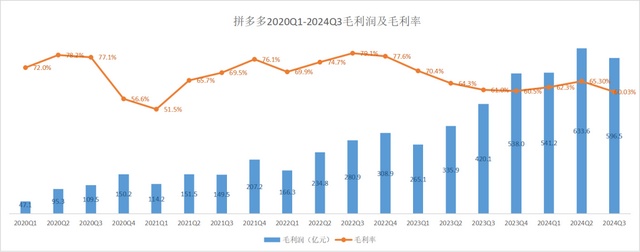
Costs and expenses rose significantly. Total cost of revenue was 39.7092 billion yuan, up 48% year-on-year, mainly due to increased fulfillment and payment processing fees. This directly led to a 5-percentage-point quarter-on-quarter drop in gross margin.
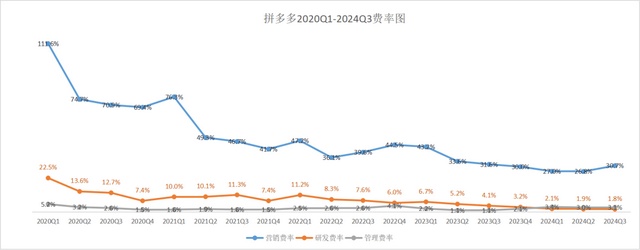
In terms of expenses, marketing drove the increase. Total operating expenses were 35.3527 billion yuan, up 39% year-on-year. Sales and marketing expenses were 30.4838 billion yuan, up 40%, mainly due to increased promotional and advertising spending. General and administrative expenses were 1.8056 billion yuan, up 138%, primarily due to higher employee-related costs. R&D expenses were 3.0634 billion yuan, also up year-on-year.
Operating profit was 24.2925 billion yuan, up 46% year-on-year. Non-GAAP operating profit was 26.7705 billion yuan, up 48%.
Ultimately, total profit fell short of Bloomberg's expectations.
Net profit attributable to ordinary shareholders was 24.9807 billion yuan, up 61% year-on-year. Non-GAAP net profit attributable to ordinary shareholders was 27.4587 billion yuan, also up 61%.
Net cash from operating activities was 27.5 billion yuan, compared to 32.5 billion yuan in the same period last year. As of September 30, 2024, the company had cash, cash equivalents, and short-term investments totaling 308.5 billion yuan.
Specifically, Pinduoduo faces different risks and challenges domestically and overseas. Slowing down and adjusting strategies may not be a bad thing.

Slowing down: Pinduoduo's "hidden worries"
With both revenue and profits missing expectations and future growth slowing, Pinduoduo is caught in internal and external troubles.
For Pinduoduo's domestic platform, the macro environment and increased competitive pressure have made it impossible to maintain the previous high-speed growth that consistently exceeded expectations.
Investors estimate that Pinduoduo's domestic e-commerce growth in Q3 was 23%, advertising grew 24%, and commissions grew 16%. Q4 growth is projected at 16%.
First, there's the weak Q3 retail sales data. According to China's National Bureau of Statistics, total retail sales of consumer goods in Q3 2024 were 11.8 trillion yuan, up just 2.5% year-on-year; online retail sales nationwide were 3.8 trillion yuan, up 6.4%.
Pinduoduo has also invested heavily in appeasing merchants.
In merchant support, it launched a 10-billion-yuan fee reduction plan and a high-quality merchant support program, benefiting over 10 million merchants. Measures include service fee refunds, "buy now, pay later" fee waivers, lower deposits, and simplified withdrawal processes. The fee reduction covers all categories, with plans to cut over 10 billion yuan next year. In logistics, it covers all transfer fees in western China, with delivery fees for agricultural and daily goods slashed by up to 70%. During the early September harvest festival, it allocated 1 billion yuan in subsidies and traffic resources to high-quality agricultural merchants to help rural products reach cities.
These measures will directly reduce Pinduoduo's commission income. Without these investments, exceeding expectations again would have been easy.
But for Pinduoduo, a healthier ecosystem is clearly more important. Domestic e-commerce is its stronghold and the ammunition for overseas expansion. Currently, all e-commerce platforms are offering concessions to merchants. Letting merchants profit first avoids killing the goose that lays the golden eggs and ensures long-term sustainability.
In marketing, Q3 saw all e-commerce platforms battling for users, and Pinduoduo's marketing spend rose again.
Pinduoduo's marketing expenses grew 40% year-on-year. JD.com's rose 26%, and Alibaba's rose 27%. This is unavoidable in the current competitive landscape.
This year's Singles' Day, Pinduoduo unusually ramped up spending, launching its first 10-billion-yuan coupon campaign. Previously, it promoted "Singles' Day every day."
Domestic concessions to merchants and increased marketing are long-term trends.
Overseas, the biggest market concern is TEMU's future growth and political risks.
Some investors dissected Pinduoduo's revenue, estimating that overseas revenue grew 11% quarter-on-quarter to 36.5 billion yuan in Q3, with losses around 2 billion yuan. Q4 holiday sales may reach 47.4 billion yuan, with losses around 3 billion yuan.
TEMU currently relies on its price advantage. If Trump's proposed 60% tariff on Chinese goods takes effect, the EU and others may follow. This would test TEMU's pricing edge.
Short-term strategies for Chinese cross-border e-commerce include partnering with Belt and Road countries, circumventing tariffs, and accelerating local supply chain investments overseas. All are tough battles.
TEMU is rolling out a semi-hosted model to improve gross margins and reduce losses while boosting local supply to mitigate Trump's tariffs. However, recent surveys suggest this model faces unexpected hurdles.
Thus, both domestically and overseas, slower revenue and profit growth seem inevitable.
Co-CEO Zhao Jiazhen said, "The overall e-commerce competition remains fierce. Constrained by natural business development paths, long-term growth won't be linear. In this context, a revenue slowdown is inevitable."
By cutting fees, lowering expectations, and not propping up its stock price, Pinduoduo is "intentionally" underperforming. After years of rapid growth that "elevated it to godlike status," and with rivals copying its low-price model, Pinduoduo is stepping off the pedestal to adjust. Meanwhile, domestic and international competition and political changes are undeniable realities.
For Pinduoduo, this is a marathon.
The copyright of this article belongs to the original author/organization.
The views expressed herein are solely those of the author and do not reflect the stance of the platform. The content is intended for investment reference purposes only and shall not be considered as investment advice. Please contact us if you have any questions or suggestions regarding the content services provided by the platform.
