


 Commemorative
Why is leverage not suitable for long-term holding?

Following up on @资深韭菜 teacher's Why Does Triple Leverage Have Decay?, I proposed the viewpoint that "Leverage is not suitable for long-term holding", which raised many questions. Let me briefly explain.
First, we need to understand that market gains are compounded. For example, if I have $100 and invest in a stock that rises 10% on the first day and falls 10% on the second day, the final result would be: Day 1: 100*1.1=110, Day 2: 110*0.9=99, resulting in a loss of $1.
Similarly, if the stock falls 10% on the first day and rises 10% on the second day, the final result would be: Day 1: 100*0.9=90, Day 2: 90*1.1=99, also resulting in a loss of $1.
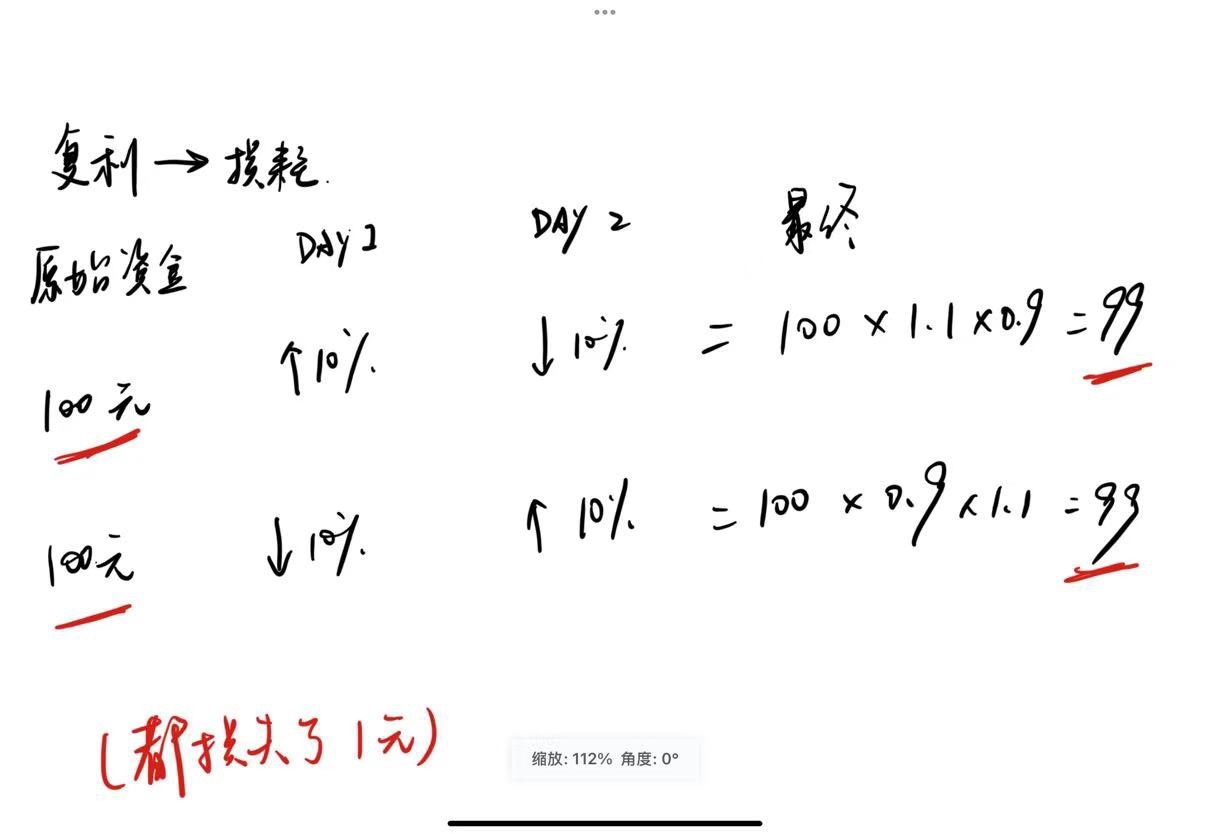
In other words, daily market fluctuations create decay.
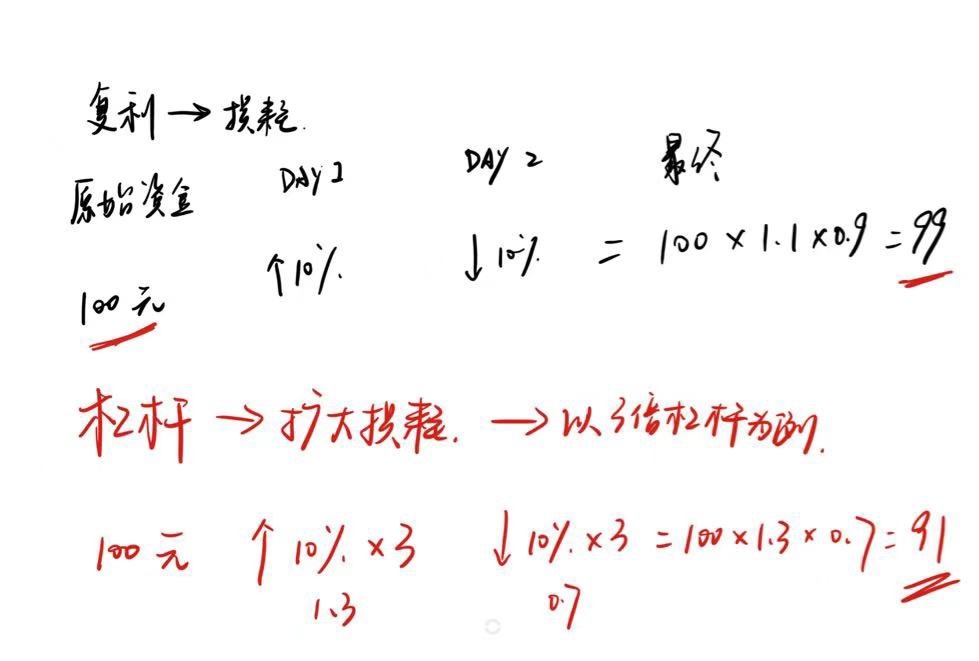
Leverage amplifies this decay! Let’s take triple leverage as an example (the same logic applies to double leverage).
If I have $100 and invest in a stock that rises 10% one day and falls 10% the next (as we saw earlier, the order doesn’t matter), the calculation would be: 100*1.3*0.7=91, resulting in a yield of (91-100)/100=-9%.
Now, what if we increase the principal by 1.3x without applying leverage? The principal becomes $130, and the yield remains 0.1. The loss would be: 130*0.9*1.1=128.7, a loss of $1.3, with a yield of (128.7-130)/130=-1%.
Next, let’s consider a profitable scenario. Assume an initial principal of $100 over five days: three days with a 10% return, one day with a 20% return, and one day with a 20% loss. This simulates a "long-term profitable, reasonably volatile market," aligning with expectations for the U.S. stock market.
Without leverage: 100*1.1*1.1*1.1*1.2*0.8=127.776
With triple leverage: 100*1.3*1.3*1.3*1.6*0.4=140.608
With a 1.3x principal increase: 130*1.1*1.1*1.1*1.2*0.8=160.1088
1.3x principal yield > triple leverage yield > no leverage yield
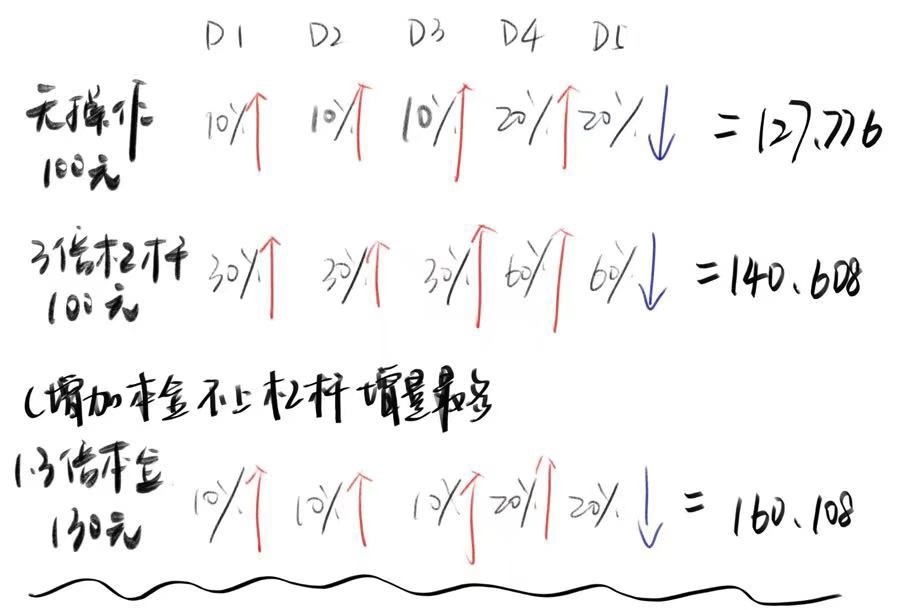
This demonstrates the difference between a 1.3x principal and a 1.3x yield. In the long run, triple leverage (1.3x yield) consistently underperforms a 1.3x principal increase due to decay.
Many argue that the U.S. stock market is a long-term, one-way market suitable for leverage.
But in long-term investing, which is more achievable: increasing the principal by 1.3x or using triple leverage? My simulation shows the former yields higher returns.
Leverage is reasonable for short-term speculation when capital is limited, but long-term investing favors increasing principal.
Leverage magnifies market volatility decay, and unstable fluctuations erode returns over time.
For long-term investing, increasing principal is more stable and sustainable than high leverage.
Leverage is better suited for short-term speculation and specific arbitrage strategies, not long-term portfolios.
(Disclaimer: This post isn’t anti-leverage. As shown, leverage on quality assets (140) outperforms no leverage (127). So, if cash flow is tight, leverage on a good stock is viable. But long-term decay is significant—here, triple leverage only beats no leverage by $13. While extreme, it illustrates triple leverage doesn’t triple returns due to decay, so increasing principal is better long-term.)
Everyone has their own investment philosophy and financial situation. Choose what suits you best. Short-term and long-term strategies differ—investment philosophy isn’t about others’ theories but building your own based on your circumstances and understanding.
$Direxion FTSE China Bull 3X(YINN.US) $Direxion FTSE China Bear 3X(YANG.US) $Direxion Daily TSLA Bull 2X Shares(TSLL.US)
The copyright of this article belongs to the original author/organization.
The views expressed herein are solely those of the author and do not reflect the stance of the platform. The content is intended for investment reference purposes only and shall not be considered as investment advice. Please contact us if you have any questions or suggestions regarding the content services provided by the platform.
