



[IPO Tracking] The third milk tea stock is coming! Will GoodMe become the "most competitive player" in the industry?

2025 may become the first year of IPOs in the freshly made tea beverage sector.
Last week (January 6-12), Mixue Bingcheng and Auntie Shanghai received IPO filings from the China Securities Regulatory Commission (CSRC) for their Hong Kong listings, and they are expected to soon undergo hearings by the Hong Kong Stock Exchange (HKEX) and debut on the Hong Kong market.
On the other hand, on January 12, China's largest mass-market freshly made tea beverage brand, Gu Ming, successfully passed the HKEX hearing, meaning it could list on the HKEX ahead of Mixue Bingcheng and Auntie Shanghai.
The chainization trend in the freshly made tea beverage industry has brought vast market opportunities for Gu Ming, which targets the mass market, but the intensifying competition in the sector also presents growth challenges.
The Expanding Bubble Tea Market
Mixue Bingcheng firmly dominates the low-priced freshly made tea beverage sector, while Gu Ming reigns supreme in the mass-market segment priced between 10-20 yuan (RMB, same below).
In terms of 2023 GMV and the number of stores as of the end of 2023, Gu Ming is China's largest mass-market freshly made tea beverage brand and the second-largest freshly made tea beverage brand across all price segments.
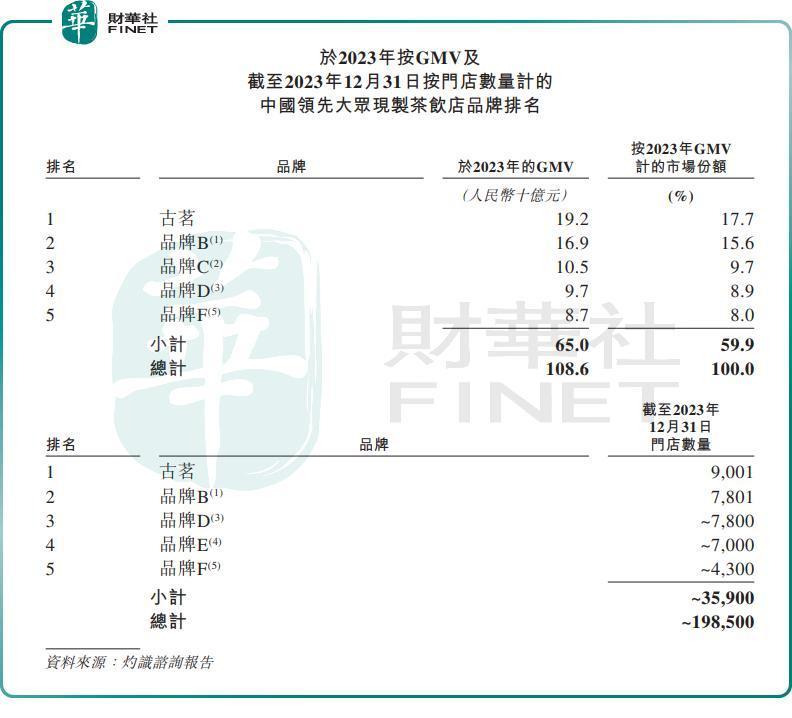
In terms of the latest store scale, according to Narrow Door Restaurant Eye data, Gu Ming, Auntie Shanghai, and $CHABAIDAO(02555.HK) rank among the top three in the mass-market freshly made tea beverage sector by store count, with 9,736, 8,454, and 8,301 stores, respectively.
In terms of performance, Gu Ming's revenue mainly comes from selling goods and equipment to franchisees and providing services. With the continuous expansion of stores, Gu Ming's revenue has grown year by year, from 4.384 billion yuan in 2021 to 7.676 billion yuan in 2023, while its profit increased from 23.992 million yuan in 2021 to 1.096 billion yuan in 2023.
In the first three quarters of 2024, Gu Ming's revenue and profit growth slowed due to industry competition.
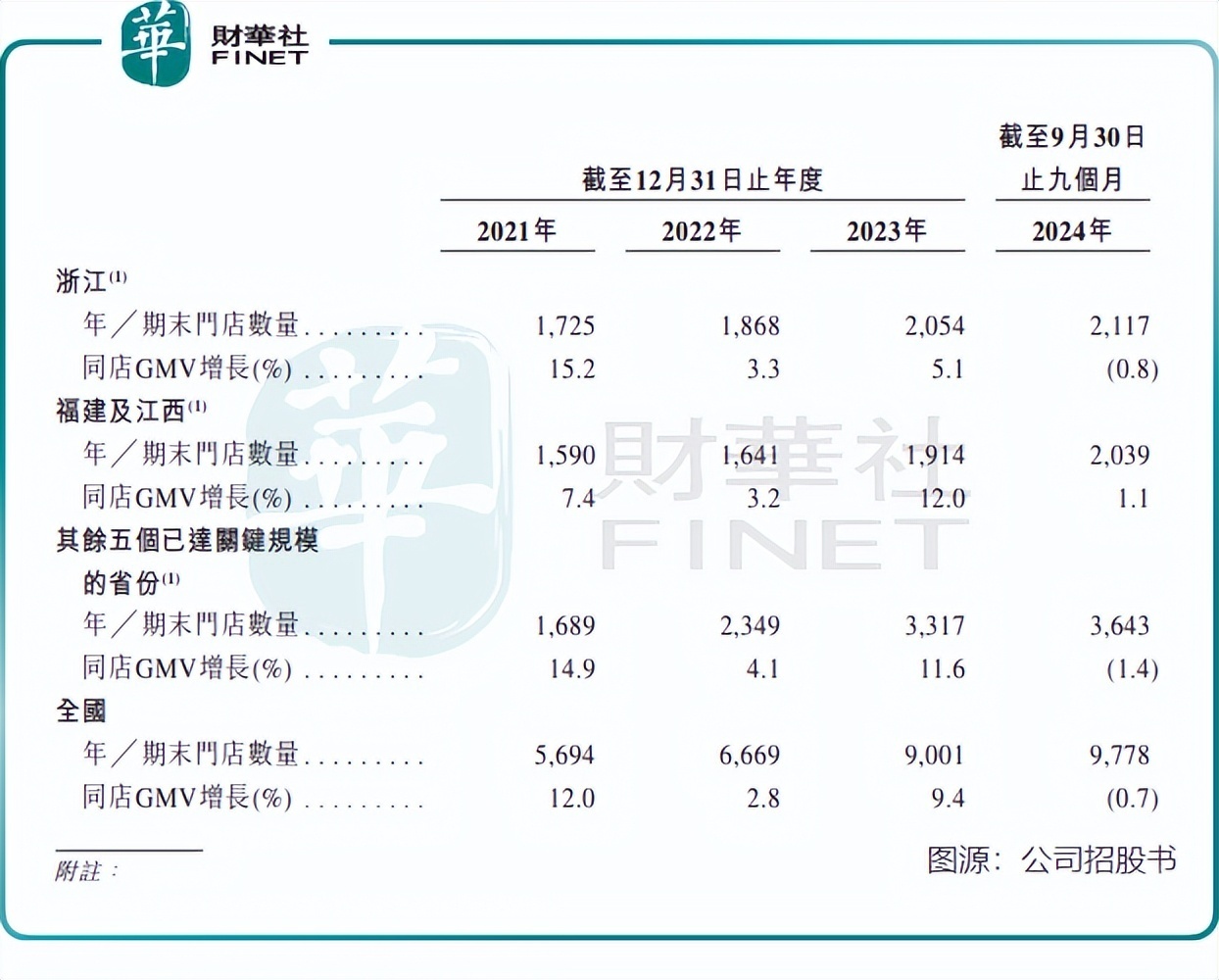
By 2023 GMV and expected GMV growth from 2023 to 2028, the mass-market freshly made tea beverage segment is the largest and fastest-growing, with fiercer competition. As a leading player in this field, driven by rapid store expansion, Gu Ming's GMV has grown rapidly since 2021, reaching nearly 20 billion yuan in 2023.
However, due to intensifying competition and industry price wars, Gu Ming's same-store GMV growth rate dropped to single digits in 2022 and 2023, turning negative at -0.7% in the first three quarters of 2024.
Gu Ming leads the industry in membership numbers and loyalty, especially in repurchase rates, which are far higher than other leading brands. As of December 31, 2023, and the three months ending September 30, 2024, the number of quarterly active members exceeded 36 million and 43 million, respectively. The average quarterly repurchase rate for 2023 reached 53%, far exceeding the industry average of below 30% for mass-market freshly made tea beverage brands.
In comparison, CHABAIDAO's repurchase rate in Q4 2023 was 35%, while Auntie Shanghai's average quarterly repurchase rate in the first half of 2024 was 44.2%.
The "King of Competition" in Lower-Tier Markets
In recent years, almost all brands have been racing to expand by attracting franchisees. The rapid increase in market concentration means the freshly made tea beverage market has become a red ocean.
The industry is nearly saturated in first- and second-tier cities, but there is still significant growth potential in certain areas of lower-tier markets.
Gu Ming adopts a regional densification strategy for lower-tier markets. Its prospectus states, "As of September 30, 2024, we have established a presence in 17 provinces and will continue to increase store network density. At the same time, we have yet to enter another 17 provinces, which together provide us with vast growth opportunities."
As of December 31, 2023, 79% of Gu Ming's stores were located in second-tier and lower cities, the highest proportion among China's top five mass-market freshly made tea beverage brands.
Thanks to its dense store network and close proximity between stores and warehouses, Gu Ming benefits from economies of scale. From 2021 to 2023, the average logistics cost from warehouse to store was less than 1% of total GMV, compared to an industry average of about 2%.
At the same time, in 2023, Gu Ming's franchisees achieved a single-store operating profit of 376,000 yuan, with a single-store operating profit margin of 20.2%, compared to an estimated industry average of below 15% for China's mass-market freshly made tea beverage stores. Notably, in fourth-tier and lower cities, franchisees' single-store operating profit reached 386,000 yuan in 2023, showing that Gu Ming is also profitable in lower-tier markets.
However, due to overall industry slowdown and intensified competition, in the first three quarters of 2024, Gu Ming's single-store GMV, daily single-store GMV, single-store cup sales, daily single-store cup sales, and average GMV per order all declined year-on-year, leading to weaker profitability.

The intensity of industry competition continues to grow. Beyond the aforementioned brands, others like Sweet Lala, Bawang Chaji, and Shuyi Shaoxiancao are also rapidly expanding. As the industry becomes increasingly saturated in first- and second-tier cities, lower-tier markets have become an unavoidable path for these brands' expansion.
Therefore, for Gu Ming to consolidate its industry position and maintain high profitability, it needs to further strengthen its supply chain capabilities, product innovation, and operational efficiency to advance steadily in the industry.
Author: Yao Yuan
The copyright of this article belongs to the original author/organization.
The views expressed herein are solely those of the author and do not reflect the stance of the platform. The content is intended for investment reference purposes only and shall not be considered as investment advice. Please contact us if you have any questions or suggestions regarding the content services provided by the platform.
