


Tariff reversal again, 11 key questions about TEMU

Chaos is a ladder to ascend.
$PDD(PDD.US) $Alibaba(BABA.US)
Trump flip-flopped again on tariff policies.
Last Saturday, Trump signed an executive order imposing a 10% tariff on goods imported from China and eliminating the "de minimis" tariff exemption for small packages from China valued under $800. This initially triggered a sharp market reaction.
Last night, Trump signed another executive order temporarily continuing to allow low-cost product packages from China to enter the U.S. duty-free. The resistance this time came domestically—the U.S. Department of Commerce lacks "sufficient systems to comprehensively and swiftly process and collect tariff revenues," so they had to take it slow.
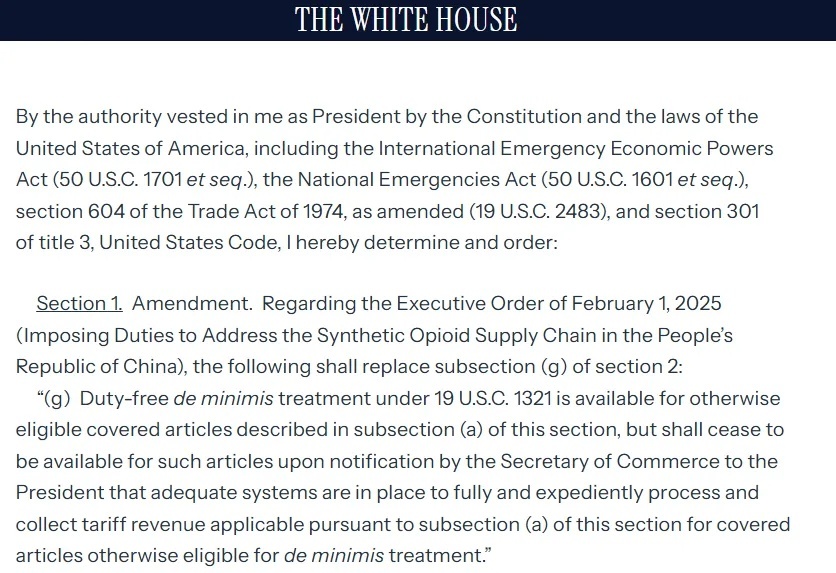
As we discussed earlier, imposing tariffs on China isn’t just a simple revenue collection move. The challenges it poses to the U.S. are no less significant than those faced by China’s cross-border e-commerce industry.
The U.S. customs system simply can’t handle it. In 2024, 1.36 billion packages entered the U.S. under the "de minimis" rule, averaging 3.7 million daily. With about 20,000 frontline customs personnel, how can they inspect them all? There’s not enough manpower or IT infrastructure—goods piling up for a week would flood customs buildings. Plus, with Musk’s DOGE laying off staff, government employees are panicking. Who has the bandwidth to inspect your $5 packages? So, even before Chinese merchants could protest, customs and the Commerce Department protested first.
Tariffs ultimately fall on consumers, and inflation is the last thing Trump wants. The U.S. Foreign Trade Committee warned that eliminating the duty-free mechanism would cost consumers an additional $11.4 billion, disproportionately burdening low-income households—the biggest buyers of these low-cost goods. With the U.S. economy grappling with high interest rates and weak consumption, Trump is pushing hard for Fed rate cuts. But inflation hasn’t budged, and tariffs driving up U.S. prices would only worsen it, exacerbating public discontent. China can be antagonized, but voters cannot.
Canada and Mexico are easy targets, but China isn’t. Trump’s global tariff campaign started with Canada and Mexico because they’re easier to pressure, and the U.S. has more leverage over their imports—oil, gas, and lumber from Canada; cars, electronics, and oil from Mexico. These are largely part of U.S. supply chains, and the U.S. has alternatives. But imports from China—electronics, rare earths, machinery, textiles—rely on China’s complete supply chain and economies of scale. These goods are inherently cheaper, and replacing them would mean higher costs, which the U.S. isn’t keen on passing to consumers.
Thus, Trump’s tariffs on China will be a long-term tug-of-war. His goal is to extract benefits, not to completely suppress Chinese goods—nor is it necessary.
For TEMU, selling clothing and daily essentials helps curb U.S. inflation. These aren’t high-tech or media-influencing products—why ban them?
In our earlier article "Tariffs Might Actually Benefit TEMU," we noted that compliance could favor TEMU in the long run. Short-term, cross-border merchants will bear the brunt, but platforms and merchants face different realities. Most focus too much on short-term tariff shocks, but Trump’s pause on eliminating the de minimis rule gives merchants more breathing room.
On closer look, there’s more to unpack—especially precedents like the EU and Brazil, where tariffs were imposed but Chinese cross-border platforms thrived.
1. Previous points summarized: Global tariffs drive up U.S. prices, benefiting TEMU; compliance offers TEMU a chance to ‘legitimize’; TEMU’s price edge over Amazon remains.
2. Small merchants exit, improving platform supply dynamics. This subtle point is often overlooked. U.S. tariffs will push cross-border e-commerce toward compliance—not shutdowns. Compliance raises costs, disproportionately hitting small merchants and independent sites with limited scale and options. Many relied on de minimis policies to compete on price; their exit will likely accelerate. Larger merchants can quickly fill the gap, leveraging scale to cut costs—whether by pressuring upstream factories or downstream consumers. It’s a game of big fish eating small fish, with top platforms as winners.
3. Higher prices, better platform margins. Short-term, tariffs hurt sales but boost platform profitability. Tariff-driven cost hikes will pass to consumers, and since tariff hikes are ‘justified,’ consumers may accept slight markup. TEMU’s prices have already risen 10-30% since November. Consider this: cross-border platforms sell low-cost goods—a $10 T-shirt rising to $12 feels negligible but is a 20% hike. U.S. consumers aren’t highly price-sensitive.
4. Industry-wide compliance improves consumer experience. China’s cross-border e-commerce boom post-pandemic outpaced regulation, leading to uneven compliance and consumer experiences. Small merchants lag behind larger players and platforms in compliance. As standards rise, so will consumer satisfaction, unequivocally improving the sector’s ecosystem.
5. Is the $800 duty-free policy gone for good? Not quite. Trump’s pause is likely temporary—don’t expect a reprieve. But the ban targets mainland China and Hong Kong; rerouting via Southeast Asia (e.g., Indonesia) preserves duty-free access.
6. How much are tariffs actually rising? Post-policy, costs include base rates, 301 tariffs, the new 10% levy, and brokerage fees (~$20/order), totaling 15%-40%. Rates vary widely by category, with textiles and apparel on the higher end.
7. Tariffs apply to declared value, not retail price—limiting platform impact. Customs taxes goods at their export (FOB) price, allowing legal B2B tax avoidance. For example, shipping B2B to a U.S. subsidiary before B2C sales is compliant and slashes taxes. If a $5 factory-price item retails for $10-$15 (2-3x markup), a 20% tariff raises end prices by just 6.7%-10%. TEMU’s fully hosted model is B2B (taxed at factory price); Amazon FBM and independent sites are B2C (taxed at retail), suffering bigger hits.
8. Immediate pain point: longer fulfillment due to customs delays. Previously, sub-$800 air shipments bypassed customs via T86; now, T11/T01 channels require declaration and inspection, adding 3-5 days. As noted earlier, systemic bottlenecks mean platforms will likely handle bulk declarations with spot checks—a thankless task. Even with upgraded systems, further adjustments are inevitable.
9. Uneven merchant impact. Small merchants and independent sites suffer most; larger players have more workarounds. Current strategies include: 1) Cutting declaration costs (e.g., bundling multiple items per order, switching to slower/cheaper sea freight, or setting up U.S. warehouses for faster delivery and tax planning). 2) Gradual consumer pass-through (e.g., seasonal price tweaks). 3) Upstream pressure (e.g., cheaper materials/packaging).
10. Limited impact on e-commerce platforms. Cross-border platforms saw this coming. Core countermeasures are localization + price hikes: 1) Onboarding U.S. sellers (albeit many are Chinese diaspora). 2) Local warehousing (e.g., hybrid ‘overseas warehouse + local delivery’ models that convert B2C to tax-efficient B2B). 3) Offshore supply chains (e.g., shifting production to tariff-exempt regions like Brazil/Southeast Asia). 4) Price hikes—major platforms have already raised prices 10-30% since November. With tariffs adding 25-30% costs and platforms’ 2-3x markups, a 10% end-price hike covers most of the blow.
11. Historical precedent: reasonable tariffs don’t dent Chinese e-commerce.
In July 2021, the EU axed VAT exemptions for sub-€22 imports, imposing ~20% tariffs. Initial chaos (logistics snarls, customs delays) didn’t stop Chinese cross-border platforms—TEMU now leads in EU MAU.
Brazil’s August 2023 move taxed sub-$50 packages at 17% ICMS; over-$50 goods faced 60% tariffs + 17% ICMS. By August 2024, sub-$50 tariffs rose to 20% + ICMS (44.5% total)—far steeper than U.S. rates. High-ticket items (e.g., phones) struggled, but cheap apparel/essentials held up. Platforms split tax burdens between consumers and merchants before fully passing them on, with sales rebounding within quarters. China’s 2024 Jan-Oct textile exports to Brazil grew 15.4%; electrical goods surged 31%. Some platforms countered by localizing production.
For now, Chinese cross-border platforms dominate apparel, household goods, and furniture—categories with little U.S./EU production. Even with tariffs, rates will likely settle at consumer-tolerable levels.
Chaos is a ladder to ascend—watch how Chinese cross-border e-commerce evolves.
The copyright of this article belongs to the original author/organization.
The views expressed herein are solely those of the author and do not reflect the stance of the platform. The content is intended for investment reference purposes only and shall not be considered as investment advice. Please contact us if you have any questions or suggestions regarding the content services provided by the platform.
