



US retail data turns out to be 'false prosperity', how to deal with it?


This week, the world is waiting for U.S. retail data and the Federal Reserve's economic outlook report.
U.S. Retail Growth May Be Driven by "Panic Buying"
U.S. retail sales data for March 2025 showed a month-on-month increase of 1.4%, exceeding February's 0.2% growth and market expectations of 1.3%. This marks the highest growth rate since January 2023.
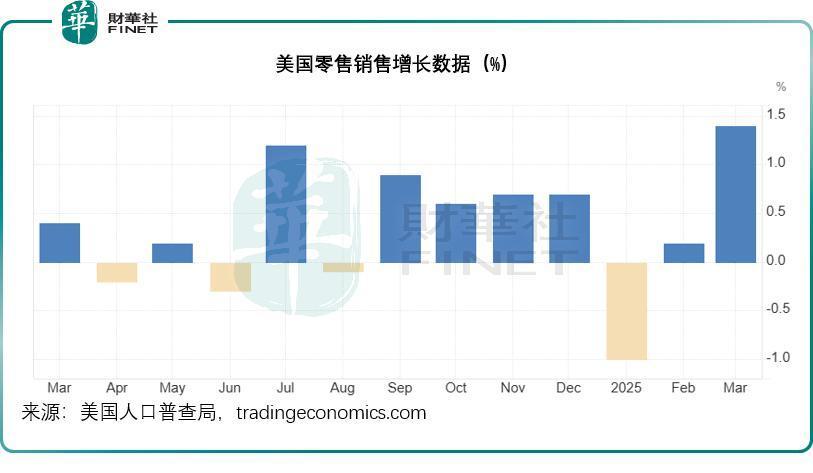
The surge in U.S. retail may be influenced by "panic buying" as consumers rush to purchase cars ahead of impending tariffs. Auto and parts sales rose 5.3% month-on-month in March. Excluding auto sales, retail sales grew 0.5%, with notable increases in building materials and garden equipment (3.3%), sporting goods, musical instruments, and books (2.4%), food services (1.8%), and electronics and appliances (0.8%).
These gains offset declines of 2.5% at gas stations and 0.7% in furniture sales. Core retail sales—excluding food services, auto dealers, building materials, and gas stations—rose 0.4%, a key metric for GDP calculations.
Markets anticipate that pre-tariff spending may barely support Q1 economic growth, but this momentum will likely fade in coming months as tariffs take effect, dimming U.S. economic prospects, increasing stock market volatility, and cratering consumer confidence.
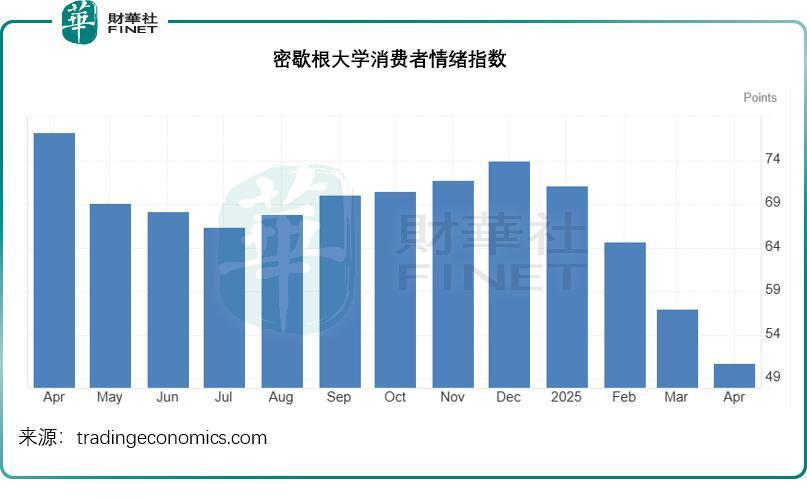
The University of Michigan’s April 2025 Consumer Sentiment Index plummeted to 50.8 from 57 the prior month, far below the expected 54.5 (see chart below).
The Conference Board’s March 25 survey revealed a 7.2-point drop in U.S. consumer confidence to 92.9 (see chart below).
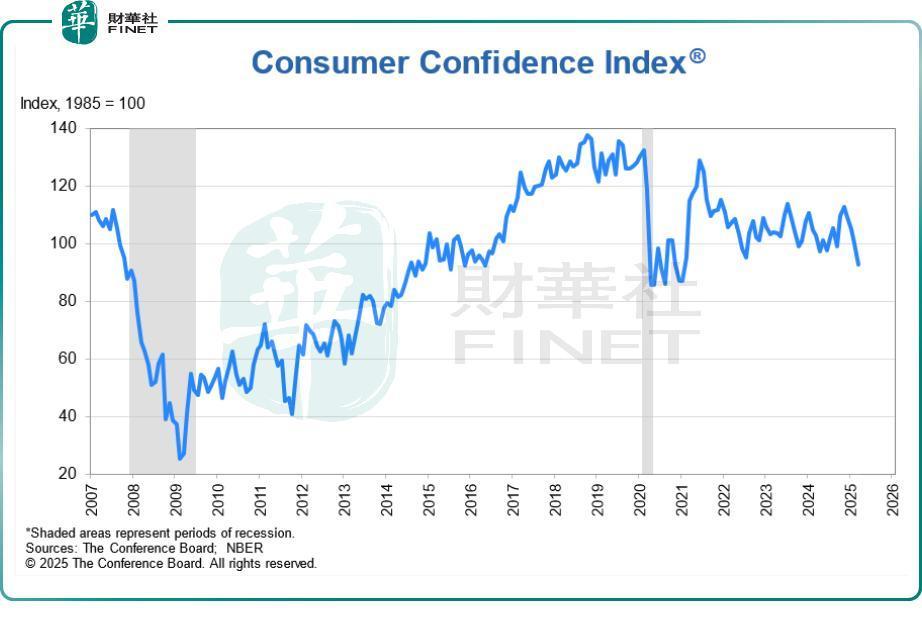
The Expectations Index—reflecting short-term outlooks for income, business, and labor—plunged 9.6 points to 65.2, a 12-year low and well below the recession threshold of 80.
Policy Uncertainty May Stagnate Industry Growth
Beyond eroding confidence, announcements from $NVIDIA(NVDA.US) and $AMD(AMD.US) triggered valuation resets for chip stocks.
AI’s rise dominated 2024 tech capex plans, with $Microsoft(MSFT.US) , Meta (META.US), and Google (GOOG.US) earmarking billions for data centers.
But Trump’s tariff uncertainty has frozen investments, potentially delaying infrastructure builds and heightening profit risks across the supply chain.
Reflecting these worries, $Taiwan Semiconductor(TSM.US) may hike U.S. wafer prices by 30%, while $ASML(ASML.US) ’s Q1 2025 orders badly missed estimates.
Fed’s Gloomy Outlook Adds to Pessimism
On April 16, Fed Chair Powell reiterated dual mandates: maximum employment and stable prices. Despite rising risks, he noted resilient growth, near-full employment, and inflation nearing 2%.
But his Q1 assessment turned cautious: growth slowed, consumer spending was tepid, and tariff-driven import surges may drag GDP. Surveys showed collapsing confidence tied to trade policies.
Forecasts now point to slower but positive growth. Job gains averaged 150K/month in Q1—below 2023 but keeping unemployment low. The jobs-to-unemployed ratio held above 1, wages outpaced inflation, and labor markets stayed balanced, not fueling inflation.
Inflation remains above target: PCE rose 2.3% YoY in March, with core PCE at 2.6%. Powell warned Trump’s sweeping policy shifts—trade, immigration, fiscal, and regulatory—carry high uncertainty.
He stressed tariffs’ inflationary impact may persist, depending on passthrough speed and long-term expectations. The Fed’s priority is anchoring expectations to prevent sustained inflation.
Powell’s hawkish tilt signaled inflation-fighting over employment if mandates clash, with no Fed intervention for market turmoil.
U.S. Stocks Plunge
Led by tech giants like NVIDIA, AMD, $Apple(AAPL.US) , and Microsoft, major indices fell: Nasdaq (-3.07%), S&P 500 (-2.24%), and Dow (-1.73%).
However, Nasdaq 100 futures rose 1% in Asian trading on April 17, with S&P 500 and Dow futures up ~0.8%.
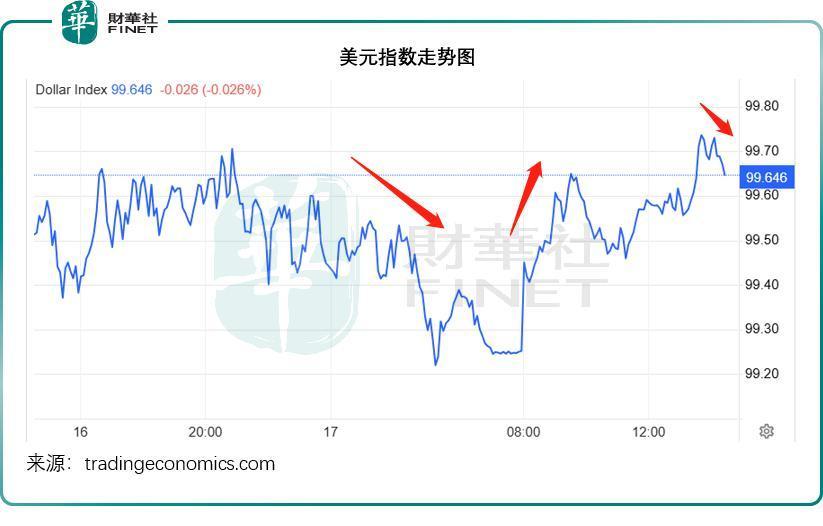
The dollar index briefly dipped post-Powell but rebounded above 99.70 (see chart).
With Trump’s chaos, Fed hawkishness, and splintered capital flows, speculative risks loom—caution is paramount.
Author: Mao Ting
The copyright of this article belongs to the original author/organization.
The views expressed herein are solely those of the author and do not reflect the stance of the platform. The content is intended for investment reference purposes only and shall not be considered as investment advice. Please contact us if you have any questions or suggestions regarding the content services provided by the platform.
