


 Likes Received
 Posts
PostsWhat are retail investors who heavily invest in LUXSHARE-ICT ignoring?

When the "reciprocal tariffs" black swan event first emerged, the stock prices of export-oriented companies were truly devastated.
Especially Apple $Apple(AAPL.US) and its supply chain companies.
Even the big brother Apple saw its stock price drop by 23% cumulatively during those black swan days, so the smaller players below naturally didn’t fare well either.
Among the Apple supply chain, the more notable ones include Luxshare Precision $LUXSHARE-ICT(002475.SZ), Foxconn Industrial Internet $Taiwan Semiconductor(TSM.US), Lens Technology, and Goertek.
Among these four smaller players, Luxshare Precision stands out as the one with relatively stable performance.
Thus, Luxshare Precision has become both a concept stock and a fundamentals stock, attracting both speculators and fundamental investors—a rare combination among A-share targets.
Everyone knows Brother Cai never speculates on concept stocks in A-shares; he only buys fundamentals stocks, certain cyclical stocks, and turnaround plays.
So, Brother Cai will analyze Luxshare from a fundamentals perspective.
.......
First, during this black swan event, Luxshare’s stock price was hit hard in the first two days—it hit the limit down on the first day and opened after hitting the limit down on the second day, still dropping 9%.
Although it stabilized and rebounded in the following days, it’s not yet truly safe by any means.
Today, Luxshare dropped another 4 points.

In the Hong Kong, U.S., and A-share markets, Brother Cai generally categorizes targets into two types: core targets and swing targets.
Some friends have asked how to distinguish between core targets and swing targets, and Luxshare serves as a perfect example.
.......
Judging by past performance and stock price trends, Luxshare is undeniably a top-performing stock.
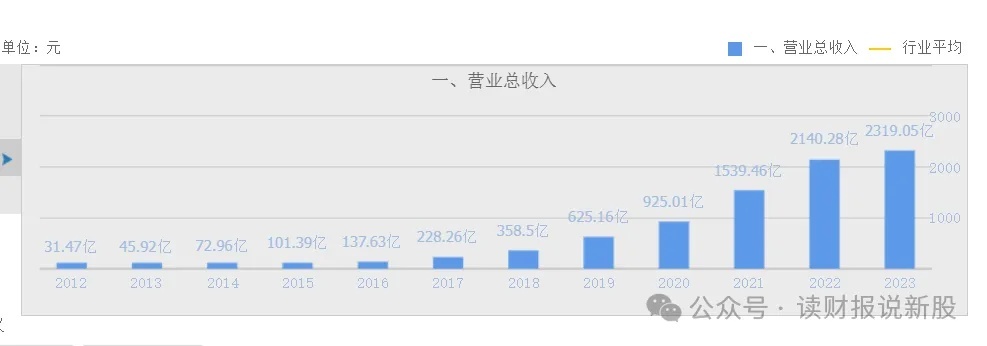
Over the past decade, revenue grew from 7.3 billion yuan in 2014 to 231.9 billion yuan in 2023, with a 10-year CAGR of 46.9%.
Non-GAAP net profit grew from 600 million yuan in 2014 to 10.19 billion yuan in 2023, with a 10-year CAGR of 37%.

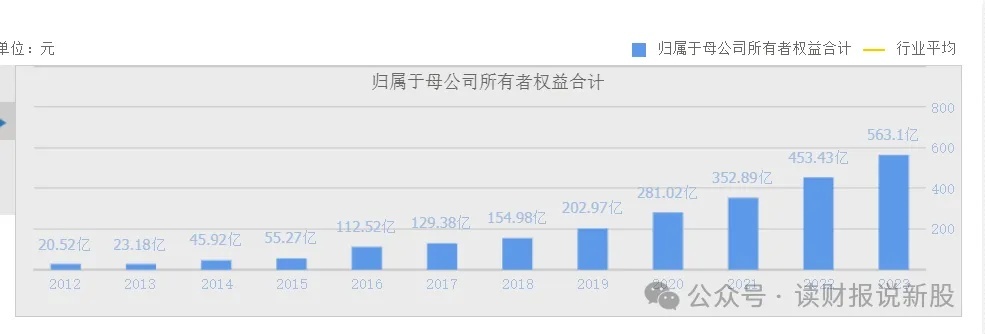
Shareholders’ equity (net assets) grew from 4.6 billion yuan in 2014 to 56.3 billion yuan in 2023, with a 10-year CAGR of 32%.
Such long-term performance over a decade places Luxshare firmly in the top 5% of A-shares, making it a long-term champion, a hot favorite, and a superstar—well-deserved titles.
While stock prices and performance may not correlate much in the short term, they inevitably converge in the long run.
Luxshare’s stock price (adjusted for splits) rose from 3.11 yuan in 2014 to 34.2 yuan in 2023—a tenfold increase over a decade, with an annualized return of 30.5%.
For long-term holders, this has been a highly rewarding investment.
Also, as Brother Cai has mentioned before, the long-term stock price performance is more closely tied to net assets than to net profit.
Among the three key metrics above: revenue CAGR of 46.9%, profit CAGR of 37%, and net asset CAGR of 32%, the stock’s annualized return of 30.5% aligns most closely with net asset growth.
Most people focus on revenue and profit, but few pay attention to net asset returns.
And net assets are one of the key factors Brother Cai uses to determine whether a stock is a core target.
Why focus on net assets?
Net assets, also called shareholders’ equity, represent our stake in the company—even if we’re just nano-sized shareholders.
But shareholders, big or small, own a proportional share of the company’s equity.
Growth in net assets means growth in our returns—that’s the first point.
Next, we also need to assess the quality of net assets.
For example, more cash (or near-cash) is always better.
Inventory (except for premium liquor) and accounts receivable should ideally be minimal, while fixed assets depend on the context—generally, the less, the better.
Now, let’s examine Luxshare’s asset composition.
In its Q3 2024 report, Luxshare had 48.4 billion yuan in near-cash but a staggering 54.3 billion yuan in debt (long-term + short-term borrowings).
This means that despite its impressive past performance, Luxshare’s internally generated cash is far from sufficient to fund its business growth.
Why is this the case?
Because this industry requires heavy fixed-asset investments and inventory—it’s a capital-intensive, tough business.
Luxshare’s fixed assets + construction in progress + inventory total 91.1 billion yuan.
After more than a decade, despite its stellar profits, Luxshare still has negative net cash. What shareholders have gained is a pile of factories and inventory—low-quality earnings.
From a cash flow perspective, what truly belongs to shareholders is the free cash flow that can be distributed to them.
And Luxshare’s free cash flow remains negative.
Thus, from a business model standpoint, Luxshare’s capital-heavy, high-expenditure model is not a good one. If big brother Apple’s performance declines and requires less outsourcing, what will happen to Luxshare’s massive fixed assets and inventory?
Luxshare’s business model is tightly tied to Apple and other consumer electronics brands. Its past high growth was largely driven by the golden decade of consumer electronics.
Looking back, even during consumer electronics’ golden decade, all Luxshare earned was a pile of factories and inventory.
Looking ahead, consumer electronics’ growth will inevitably slow compared to the past decade. Are Luxshare’s factories at risk?
This is where independent thinking comes in!!!
In summary, such a tough and risky business model definitely doesn’t qualify for Brother Cai’s core target pool.
Honestly, Brother Cai isn’t keen on swing targets either, but with less than 40% of his portfolio in A-shares, he can afford to play Luxshare’s swings briefly.
As for the target price, it’s already been shared in the private group and won’t be disclosed here.
But if your A-share exposure is heavy, skip Luxshare!
Finally, a reminder: core targets are essentially companies you’d treat as if they were unlisted.
If a company were unlisted, stock prices wouldn’t matter. What you’d care about is the company’s cash flow—especially free cash flow—growing steadily year after year.
For such companies, annual stock price gains may not be dramatic, but you can hold them with peace of mind. Their strength lies in the long term, not the short term.
Typically, core targets show little short-term volatility but deliver annualized returns of around 20% or higher over the long run!
The copyright of this article belongs to the original author/organization.
The views expressed herein are solely those of the author and do not reflect the stance of the platform. The content is intended for investment reference purposes only and shall not be considered as investment advice. Please contact us if you have any questions or suggestions regarding the content services provided by the platform.
