


Meituan Instant Delivery and others

In Jin Yong's martial arts novels, Yue Buqun is a very interesting character:
What Teacher Yue loves to do most is to establish a righteous persona, occupying the moral high ground, even naming his sword 'Gentleman's Sword';
But in reality, this guy secretly practices demonic sword techniques like the 'Evil-Quelling Sword Manual,' pursuing the desire to dominate the martial arts world.
When dealing with followers, he says, 'Your master has always been fair, showing no favoritism,' but when meticulously planning to expel Linghu Chong from the sect, he claims, 'It's because I care deeply that I reprimand severely.'
When he needs someone, he says, 'I will never mistreat any brother,' but when kicking someone out, he says, 'If you don’t strive, you’re no longer my brother,' always occupying the moral high ground. What can others do?
Competing in the same direction is rivalry, opposing directions is conflict. On the battlefield, victory or defeat is common. Some things didn’t need to happen at all.
Meituan Instant Shopping
Meituan Instant Shopping is great, but it’s still in its early stages of development. Using Jin Yong’s martial arts terminology, it’s like 'Dugu Nine Swords' has only been mastered up to the third move.
Although this business has been around for seven years and has achieved overall breakeven, investors are already familiar with it, but ordinary consumers still don’t know what Instant Shopping is.
In the past, it didn’t even have a unified entry point—no portal, no brand recognition—but that didn’t stop it from advancing rapidly. By Q4 2024, it had already become a behemoth with over 10 million daily orders, still growing at high speed. According to GMV statistics, Instant Shopping’s scale in 2024 reached around 270 billion.
Specifically, all platform-based instant retail businesses outside of food delivery fall under Meituan Instant Shopping, including vegetables and fruits, medicine purchases, flowers, 3C electronics, daily necessities, and all 30-minute delivery services. Xiaoxiang is Meituan’s self-operated instant retail business, procuring directly through front warehouses and delivering via an independent rider system.
In the past, these scattered businesses were like pearls scattered across Meituan’s various corners, including the homepage diamond slots, information feeds, search pages, and Meituan food delivery feeds. Now, they have a unified entry point: Meituan Instant Shopping, which has been given the first diamond slot on the homepage, alongside food delivery, group buying, hotels, and medicine purchases, occupying the fourth position.
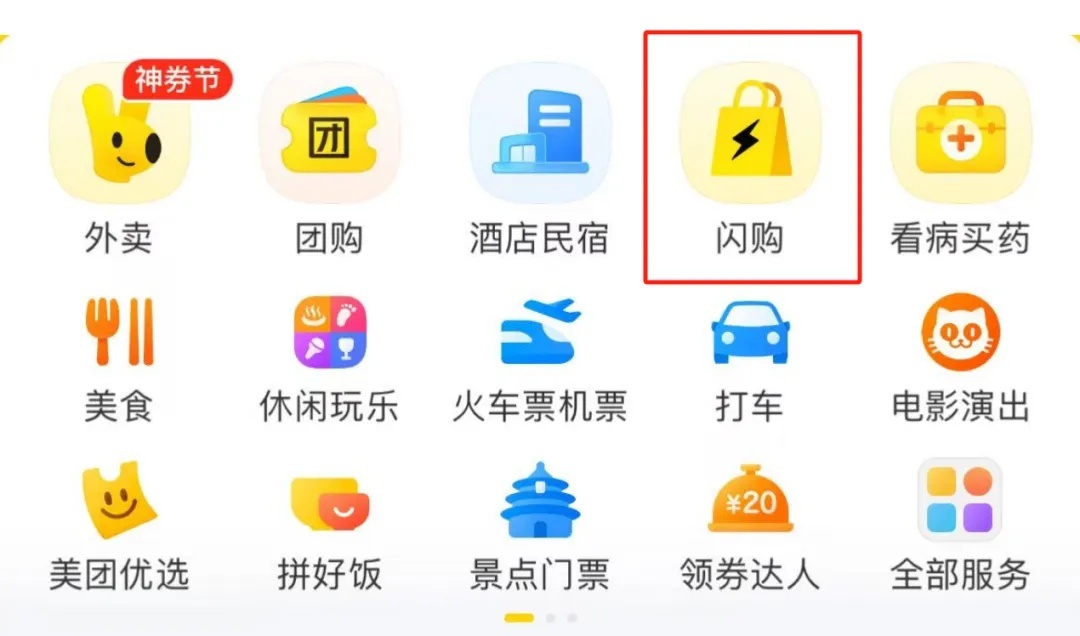
However, it hasn’t been fully rolled out yet; you need to upgrade Meituan to the latest version to possibly see it.
With the Instant Shopping upgrade, today we’ll discuss the potential, challenges, and value of instant retail.
Potential
Meituan Instant Shopping is a business with deep moats because it relies on Meituan’s nearly 10 million food delivery riders. Like food delivery, Instant Shopping benefits from the three-sided network effects of merchants, riders, and consumers. This network effect is stronger than e-commerce’s, mainly for two reasons:
First, delivery riders, as a key part of the network, have strong exclusivity, unlike e-commerce logistics, which is entirely social infrastructure.
Second, the business is inherently time-sensitive. Consumers are sensitive to delivery times, naturally leading to a winner-takes-all accumulation effect. We can refer to ride-hailing: when you’re in a remote area, calling a Didi might take only 5 minutes, while other platforms might not have cars available or have longer wait times. In such cases, Didi has an overwhelming advantage. The logic is the same for food delivery or Instant Shopping.
This is why platforms like Meituan and Ele.me have strong momentum when entering instant retail.
Meituan Food Delivery currently holds about 70% of the market share. We estimate Instant Shopping’s market share will reach around 60%, close to food delivery but slightly lower because Instant Shopping’s time sensitivity is weaker than food delivery’s.
According to our predictions in the article 'Who Will Dominate the Trillion-Yuan Instant Retail Market in the Future?', the instant retail industry will reach around 770 billion in scale by 2025 and is expected to surpass 1 trillion by 2026.
By 2025, Instant Shopping’s scale is expected to reach around 350 billion, and by 2026, it will approach 450 billion, accounting for 45% of the entire instant retail industry. Including Xiaoxiang, Meituan’s instant retail share could reach around 52%.
More important than market share is the ceiling of the entire instant retail market.
This is still highly debated. Some investors believe that, as a niche demand for urgent, fast, and flexible needs, instant retail’s ceiling won’t be too high, capping at around 1.5 trillion due to its inherent price disadvantage.
Others argue that while instant retail initially meets niche demands like urgency and speed, as the instant delivery network expands—especially with declining delivery costs—the supply richness and competition intensity will significantly increase. This will lead to more brand-side resource allocation, potentially achieving relatively cheaper prices and eventually becoming one of the three core retail scenarios alongside e-commerce and offline.
I think it’s too vague to generalize the pros and cons of the entire instant retail market. It’s better to analyze by category.
Among the various retail categories, the core categories suitable for online development include:
Fresh produce, 3C electronics, home appliances, apparel, footwear, bags, beauty and skincare, stationery, personal and household cleaning, home furnishings, medicine, contraceptives and adult products, flowers, watches and glasses, sports and outdoor, automotive supplies, and alcohol—15 major categories in total.
Shelf e-commerce will likely maintain dominance in 9 categories: 3C electronics, home appliances, apparel, footwear, bags, beauty and skincare, watches and glasses, sports and outdoor, home furnishings, automotive supplies, and stationery. These categories either align with high-price attributes (e.g., 3C electronics, home appliances, watches and glasses, automotive supplies) or lean toward long-tail attributes (e.g., apparel, footwear, bags, beauty and skincare, sports and outdoor, home furnishings, stationery). Some also have customization aspects (e.g., automotive supplies—many products are vehicle-specific; home furnishings—some renovation items require customization).
Instant retail already holds an advantage over self-operated e-commerce in 5 categories: fresh produce, medicine, contraceptives and adult products, flowers, and alcohol.
Personal and household cleaning is still dominated by self-operated e-commerce, but instant retail may catch up in the long run.
Why does instant retail have an advantage over self-operated e-commerce in fresh produce, medicine, contraceptives and adult products, flowers, and alcohol? Mainly because these categories have stronger emergency attributes and lower unit prices. The emergency nature means broader demand, and the low unit price means local supply chain costs aren’t at a disadvantage compared to self-operated e-commerce.
High-value items like smartphones, electronics, and large appliances are more suited to self-operated e-commerce because they are more planned purchases, and a 1% price difference can mean tens or hundreds of yuan. Under economies of scale, self-operated e-commerce’s massive regional warehouse and distribution systems greatly mitigate cost impacts.
For low-price items like fresh produce, medicine, contraceptives and adult products, flowers, alcohol, and personal and household cleaning, the added warehousing and distribution costs of self-operated e-commerce erase any price advantage, while the next-day delivery time lag is infinitely magnified by 30-minute instant delivery.
Overall, low-price, high-frequency, mass-market, and low-planning purchases will likely become increasingly suited to instant retail. Conversely, high-price, low-frequency, long-tail, and highly planned purchases will remain dominated by e-commerce. Offline stores will gradually shift toward warehouse or hybrid warehouse-store models.
If we generally agree with the above analysis of different categories’ current status and future trends, we can predict their scale ceilings.

Long-term, the online penetration rates for fresh produce, medicine, flowers, contraceptives and adult products, alcohol, and personal and household cleaning are expected to reach 35%, 50%, 70%, 80%, 40%, and 50%, respectively. Even if their overall scales remain unchanged, the corresponding online consumption scales would reach 2.45 trillion, 325 billion, 161 billion, 157.5 billion, 460 billion, and 145 billion, respectively. Instant retail’s share of online sales in these categories is projected to reach 50%, 70%, 50%, 80%, 50%, and 30%, corresponding to fresh produce (1.23 trillion), medicine (227.5 billion), flowers (80.5 billion), contraceptives and adult products (126 billion), alcohol (230 billion), and personal and household cleaning (43.5 billion), totaling 1.9375 trillion. Including other categories, the total instant retail scale could reach 2.5–3 trillion.
If Meituan can capture 60% of the instant retail market, its potential GMV could reach 1.5–1.8 trillion.
These projections assume no growth in overall retail. If retail continues to grow, instant retail’s potential will be even greater.
Challenges
To achieve these goals, the instant retail industry still faces two major challenges.
The first is supply-side disadvantages; the second is delivery-side costs.
On the supply side, past disadvantages included insufficient supply, inflated prices, and lack of after-sales guarantees. Over the last three years, with competitors flooding in—platform-based instant retail like Instant Shopping, Ele.me’s All-in-One Supermarket, and JD Daojia; front warehouse models like Xiaoxiang Supermarket, Dingdong Maicai, and Pinduoduo’s Puduoduo; warehouse-store hybrids like Alibaba’s Hema and JD’s 7Fresh; and supermarkets and membership warehouses like Walmart, Sam’s Club, and Costco—the severe supply shortage has been largely alleviated. Meituan’s heavy investment in Lightning Warehouses has now gathered over 30,000 such warehouses, easing supply shortages in lower-tier markets. More importantly, by controlling warehousing management and some procurement, Meituan has significantly improved price competitiveness. Integrated warehousing and procurement are expected to gradually narrow the cost gap between Instant Shopping and self-operated e-commerce. As the industry develops, after-sales management will also improve.
In fact, front warehouse and warehouse-store hybrid models can perfectly solve procurement costs, warehousing management, and after-sales issues. But these models have high overall operational costs, making it harder to expand into lower-tier markets, mainly active in economically developed first- and second-tier cities.
Delivery-side costs have gradually declined with the expansion of the instant delivery system and the crowding of workers. But this cost optimization has a ceiling. The inflection point can only come with AI advancements—unmanned vehicles and drones will one day be far cheaper than human labor, at which point instant retail’s disadvantages will disappear.
By then, we believe it’s highly likely that instant retail will become one of the three core retail scenarios alongside e-commerce and offline.
Value
Amid escalating trade wars and increasingly uncertain consumption environments, instant retail is the most certain growth area in the entire consumer market.
First, it doesn’t reduce the value of offline retail at all. All orders ultimately require processing, packaging, and delivery through offline stores or warehouses, making it very friendly to offline consumption.
Second, it creates massive incremental value. Take Meituan Instant Shopping: in the three years since Lightning Warehouses launched, daily orders have surged to around 5 million, with nighttime orders (9 PM to 6 AM) accounting for 26%. 124 million consumers place orders via Instant Shopping at night, a time when offline stores are usually closed. Instant Shopping has turned instant consumption into a 24/7 business. Even during the day, many instant purchases are 'miss it and it’s gone' opportunities.
Thus, for offline retailers, instant retail is like a knight in shining armor during a crisis, giving offline stores internet wings, upgrading them from passive to active sales models.
This model not only adds many community front warehouses but also popularizes the Lightning Warehouse model, directly creating many jobs. The industry already handles nearly 7.5 billion instant retail orders annually, creating over 860,000 new rider jobs—assuming an average annual income of 50,000 yuan per rider. These are just the direct new jobs; if we further calculate the value created for upstream and downstream supply chains, the indirect job creation would be even larger.
For consumers, instant retail also provides irreplaceable life enrichment and convenience, achieved at low cost and high quality.
For the entire retail ecosystem, it essentially transfers value from commercial real estate. Many stores and warehouses have moved from high-traffic areas to communities, underground warehouses, or even remote suburbs, saving rental costs that would have gone to commercial real estate and redirecting value to consumers, merchants, and riders.
Instant retail is a sunrise industry, like e-commerce, capable of accommodating many players. The entire internet industry is a huge beneficiary of China’s market economy. Market issues are best left to the market—we’re all in the same boat. $MEITUAN(03690.HK)
The copyright of this article belongs to the original author/organization.
The views expressed herein are solely those of the author and do not reflect the stance of the platform. The content is intended for investment reference purposes only and shall not be considered as investment advice. Please contact us if you have any questions or suggestions regarding the content services provided by the platform.
