


This company could be the next 100-bagger

This article was first published on May 5th. This is just my personal investment tracking and does not constitute any investment advice. Please proceed with caution.
Hims, short for Hims & Hers Health, is a personalized telemedicine platform founded in 2017 by Andrew Dudum, Jack Abraham, and Hilary Coles. It aims to provide personalized, convenient, and private healthcare services digitally. Initially focused on men's health—colloquially speaking, selling erectile dysfunction meds online—it has since expanded into women's health, mental health, skincare, and weight loss products.
The company's current Chairman and CEO is Andrew Dudum, whose background is anything but ordinary. Born in 1988 in San Francisco and raised in an entrepreneurial family, he once dreamed of becoming a rock star but ultimately became an accomplished cellist.

(Andrew Dudum, Chairman and CEO of Hims & Hers Health)
How accomplished? He has performed cello concerts across the U.S. and Europe, including at Carnegie Hall. But another dream of his ultimately shone brighter: after high school, he attended the Wharton School at the University of Pennsylvania, where he studied management and economics, becoming an alumnus of Trump. This might explain why Hims donated $1 million to Trump before his second presidential term.
In short, Dudum is no ordinary figure. At just 37, he already has over a decade of serial entrepreneurship under his belt. At 25, he founded a venture capital fund and startup incubator with backing from Silicon Valley heavyweights like Peter Thiel and Marc Andreessen. In 2020, he was named one of Fortune's "40 Under 40" global business leaders.
Both Peter Thiel and Marc Andreessen are Trump supporters. Combined with Dudum's alumni ties to Trump and the $1 million "pledge" in early 2025, this could help Hims face less headwind as it challenges traditional healthcare.
I. Hims Has 10x Potential in the Short Term
Note: This doesn’t mean Hims will definitely become a 10x or 100x stock. Don’t get carried away.
Here’s my brief logic:
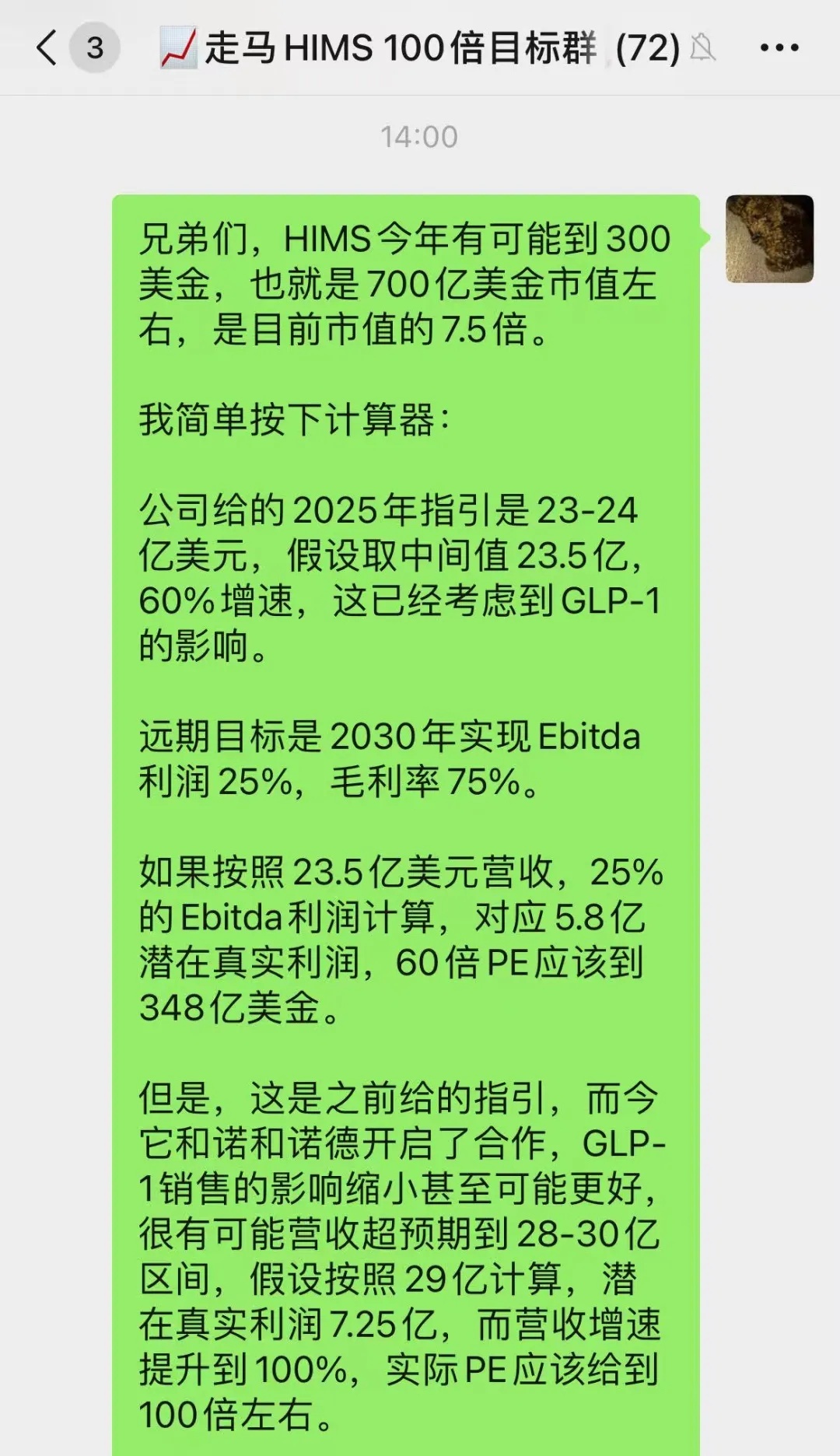
Hims reported $1.48 billion in revenue for 2024, with 2025 guidance at $2.3–2.4 billion (midpoint: $2.35 billion), implying ~60% growth. Note: This guidance was issued after the FDA announced the end of the semaglutide shortage—which could impact Hims' weight-loss drug sales—yet the company still expects to outperform. With its partnership with Novo Nordisk, the odds of Hims exceeding 2025 revenue expectations are near 100%.
The company’s long-term margin target is 25% EBITDA and 75% gross margin by 2030. Assuming this is achieved—historically, Hims has beaten guidance—2025 implied earnings would be $590 million at a 60% growth rate. A 60x P/E multiple would imply a $35 billion market cap or ~$150/share.
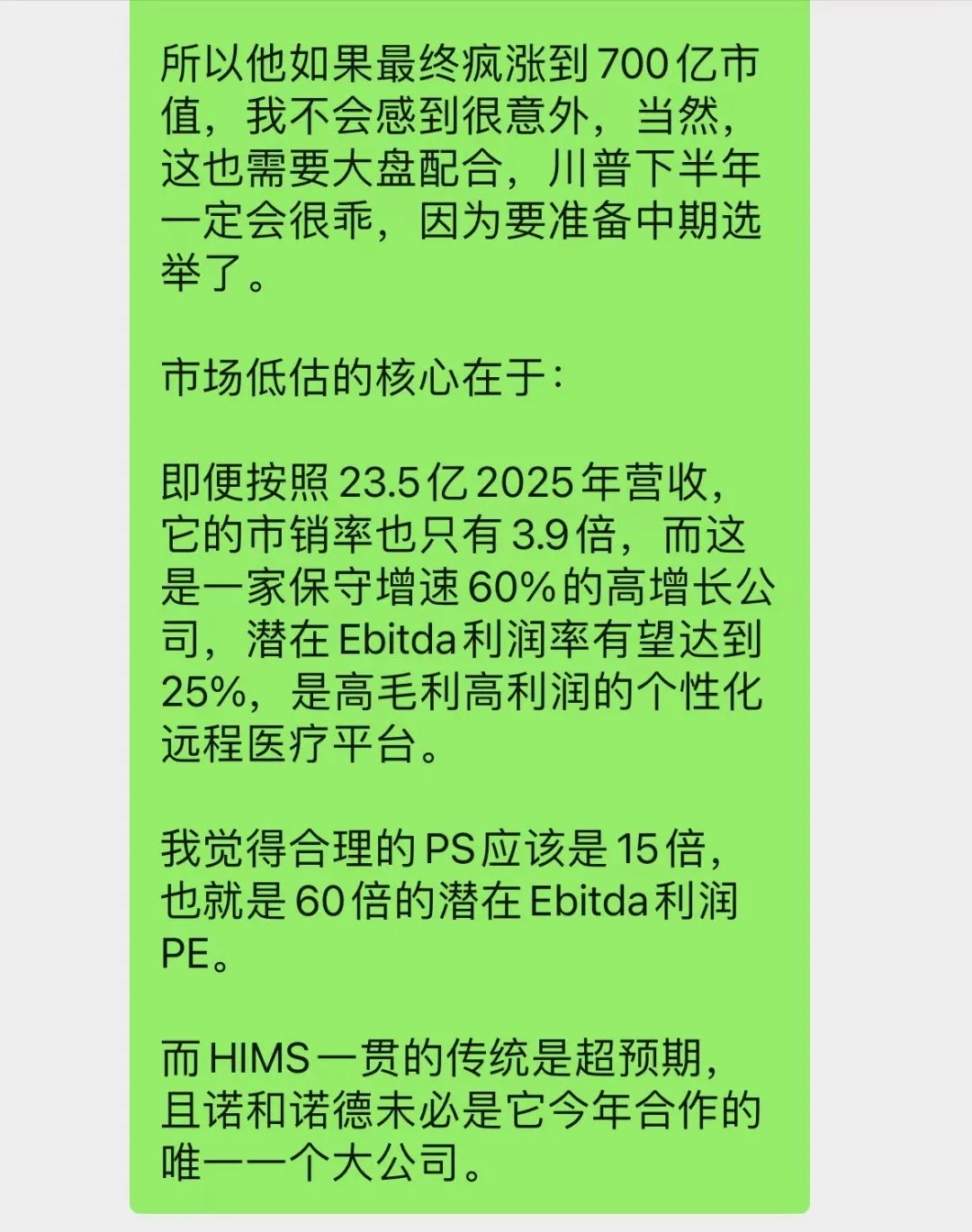
Currently, Hims trades at $40/share ($9.1 billion market cap), with a 2025 P/S of just 3.9x. A 25% EBITDA margin implies a forward P/E of only 15.5x—unjustifiably low for a company growing at 60% (likely faster). A 15x P/S (60x implied P/E) is more reasonable here.
We project Hims could hit $2.8–3.0 billion in 2025 revenue (midpoint: $2.9 billion), implying 95.9% growth and $725 million in earnings. Higher growth warrants a higher multiple—a 96x P/E would imply a $70 billion market cap.
Novo Nordisk is Hims' first major partnership this year, but likely not the last. How this plays out remains to be seen.
II. The 100x Long-Term Thesis
Hims aims to simplify healthcare access, bridge gaps in sensitive health issues, and destigmatize care—a massive market.
How massive? The U.S. has 340 million people (and growing). In 2023, per capita healthcare spending (including insurance and out-of-pocket) was ~$13,000, totaling $4.4 trillion (17–18% of GDP)—the highest globally.
Breakdown: 40% federal/state insurance, 30% private insurance, 10% out-of-pocket, 10% employer-paid, 10% other.
Over the next 5–10 years, U.S. healthcare spending will easily surpass $6 trillion. Hims starts in the U.S. but won’t stop there—Canada, Europe, and Australia are potential markets, creating a $10 trillion opportunity.
Most consumer sectors have been digitized; healthcare remains a fortress. Capturing just 1% of this market would mean $100 billion in revenue. At 25% margins and 30x P/E, that’s a $750 billion market cap—a 100x return from recent prices ($25–30).

Not all healthcare spending can be digitized:
Hospital services (31%: inpatient, ER, surgery) are unlikely candidates. Physician/clinical services (20%: outpatient, labs) are prime targets for telemedicine like Hims. Prescription drugs (10%) and durable equipment (17%) are also digitizable. Nursing homes (8%), dental (4%), admin (7%), and public health (3%) are harder to disrupt.
~50% of the $10 trillion market (~$5 trillion) is addressable. A leader could capture 10% ($500 billion–$1 trillion). Hims, as a potential leader, might achieve this scale long-term.
At $500 billion revenue and 8% margins, that’s $40 billion in profit—on par with Meta’s earnings and close to Amazon’s revenue.
Dudum often compares Hims to Amazon and Netflix—Amazon for vertical integration, Netflix for its subscription model.
III. Qualitative Factors
Why I believe this story:
1. Healthcare digitization is inevitable. Personalized AI-driven care aligns with macro trends.
2. Overprotected IP in pharma needs disruptors. Hims has grassroots support as traditional systems fail ordinary people.
IV. The Pinduoduo of Telemedicine
Though Dudum likens Hims to Amazon/Netflix, I see it as the Pinduoduo of telemedicine. Key parallels:
1. Bad PR
Hims faces stigma ("pill-pusher," "scam") and attacks from IP incumbents.
2. Resilience
Founded in 2017, Hims went public via SPAC in 2021 at a $1.6 billion valuation—now up 6x (10x at peaks). Revenue grew 10x from 2020 ($149M) to 2024 ($1.48B), with a 78% CAGR.
Subscribers grew from 610K (2021) to 2.23M (2024):

User growth hasn’t slowed in 8 quarters:

2024 saw acceleration.
3. Consumer-Centric
Despite media backlash, users love Hims. It’s profitable and scales fast by addressing unmet needs (e.g., ED, hair loss) for underserved demographics.
4. Marketing Prowess
Hims’ customer acquisition is relentless—even polarizing. Its Super Bowl ad spiked shares 20%.
These traits mirror Pinduoduo: similar PR battles, growth, and non-consensus appeal.
V. Moats & Risks
I once misjudged Hims’ moat, selling during Meta’s ad policy changes and Amazon’s telemedicine entry. But the market corrected—Amazon can’t stop Hims because:
1. Amazon benefits from the status quo; Hims disrupts it.
2. Healthcare’s complexity favors vertical integration. Hims’ full-stack platform (providers, EHRs, pharmacies, telehealth) took 7 years to build.
Brand, data (millions of consults), and regulatory savvy (e.g., Trump ties) widen its moat.
Final Warning: Hims remains a high-risk, high-reward bet. Volatility is guaranteed—bad PR, misses, regulation, dilution, lawsuits, shorts, or insider sales could crater the stock.
Invest cautiously. This is not advice—just my tracking. $Hims & Hers Health(HIMS.US) $PDD(PDD.US)
The copyright of this article belongs to the original author/organization.
The views expressed herein are solely those of the author and do not reflect the stance of the platform. The content is intended for investment reference purposes only and shall not be considered as investment advice. Please contact us if you have any questions or suggestions regarding the content services provided by the platform.
