


JD.com's Q1 report: Performance exceeds expectations but balance sheet has hidden concerns

For a company, the balance sheet is the "substance," while revenue and profit data are the "appearance." The best scenario is when both the balance sheet and revenue/profit are strong. Other situations need to be evaluated case by case.
In Q1 2025, JD.com exceeded expectations in terms of revenue and profit, but there are concerns about cash flow and the balance sheet. Considering the increased expenses from expanding the food delivery business in Q2, short-term cash flow may face further pressure.
However, historically, Q2 has always been JD.com's strongest quarter for cash flow, thanks to the 618 shopping festival, which JD pioneered. This year, the impact of food delivery investments on cash flow might not be severe in Q2, but Q3 could be the most challenging period—if JD continues heavy subsidies in the food delivery market.
A simple conclusion: The price war in the food delivery industry will normalize by the end of Q3 at the latest.
This may not be entirely accurate, so let's wait and see.
First, let’s look at JD.com's balance sheet condition:

In Q1 2025, JD.com's total current assets were 357.2 billion yuan, total current liabilities were 284.1 billion yuan, and net current assets were 73.1 billion yuan. Current assets refer to assets the company can utilize within 12 months, while current liabilities are debts due within 12 months.
Current Ratio = Current Assets / Current Liabilities;
Quick Ratio = (Current Assets - Inventory - Prepayments) / Current Liabilities.
These two ratios reflect the strength of a company's balance sheet. Higher ratios indicate stronger solvency and a healthier balance sheet, but excessively high ratios (e.g., an overly high current ratio) may suggest overly conservative management and idle capital.
Generally, a current ratio of 1.5-2 and a quick ratio of around 1 are ideal for the retail industry.
As an internet retail company, JD.com's slightly lower ratios than the industry average are acceptable. However, compared to its own historical performance, the current balance sheet is relatively tight, though it has improved from the bottom—Q1 2024.
But this recovery is unstable:
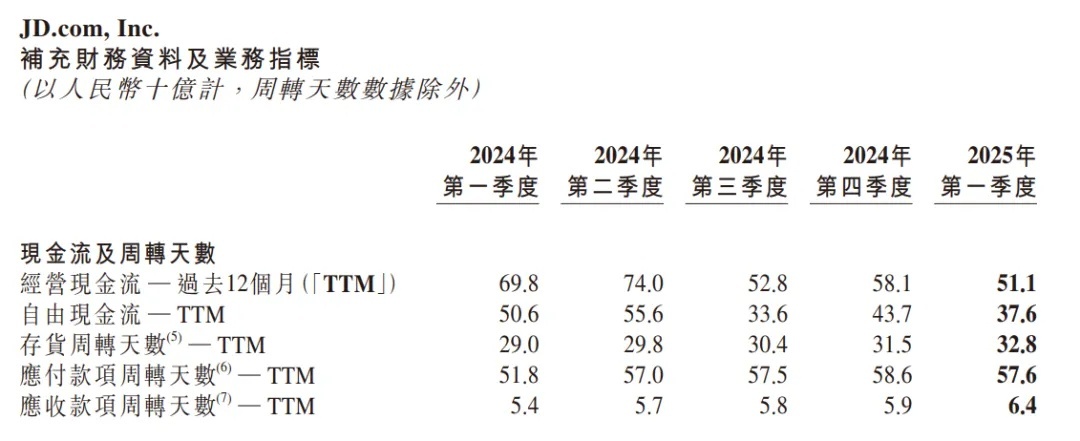
On one hand, JD.com's inventory turnover days have been increasing, indicating declining retail efficiency.
On the other hand, accounts payable turnover days hit a record high of 58.6 days in Q4 last year, slightly dropping to 57.6 days this quarter—still the second-highest ever. This minor decline may be due to seasonal fluctuations in e-commerce rather than a trend reversal, suggesting JD is further extending payment cycles to suppliers.
Meanwhile, increased investments in new businesses like food delivery will further strain cash flow.
Next, let’s examine cash flow:

Despite longer accounts payable cycles, JD.com's free cash flow remains weak, at -21.6 billion yuan in Q1 2025. Due to settlement cycles, JD's cash flow is highly seasonal, with a gradual improvement over the past three years on an annual basis.
However, based on the trailing 12-month (TTM) free cash flow, JD's free cash flow-TTM dropped to 37.6 billion yuan by the end of March. With a current Hong Kong market cap of 392.5 billion HKD (~365 billion RMB), the TTM free cash flow PE is about 9.7x—not expensive, but further cash burn and declining free cash flow could lead to a "low valuation trap."
Operationally, JD.com outperformed expectations, delivering excellent results.
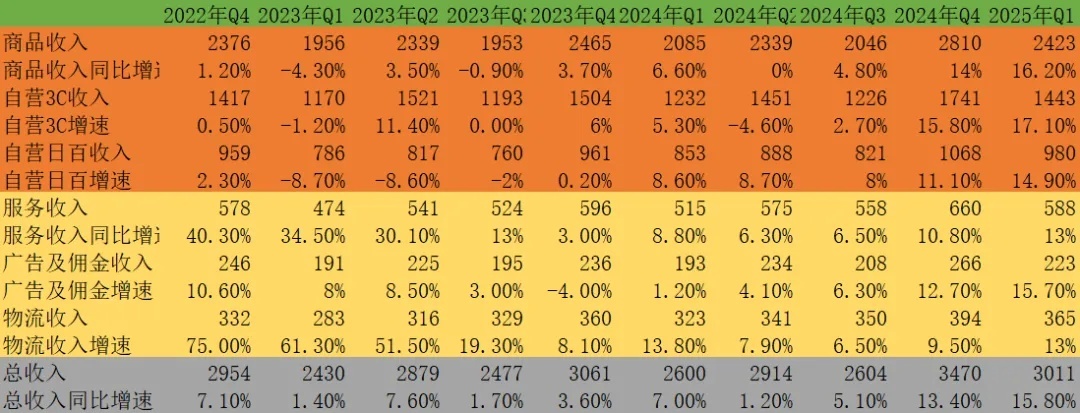
Q1 2025 total revenue was 301.1 billion yuan, up 15.8% YoY, beating market expectations of 290.3 billion yuan by 3.7%.
Product revenue grew 16.2% YoY to 242.3 billion yuan, likely 6-7 percentage points faster than GMV growth, implying JD's self-operated GMV grew around 10%—far outpacing the industry average of 5.7% for online physical goods sales, highlighting the impact of government subsidies.
Certain categories grew even faster at 17.1%, further proving the subsidy effect. Daily necessities self-operated sales rose 14.9%, with GMV growth likely at 8-9%, also above the industry average.
Service revenue grew 13%, suggesting third-party GMV growth of ~7%, slightly above the industry mean.
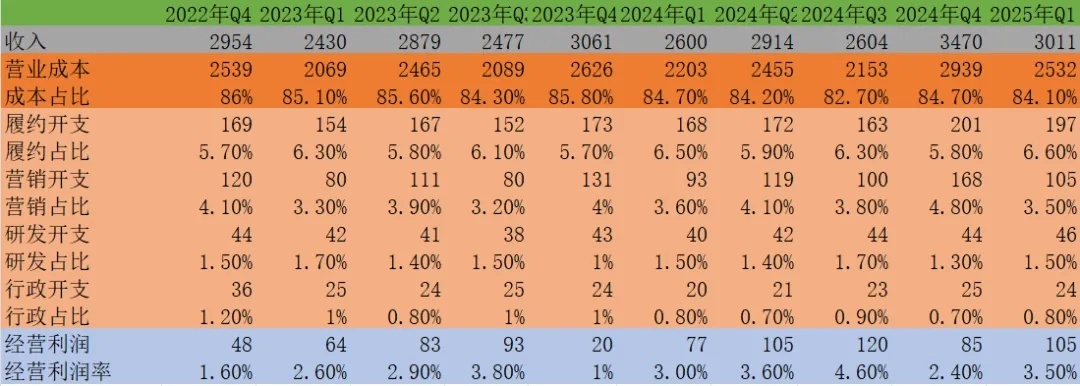
Cost of revenue as a percentage of total revenue fell to 84.1%, showcasing JD's cost control. However, fulfillment expenses rose 0.8 percentage points QoQ and 0.1 percentage points YoY, possibly due to lower average order values under subsidies. Other expenses had minimal impact, with no sudden changes in operating costs. Operating profit reached 10.5 billion yuan, far exceeding the expected 9 billion yuan.
Summary:
Thanks to government subsidies, JD.com delivered better-than-expected results. However, the subsidy window is narrowing, and competitors are catching up.
The focus in Q2 may not be 618 performance but how food delivery expansion affects profits and cash flow.

JD's free cash flow and balance sheet remain stable for now, but if new business margins keep declining, the trajectory of overall profits, cash flow, and the balance sheet will be the market's top concern.
In short, JD's Q1 report was neither exceptionally good nor bad. Looking ahead, there are no major opportunities, but risks are relatively contained—limited upside, solid downside, and low volatility. $JD.com(JD.US) $JD-SW(09618.HK)
The copyright of this article belongs to the original author/organization.
The views expressed herein are solely those of the author and do not reflect the stance of the platform. The content is intended for investment reference purposes only and shall not be considered as investment advice. Please contact us if you have any questions or suggestions regarding the content services provided by the platform.
