


JD.com's "ZTE": flash sales are unavoidable


With the founder's high-profile return, JD.com has recently shown signs of a "revival." The company has ambitiously launched a food delivery business, and total revenue growth has also picked up momentum, as if everything has returned to the bustling scene of the past.
In the court of public opinion, JD.com seems poised to reclaim the C-spot, but the capital market tells a different story. As of writing, the company's P/E ratio remains below 10x, which is clearly not the valuation a high-growth company should have.
The disconnect between public opinion and the capital market raises questions: Is the market misjudging JD.com, or are there hidden secrets about the company yet to be uncovered? This has piqued our curiosity.
Key takeaways from this article:
First, JD.com's "revival" is driven not only by government subsidies but also by its self-operated procurement and sales team's bargaining power in the supply chain. Under this dual boost, both revenue and profits have rebounded.
Second, JD.com's high-profile entry into food delivery is actually a defensive move to protect its moat.
Third, the benefits of shifting from exports to domestic sales are hard to digest.
The two-pronged approach to revival: Government subsidies and procurement
In Q1 2025, JD.com's total revenue grew 15.8% YoY to RMB 301.1 billion, while operating profit increased from RMB 7.7 billion in the same period last year to RMB 10.5 billion. Both scale and profits saw significant gains, marking a strong quarter.
Market interpretations often attribute this performance to government subsidies. JD.com's unique advantages (high 3C product share and corporate structure) allowed it to quickly capitalize on these subsidies and local appliance incentives, ushering in a golden period since late 2024.
While this view is widely accepted, we offer another perspective: JD.com's bargaining power in the supply chain through its self-operated business.
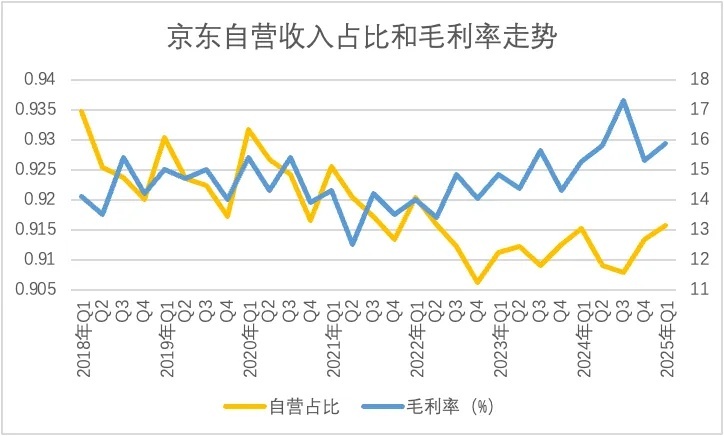
During the unusual cycle of 2020-2022, JD.com's self-operated share and gross margin both declined (as its open platform grew rapidly). At the time, major retail platforms were focused on supporting merchants with traffic subsidies, and JD.com was also clearing inventory at discounted prices, which diluted profitability. To mitigate future risks, the company reduced inventory to lower operational burdens.
After 2023, this trend reversed, with self-operated share and gross margin rising in tandem. By Q1 2025, self-operated share had returned to a two-year high (outpacing open platform growth). This seems counterintuitive: self-operated gross margins are typically lower than open platforms, so higher self-operated share should theoretically dilute margins. Reality, however, defies theory.
This reflects JD.com's bargaining power with upstream suppliers:
1) In recent years, China's listed supermarket chains have struggled. After 2023, offline retail failed to rebound, facing one challenge after another. For suppliers, traditional sales channels became unreliable (even former industry leader Yonghui sought help from Pang Donglai for a "makeover"). As a major bulk buyer, JD.com's position strengthened, granting it "pricing power" over suppliers—especially in daily necessities, where gross margins improved.
In early 2024, JD.com leveraged its procurement advantage to wage price wars while maintaining high gross margins, showcasing its scale benefits for merchants.
2) In late 2024, with the rollout of government subsidies, JD.com captured this opportunity, with 3C products becoming a key driver of gross margins.
JD.com's "revival" isn't just luck—its supermarket procurement team played a crucial role. This also explains JD.com's recent wariness of flash sales:
As offline supermarkets join online flash sales led by Meituan and Alibaba, this could reduce demand for JD.com's marketplace and weaken its supply chain bargaining power (suppliers gain leverage). If unchecked, this could hurt JD.com's profits and revenue, undermining the sustainability of its "revival."
To turn the tables, JD.com is using high-frequency food delivery to attract users and build logistics capacity, with the goal of expanding into multi-category flash sales.
As one of the oldest forms of commerce, retail is simple (profiting from markups, and later, selling traffic online). Channels always reign supreme. JD.com built an efficient, massive self-operated system, creating a formidable moat.
Yet retail evolves rapidly. When flash sales disrupted traditional e-commerce, JD.com was forced to compete. While its recent moves seem proactive, they were ultimately necessary.
Export-to-domestic sales also hinge on flash sales
Amid geopolitical turmoil, export-oriented businesses face disruptions. JD.com and other retailers have drawn attention with "export-to-domestic sales," sparking optimism about increased platform supply.
In theory, this holds, but the data tells a different story.
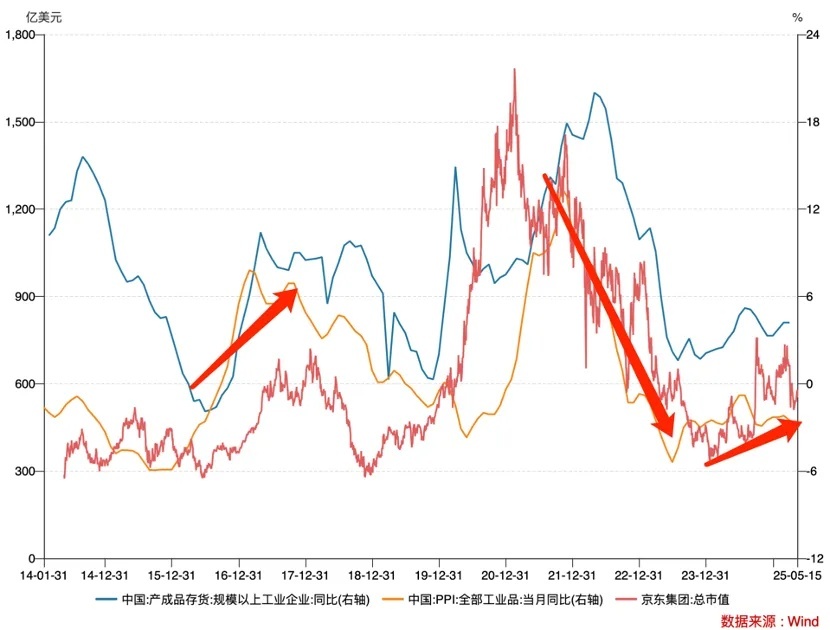
JD.com started with self-operated sales, centered on markups. Its logistics speed made it a symbol of consumption upgrades. This logic held in boom cycles: rising demand lifted prices, and JD.com amplified profits through "spread" gains, winning investor favor.
In downturns, price-sensitive users viewed JD.com's premium positioning as a liability, dampening market sentiment.
After 2022, China entered a prolonged inventory reduction cycle. Post-2023, macro indicators like PPI hovered below zero, reflecting weak demand—a tough environment for JD.com.
What would export-to-domestic sales bring?
1) Historically, the 2018 trade war birthed Pinduoduo, and the post-2020 inventory cycle fueled live commerce. Whether forced or voluntary, businesses needed "quick sales" and new traffic platforms.
2) Exporters turning domestic face fiercer competition. With prolonged industry slumps, small business confidence is shattered, leaving little energy for cutthroat rivalry.
Thus, to capitalize on export-to-domestic sales, platforms need strong sales volume and growth momentum—otherwise, they can't solve exporters' survival woes.
This underscores JD.com's urgency in food delivery: to quickly grow its user base and logistics, then pivot to flash sales to defend its moat.
While we understand JD.com's logic, short-term risks warrant caution:
1) Soaring costs: Food delivery's high subsidies and traffic buys in Q1 2025 may impact earnings for 1-2 quarters, as transitions often hit financials.
2) Cash flow: JD.com thrives on "payment gaps," with accounts payable stretching to 57.6 days—a cash flow bedrock and bargaining power indicator. This metric has little room to grow, so we'll watch operating and free cash flow closely for operational safety.
On the surface, JD.com is in a "revival," but its longevity depends on post-subsidy performance. JD.com's 2025 earnings will be telling—perhaps why its P/E lingers below 10x despite the hype.
$JD.com(JD.US)
The copyright of this article belongs to the original author/organization.
The views expressed herein are solely those of the author and do not reflect the stance of the platform. The content is intended for investment reference purposes only and shall not be considered as investment advice. Please contact us if you have any questions or suggestions regarding the content services provided by the platform.
