


First profit decline in the semi-annual report! Why can't multiple first-mover products drive growth for Beta Pharma?

The "first stock of innovative drugs" is struggling to maintain its superficial "glamour".
According to the latest financial report, in the first half of this year, Beta Pharma achieved operating revenue of 1.731 billion yuan, a year-on-year increase of 15.37%; net profit attributable to the parent company was 140 million yuan, a year-on-year decrease of 37.53%.

The investment market is also showing signs of retreat. Currently, Beta Pharma's stock price is significantly weaker, having fallen below the 70 yuan mark, closing at 64.08 yuan per share as of August 21.
Specifically, the second quarter had the greatest impact on Beta Pharma's overall performance in the first half of the year. The quarter's operating revenue reached 814 million yuan, a year-on-year increase of 6.4%, while net profit attributable to the parent company was 39.81 million yuan, a year-on-year decrease of 68.4%. As a result, this marks the first time since 2022 that Beta Pharma's semi-annual report has shown a year-on-year decline in net profit.
With the "dignity" of simultaneous revenue and profit growth shattered, some harsher realities have also come to light.
8 drugs on the market: Is commercial promotion more important than R&D?
Regarding the significant decline in net profit in the first half of the year, Beta Pharma explained in its financial report that it was mainly due to increased expenses such as depreciation and amortization included in current profits and losses. However, a closer look at Beta Pharma's expense structure reveals a notable issue: "prioritizing sales over R&D."
The financial report shows that in the first half of the year, Beta Pharma's R&D investment was 299 million yuan, a year-on-year decrease of 21.8%, while R&D expenses were 226 million yuan, a year-on-year decrease of 10.40%. In contrast, sales expenses reached 594 million yuan, a year-on-year increase of 13.34%. Additionally, administrative expenses during the reporting period were 261 million yuan, a year-on-year increase of 23.47%, and financial expenses were 39.5305 million yuan, a year-on-year increase of 118.06%.
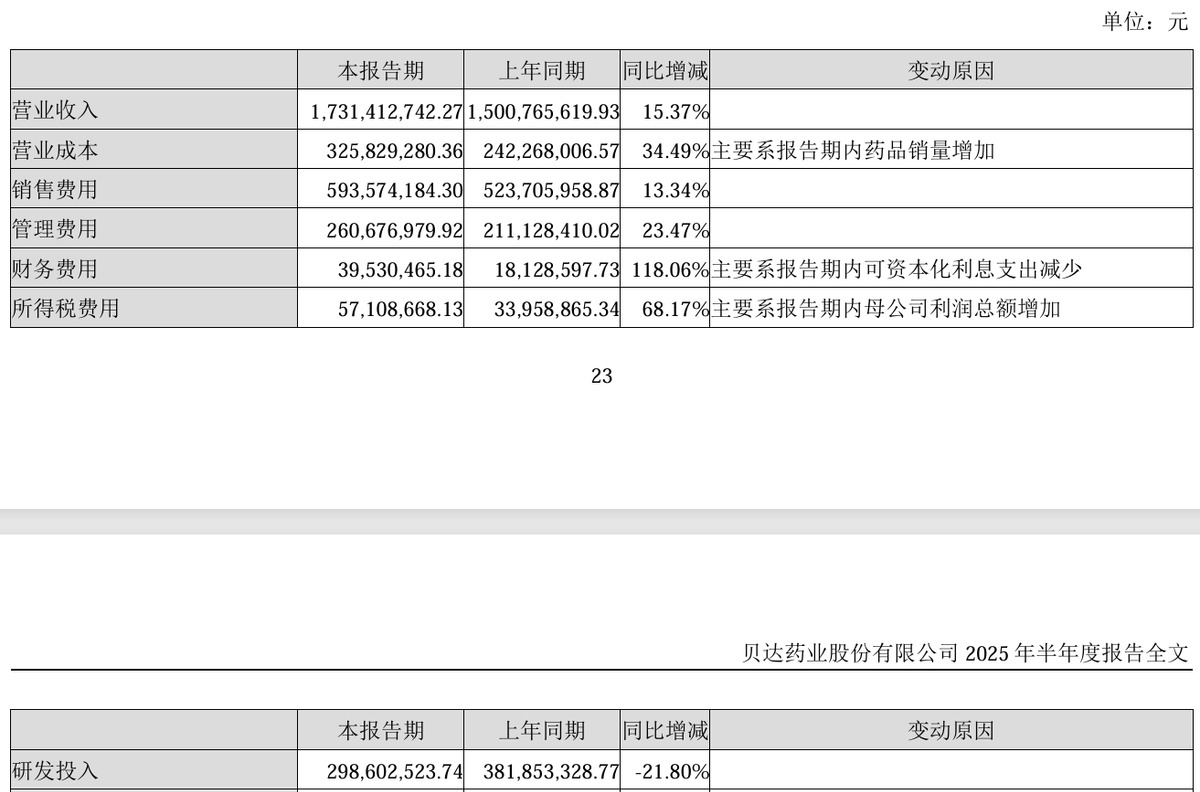
It is understood that since the third quarter of 2023, Beta Pharma's R&D expenditures have been shrinking, while sales expenses have gradually increased, indicating that the company's strategic focus is clearly on market promotion.
Accelerating commercialization is indeed a pressing need for Beta Pharma at the moment.
The financial report shows that the company has 8 drugs on the market, including Icotinib Hydrochloride Tablets (Conmana), Ensartinib Hydrochloride Capsules (Bemena), Bevacizumab Injection (Beiantin), Befotertinib Mesylate Capsules (Saimena), Vorolanib Tablets (Fumeina), Tirabrutinib Hydrochloride Capsules (Kangmeina), the strategic collaboration product Trastuzumab for Injection (Anruize), and Recombinant Human Albumin Injection (Aofumin). Among these, Kangmeina and Aofumin were only approved for market this year.
With the commercialization product lineup becoming increasingly robust, Beta Pharma is naturally eager to boost sales.
According to the financial report, Beta Pharma has assembled a commercial operations team focused on promoting innovative oncology drugs. During the reporting period, the commercial team strengthened its core advantage in academic promotion through a series of anniversary academic events, the SUCCESS Innovative Drug Experience Sharing Conference, the BECOMES Beta Summit, and the Gongshoudao Thoracic Surgery Forum. These platforms facilitated cross-regional expert exchanges and systematically showcased the differentiated advantages of the company's innovative drugs, promoting their clinical application.
Meanwhile, healthcare policies have also accelerated product sales, contributing to Beta Pharma's revenue growth. However, given the decline in profits, the company's current revenue scale remains relatively small and cannot fully cover expenses, making it difficult to release profits accordingly.
It can be said that Beta Pharma's "sales-first" strategy has not yet achieved ideal results. So, what obstacles are hindering Beta Pharma's product sales? Is the road ahead still bright?
Sluggish product sales, tight finances, and looming debt crisis
In terms of product portfolio, Beta Pharma actually holds a significant first-mover advantage.
The financial report notes that the company has achieved several "first in China" milestones in its core therapeutic areas.
For example, in the field of lung cancer treatment, it successfully developed and commercialized Conmana, the first EGFR-TKI in China approved for postoperative treatment of early-stage lung cancer, and Bemena, the first domestically developed new drug for treating ALK-positive advanced non-small cell lung cancer (NSCLC). In the field of kidney cancer treatment, it achieved the approval of Fumeina, China's first independently developed anti-angiogenic drug.
Given this, with multiple products leading the way, Beta Pharma seems well-positioned to dominate the market.
However, reality is harsh. In the EGFR-TKI field, the market is expanding, and new dominant players are emerging.
Data from CICMH shows that in 2024, China's EGFR-TKI market sales reached 20.44 billion yuan, a year-on-year increase of 19.5%. Among these, third-generation EGFR-TKIs like Osimertinib and Almonertinib contributed 17.99 billion yuan in sales, accounting for 88.0% of the market share, further solidifying their dominance. The market share of third-generation products also rose from 79.1% in 2022 to 88.0% in 2024.
As new drugs become mainstream, older drugs inevitably lose ground. In 2024, first-generation products like Gefitinib and Icotinib (e.g., Conmana) saw their market share drop to 9.9%, while second-generation products further shrank to 2.0%.
Faced with this market reality, Beta Pharma has launched multiple commercial products in recent years to diversify risks and reduce reliance on Conmana. However, competitive pressures persist.
Beta Pharma admitted in its financial report: "Currently, new treatment options are rapidly developing due to technological advancements, leading to crowded hot sectors and significant homogeneity in new drug targets. The launch of drugs with the same indications as our products has intensified market competition. Conmana and Saimena face varying degrees of competition from other EGFR-TKIs, while Bemena, Beiantin, and Fumeina are under intense competitive pressure from ALK inhibitors, bevacizumab, and kidney cancer treatments, respectively."
This highlights the importance of continued R&D investment to enhance product competitiveness, which somewhat contradicts Beta Pharma's current "sales-first" strategy.
Additionally, the transition period in building a product matrix inevitably leads to gaps, which somewhat affects sales momentum. Under these combined factors, Beta Pharma's product sales scale remains relatively limited, and profitability is also impacted.
At the same time, an even more serious issue has emerged—a debt crisis. In the semi-annual report, Beta Pharma disclosed an important accounts payable of 180 million yuan overdue for more than a year, owed to InventisBio.
It is reported that Beta Pharma signed a collaboration agreement with InventisBio to jointly develop the innovative drug Befotertinib. Upon reaching two milestone events, Beta Pharma was required to pay InventisBio 100 million yuan and 80 million yuan, respectively.
However, Beta Pharma has yet to pay these amounts. The reason can be inferred from the financial report: as of the end of the first half of the year, Beta Pharma's current assets were 1.359 billion yuan, lower than its current liabilities of 1.757 billion yuan. The current ratio has been below 1 for three and a half years since 2022.
With "revenue growth without profit growth" and relatively limited product sales, Beta Pharma's financial pressure is substantial, and milestone payments can only be temporarily deferred.$贝达药业(0BDYY.HK)
Source: Pharmaceutical Research Society
The copyright of this article belongs to the original author/organization.
The views expressed herein are solely those of the author and do not reflect the stance of the platform. The content is intended for investment reference purposes only and shall not be considered as investment advice. Please contact us if you have any questions or suggestions regarding the content services provided by the platform.
