Qualcomm and Intel join forces to challenge NVIDIA! Seeking to break the dominance of CUDA

Zhitong
2024.03.25 14:16
portai
I'm PortAI, I can summarize articles.

Qualcomm, Google, and Intel plan to break NVIDIA's monopoly in the AI field by developing a set of software and systematic tools that can support multiple AI chips. They hope to address the current AI ecosystem dominated by a few chip companies by creating an open-source AI hardware and software ecosystem. This project, named UXL, aims to enable computer code to run on any chip architecture and any hardware

NVIDIA (NVDA.US), the undisputed "dominant player" in the global AI chip field, relies on two major "core money-making tools": the unparalleled sales of the H100 AI GPU based on the breakthrough Hopper GPU architecture, and the CUDA computing platform that has been deeply cultivated in the high-performance computing field for many years. CUDA is undoubtedly the preferred software and hardware collaborative system for high-performance computing in areas such as AI training/inference. NVIDIA's current market value has climbed to $2.4 trillion, ranking third globally, with the gap between it and the second-ranked Apple narrowing.

From startups like Claude and OpenAI to global cloud service giants like Microsoft, AWS under Amazon, and Google under Alphabet, NVIDIA's ultra-high-performance AI chips and the software and hardware collaborative system CUDA have become the "lifeline" for new era AI developers at companies like Microsoft and OpenAI.

In the eyes of some AI engineers, NVIDIA's ability to capture as much as 90% of the monopolistic share in the AI chip market is mainly attributed to its high-performance AI GPU and software and hardware collaborative system CUDA. However, engineers generally believe that the "monopolistic advantage" of the CUDA software and hardware collaborative computing platform is the core reason for NVIDIA's monopoly in the AI chip market, especially as NVIDIA's competitors such as AMD (AMD.US) and AI chip startups like Groq have been introducing AI chips that rival NVIDIA's performance.

Therefore, in recent times, tech giants including Qualcomm, Google, and Intel are planning to break NVIDIA's dominance in the AI field by developing software and systematic tools that can support a variety of AI chips. This project, named UXL, aims to create an open-source AI software and hardware ecosystem that allows computer code to run on any chip architecture and any hardware, thereby addressing the current AI ecosystem dominated by a few chip companies. In addition, given the immense influence of NVIDIA's CUDA platform, UXL also plans to provide long-term support for NVIDIA's hardware and code, with the aim of promoting "diversity in AI hardware choices" and improving development efficiency.

CUDA, the Core of NVIDIA's Monopoly in AI Chips

The current demand for AI chips is incredibly strong and is likely to remain so for the foreseeable future. According to the latest forecast by market research firm Gartner, the AI chip market is expected to grow by 25.6% from the previous year to reach $67.1 billion by 2024. It is projected that by 2027, the AI chip market size will be more than double that of 2023 Reaching $119.4 billion.**

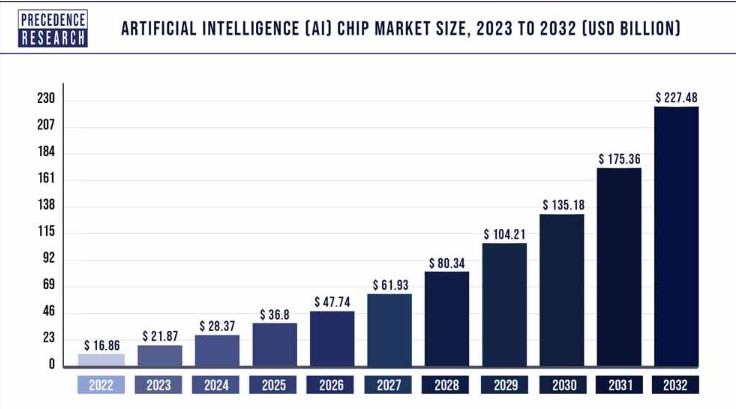
According to a recent AI chip market size forecast report released by the well-known market research firm Precedence Research, it is estimated that by 2032, the market size of AI chips covering CPU, GPU, ASIC, and FPGA will surge from around $21.9 billion in 2023 to $227.48 billion, with a compound annual growth rate of nearly 30% from 2023 to 2032.

CUDA computing platform is a parallel computing acceleration platform and programming assistance software exclusively developed by NVIDIA, allowing software developers and engineers to use NVIDIA GPUs for accelerated parallel general-purpose computing (only compatible with NVIDIA GPUs, not compatible with mainstream GPUs such as AMD and Intel). In short, the CUDA platform enables developers to leverage the powerful computing power of NVIDIA GPUs to accelerate computationally intensive tasks through software and hardware collaboration, such as applications in deep learning, scientific computing, and image processing, rather than just traditional graphics rendering.

More importantly, this acceleration technology, by providing NVIDIA-specific APIs, various libraries, and compiler support, makes parallel computing on NVIDIA GPUs more efficient and very easy for the core of AI software - the development of AI large models, making CUDA a platform that ChatGPT and other generative AI applications heavily rely on, its importance is on par with hardware systems, crucial for the development and deployment of artificial intelligence large models.

The AI software-hardware integrated ecosystem based on the CUDA computing platform has created a very broad "moat" for NVIDIA, with CUDA's high technical maturity, absolute performance optimization advantages, and extensive ecosystem support, CUDA has indeed become the most commonly used and widely adopted collaborative platform in AI research and commercial deployment. This also makes it difficult for competitors like AMD to match NVIDIA's CUDA platform in terms of integrated system and acceleration optimization level for deploying AI applications.

Qualcomm joins forces with tech giants like Intel, aiming to break NVIDIA's dominant position with CUDA!

Several tech companies, including Qualcomm (QCOM.US), Google (GOOGL.US), and Intel (INTC.US), are currently planning to develop a set of software and systematic tools that can support multiple AI accelerator chips to break NVIDIA's dominant position in the AI field, especially striving to break the monopoly of the CUDA platform. This project, named UXL, aims to create an open-source ecosystem that allows computer code to run on AI chips and hardware of any architecture, thus addressing the AI ecosystem currently dominated by a few chip giants For NVIDIA's AI chips like the H100, what is almost equally important is the CUDA software and hardware ecosystem that the company has been dedicated to building for nearly 20 years. This even makes it almost impossible for competitors like AMD and Intel to compete with the company in the field of AI chips. Globally, over 4 million developers heavily rely on NVIDIA's CUDA computing platform to build artificial intelligence and other high-performance applications.

Now, many technology companies including Qualcomm, Google, and Intel have formed an alliance called UXL, planning to weaken NVIDIA's monopoly advantage in the AI chip field by tracking NVIDIA's secret weapon - the CUDA platform that binds developers to NVIDIA's chips. They are part of a growing number of financiers and corporate groups challenging NVIDIA's absolute dominance in the artificial intelligence chip field.

Vinesh Sukumar, head of artificial intelligence and machine learning at Qualcomm, said in a media interview: "We are actually showing developers how to migrate away from the NVIDIA platform and provide a diversified computing platform."

Executives from the UXL Foundation of technology companies stated that the foundation plans to start with a technology developed by Intel called OneAPI to build a set of software and systematic tools that can provide acceleration power for various types of AI chips and help develop AI models. According to media reports, the goal of this open-source project is to make computer code run on any machine, regardless of the hardware it uses.

Bill Hugo, Director of High-Performance Computing and Chief Technology Officer at Google, said in a media interview: "This is about how we create a comprehensive open ecosystem in the context of machine learning frameworks to promote productivity improvement and hardware selection." Hugo stated that Google is one of the founding members of UXL and has helped determine the technical direction of the project.

According to media reports, the technical steering committee of UXL is preparing to finalize technical specifications in the first half of this year. Technology executives have stated that engineers plan to refine the technical details to a "mature" state by the end of this year. These executives emphasize the need to establish a solid foundation, including contributions from multiple companies that can be deployed on any chip or hardware.

In addition to some initial participating technology companies, UXL also plans to attract cloud computing giants like Amazon and Microsoft, as well as some chip manufacturers.

Some executives involved in the project have stated that since its launch in September last year, UXL has begun to accept technical contributions from third parties, including foundation members and external individuals enthusiastic about using open-source technology. Intel's OneAPI is already available, and the next step is to create a standard programming model designed for artificial intelligence.

UXL plans to allocate resources to address the most urgent computational acceleration issues dominated by a few chip giants and the relatively closed software and hardware ecosystem issues. These early plans contribute to the organization's long-term goal of attracting a large number of developers to its platform From a long-term perspective, due to the profound impact of NVIDIA CUDA, UXL's ultimate goal seems to be to support NVIDIA hardware and CUDA ecosystem code.

When asked about the efforts of open source and venture capital software to break NVIDIA's dominance in the field of artificial intelligence, NVIDIA executive Ian Buck once stated in a declaration: "The world is accelerating. New ideas for accelerated computing come from the entire AI ecosystem, which will help advance the scope of what artificial intelligence and accelerated computing can achieve."

In addition to tech giants, there are nearly 100 AI startups aiming to challenge NVIDIA's software and hardware ecosystem

The UXL Foundation's plan is one of many efforts to weaken NVIDIA's control over the software and hardware ecosystem that drives artificial intelligence. According to exclusive data compiled by PitchBook, venture capitalists and corporate funds have invested over $4 billion in 93 AI software and hardware ecosystem development projects related to breaking NVIDIA's monopoly.

PitchBook's data shows that last year, venture capital firms' interest in breaking NVIDIA's ecosystem by exploiting potential weaknesses in the software field has been increasing. In 2023, AI startups targeting vulnerabilities in NVIDIA's leadership position received slightly over $2 billion in venture capital, compared to just $580 million in the same period the previous year.

Succeeding under the profound impact of NVIDIA's artificial intelligence data processing software and hardware ecosystem is an area where few startups can make any breakthroughs. After all, NVIDIA's CUDA platform is theoretically a remarkable software because it is full-featured and continuously evolving with contributions from NVIDIA's AI expert group and developer community based on NVIDIA GPUs.

"I don't think it's really important, NVIDIA's current software and hardware position in the AI field is difficult to shake." Jay Goldberg, CEO of financial and strategic consulting firm D2D Advisory, said. "What's important is that people have been using CUDA for 15 years, writing code around CUDA and doing corresponding optimizations."