Intel wants to move Qualcomm's cheese

Huxiu
2024.08.14 08:21
portai
I'm PortAI, I can summarize articles.

Intel is re-entering the automotive chip market, actively challenging Qualcomm and NVIDIA, and plans to focus on smart cockpit chips, AI management, and open automotive chip customization platforms. However, Intel has experienced strategic swings in the automotive business, especially after losing the market initiative, with competitor Qualcomm already holding a 66.7% market share. Despite facing significant challenges, Intel hopes to seek breakthroughs by leveraging the trend of AI large models and high computing power graphics cards

Produced by: Huxiu Automotive Team

Author: Xiao Man

Cover Image: Visual China

"How can the industry truly believe that Intel will continue to invest in the automotive business?"

Intel re-enters the automotive chip market, challenging Qualcomm and NVIDIA.

• 🚗 Intel enters the smart cockpit chip and AI management

• 🌐 High computing power independent graphics cards meet the needs of large models

• 🔄 Strategic adjustments, Intel accelerates commercialization

In January of this year, at the CES 2024 Intel automotive business release event, after Intel CEO Pat Gelsinger took the stage, Intel automotive business general manager Jack Weast raised this question.

As a global leading chip manufacturer, it is a well-known fact that Intel's strategic swings and absence in the automotive business in recent years have been evident. The end result is that its main competitor Qualcomm dominates in the cockpit field, NVIDIA shines in smart driving chips, and Intel's several entries and exits directly lead to its loss of market opportunities.

"Intel has had a 5-year blank period, but now we will take back everything we lost." At the communication meeting after the release of the independent graphics card for the cockpit, Li Zhe, sales director of Intel's automotive business, said.

It is worth noting that on the eve of the release of the independent graphics card for the cockpit, Intel is facing an unprecedented crisis, with financial reports falling short of expectations, massive layoffs, and a stock price once falling by 26.06%... A series of news has hit this chip company in succession.

Although the automotive business is not Intel's core business, as the most vibrant and promising market at present, Intel urgently needs to seize this lifeline.

Riding the wave of AI large models

At this year's CES conference, Intel announced that it will focus on three main directions: intelligent cockpit chips, electric car energy AI management, and an open automotive chip customization platform.

However, the current market situation is that Qualcomm already has an ecological advantage in the cockpit chip market, with brands such as Li Auto, XPeng, and Nio adopting it. Data from the first half of 2024 shows that Qualcomm dominates the cockpit domain control chip market with an installed base of over 1.55 million units, accounting for 66.7% of the market share.

Intel's entry at this time poses a significant challenge with low chances of success.

Facing a tough start, Intel's strategy is to ride the trend of AI large models and deploy high computing power on the edge through different product combinations to meet the high computing power requirements of smart cockpits.

Based on this prediction, Intel has launched the product combination of "Cockpit SOC + Cockpit Independent Graphics Card" this year At the beginning of this year, Intel released the first generation of software-defined in-vehicle cockpit SoC series, derived from the Core chip, with 12 cores, using 7nm process technology, capable of supporting functions such as PC gaming entertainment, AI voice assistants, and driver monitoring.

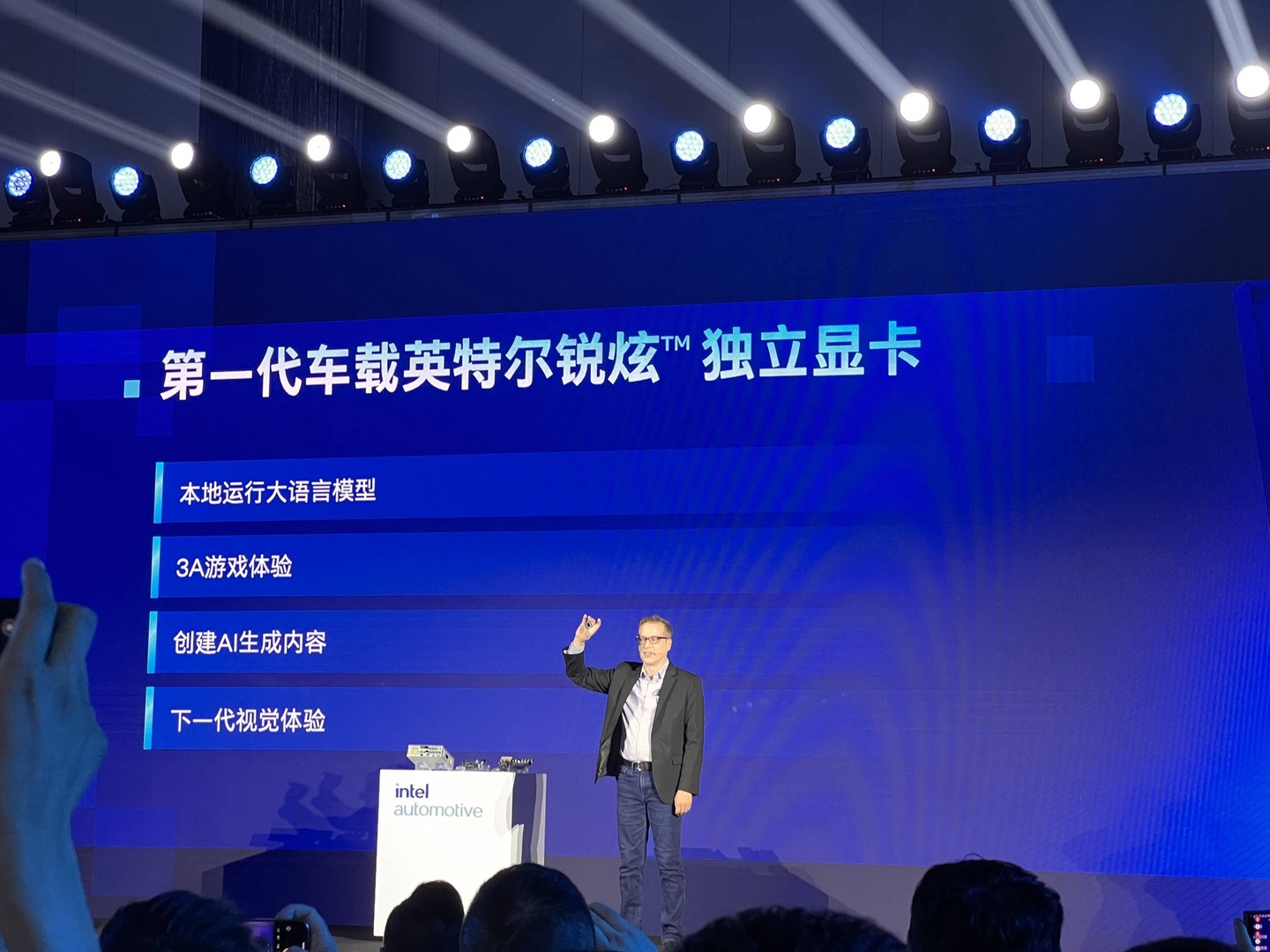
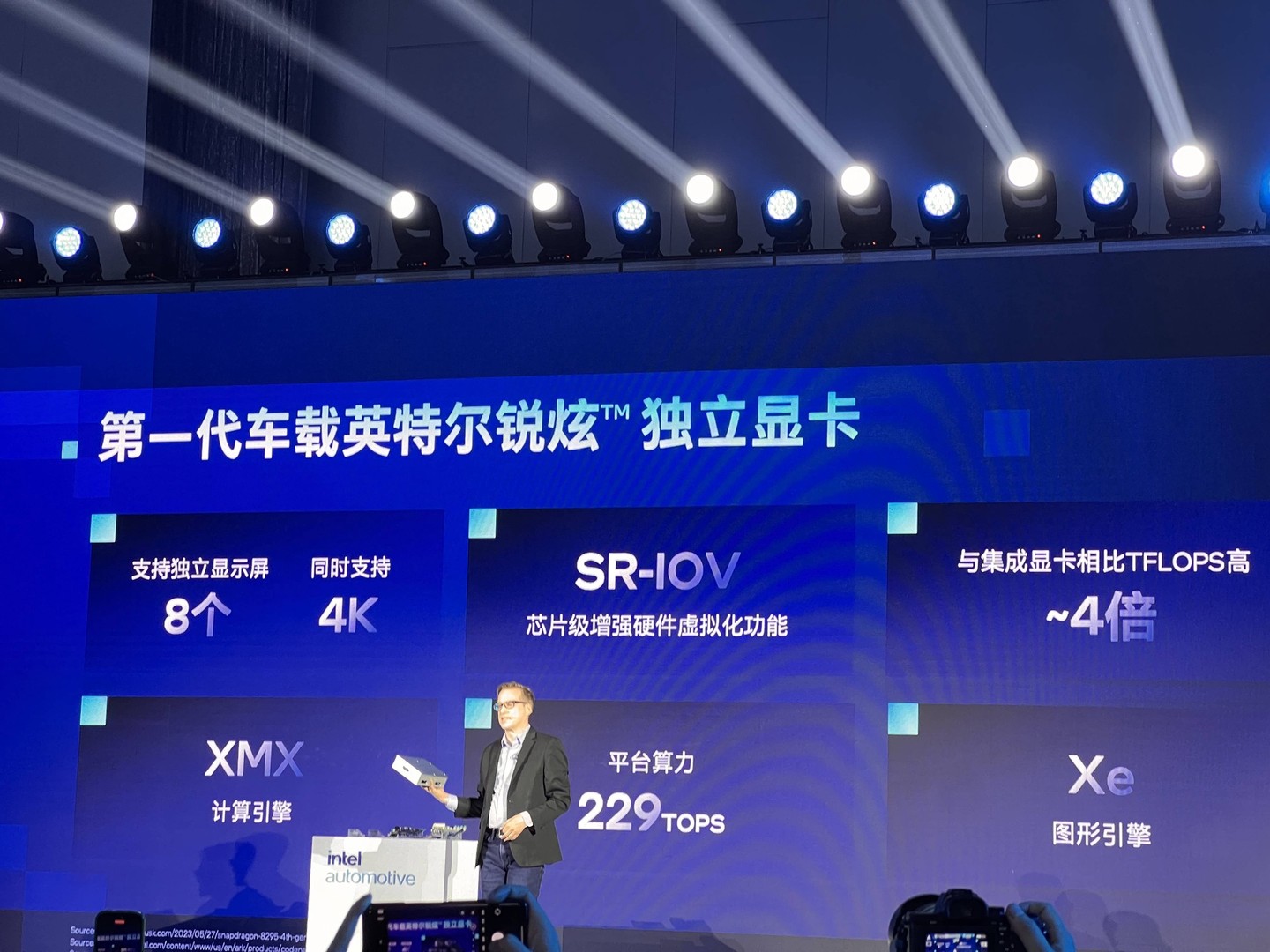
Seven months later, Intel launched the second product in the in-vehicle product line - the first independent cockpit graphics card dGPU Ruixuan. This independent graphics card has 229TOPS AI computing power, supports the deployment of AI large models with a scale of over 14 billion parameters locally, and is expected to be commercially available as early as 2025.

For entry-level and mid-range vehicle models, the computing power of the in-vehicle SoC can meet the requirements; for high-end models with higher demands for AI computing power and graphics processing capabilities, they can choose to use the Arc A760 in-vehicle independent graphics card.

Since the beginning of this year, the automotive market has been accelerating the deployment of large models. Companies such as Nio and Li Auto are accelerating the deployment of large models. However, due to the high computing power requirements of large models, automotive companies deploy large language models in the cockpit through cloud training, which may have certain limitations, such as strong network dependency and security issues.

"In the market, chips for car systems claiming to be able to run large models with 30 to 40 TOPS can basically only be used for demo displays. If a 6-7 billion large model is compressed to a 30-40 TOPS NPU, the response time of the first token is basically more than 3 seconds, which users cannot accept." Gao Yu, General Manager of Intel China's Technical Department, said in a post-meeting exchange.

Gao Yu pointed out that deploying large models on the terminal side can reduce dependence on the network, ensure extremely low latency, store data locally, and avoid the risk of information leakage.

Intel clearly realized the limitations of the cockpit SoC's computing power for deploying large models at the beginning of the year, so it accelerated the launch of an independent graphics card with a platform computing power of 229TOPS.

From the on-site demonstration, high-computing cockpit chips have two main application scenarios - one is graphic rendering, making the car interface display more exquisite car models, more realistic weather, day and night effects, etc.; the other is AI performance.

The AI performance in the cockpit can be further divided into two levels, one is traditional AI in the cockpit, such as DMS (driver monitoring system), voice interaction, gesture control, and other standard functions; the other is generative AI, that is, deploying large language models in the car. According to the test results, Intel's in-vehicle A760-A runs a 6B model, with a first token latency of 0.058 seconds, achieving a throughput of 88 tokens per second, equivalent to 150 Chinese characters According to the on-site demonstration by Intel's partner Zhipu AI, deploying large models on Intel chips at the edge can recognize user needs through voice, for example, opening the air conditioning when the user mentions "it's a bit hot in the car".

Cabin and Autonomous Driving: Intel's 10-year Swerve

As Intel accelerates its layout of automotive cabin chips, Intel and Qualcomm, the two chip manufacturers, will once again face off in the automotive market. However, the two are no longer on the same starting line.

During the time Intel missed out on the automotive market, Qualcomm has become a leading player in the cabin field, while Intel now looks more like a follower.

As a player who once stood at the crossroads of automotive electrification and intelligence transformation, Intel got up early but arrived late.

The gradual move towards intelligent automotive cabins began after the release of the Model S in 2012. Tesla strengthened vehicle function control through a central console similar to an iPad, enabling control of functions such as air conditioning, audio entertainment, lighting adjustment, seat heating, and sunroof opening, breaking the traditional in-car infotainment system.

It is worth mentioning that prior to this, Intel had already participated in the automotive automation process by providing infotainment systems. However, with the launch of the Tesla Model S and the subsequent wave of autonomous driving, Intel changed its strategy.

After recognizing the trend of autonomous driving, Intel established a new automotive product R&D center in Germany, its first R&D center in the automotive industry, and collaborated with car manufacturers such as Jaguar Land Rover and Toyota to jointly develop new technologies including in-car infotainment systems, assisted driving, self-parking, and autonomous driving.

Although Intel initially focused on in-car infotainment systems, it had already sensed the wave of artificial intelligence and autonomous driving at that time. A concrete example is Intel's acquisitions around 2015 of programmable logic device manufacturer Altera (the largest acquisition in Intel's history) and Russian computer vision company Itseez, accelerating its layout in autonomous driving.

Furthermore, in 2016, Intel partnered with BMW and Mobileye to jointly develop solutions for autonomous driving and innovative systems, planning to achieve mass production of highly automated and fully automated vehicles in 2021.

At that time, Intel placed great emphasis on the development of autonomous driving internally, establishing a dedicated autonomous driving group led by Intel IoT business executive Davis.

In early January 2017, Intel announced the launch of the Intel Go platform, offering two major versions - one using Atom processors with FPGA, and the other using high-performance Xeon processors with FPGA, further boosting Intel's development in the autonomous driving business.

A significant moment in Intel's advancement in autonomous driving was the acquisition of Mobileye for $15.3 billion. It is important to note that at that time, Mobileye's products covered almost all mainstream car brands, including Tesla, Nio, Li Auto, Great Wall Motors, and other car manufacturers that used Mobileye's solutions A turning point occurred after the acquisition. Although Intel acquired Mobileye, the latter basically maintained independence in its operations. However, after Intel handed over the responsibility for autonomous driving to Mobileye, its presence in the automotive industry gradually weakened.

Subsequently, it can be seen that Intel's presence in the automotive industry has become increasingly weaker. Due to the "black box mode" limiting car manufacturers' independent adjustment and upgrading of software and algorithms, Mobileye's market share has been gradually eroded by competitors such as NVIDIA and Horizon Robotics.

While Intel neglected to layout in the cockpit field, Qualcomm quickly opened up the market in the automotive cockpit field with products such as Snapdragon 820A and Snapdragon 8155P, firmly establishing its position.

In the end, despite years of presence in the automotive market, Intel lost its leading position due to its lack of strategic firmness.

Does Intel still have a chance?

Intel does have the opportunity to catch up.

In terms of products, judging from the two recent releases this year, Intel is accelerating its layout in the cockpit market, especially with the release of independent graphics cards. With the trend of AI large model acceleration, its high computing power undoubtedly provides OEMs with a new option.

"Nowadays, the R&D cycle of a car from project initiation to SOP is approximately 18-24 months. In the AI era, no one can clearly predict what AI will look like in 18-24 months, or what killer AI applications will emerge. So when we design today, we embed the anticipated AI computing power, laying the foundation for the future through scalable forms." Li Zhe said.

In terms of technology, based on the Chiplet architecture, Intel can provide customized computing platforms for car manufacturers, integrating chiplets designed by OEMs with Intel's CPU, GPU, and NPU product lines to form a differentiated cost.

Furthermore, based on the integration of the x86-supported software ecosystem, it can provide drivers or passengers with an in-car experience that integrates entertainment, multimedia, and teleconferencing functions, allowing various operating systems including AutoSAR, Linux, Windows, and Android to run in parallel on the same chip.

In terms of manufacturing, under the IDM 2.0 strategy, Intel has chip manufacturing capabilities. "Intel has a thousand billion reasons to deeply cultivate the automotive industry in the long term, because we have invested $100 billion in chip capacity." Wester said.

However, Intel's weakness lies in the fact that its cockpit chip products have not yet achieved large-scale commercialization.

Currently, only ZEEKR publicly adopts Intel's in-vehicle cockpit SoC series. However, given that Intel invested in ZEEKR in August 2021, cooperation between the two parties is reasonable. Outside of these relationships, no OEMs have clearly stated their adoption of Intel's cockpit chips. Although the official statement mentioned obtaining some designated vehicle models, specific numbers have not been disclosed.

Compared to the strong competitor Qualcomm, which has commercialized multiple products, it is crucial for Intel to accelerate the commercialization of intelligent cockpit products in order to compete in this field

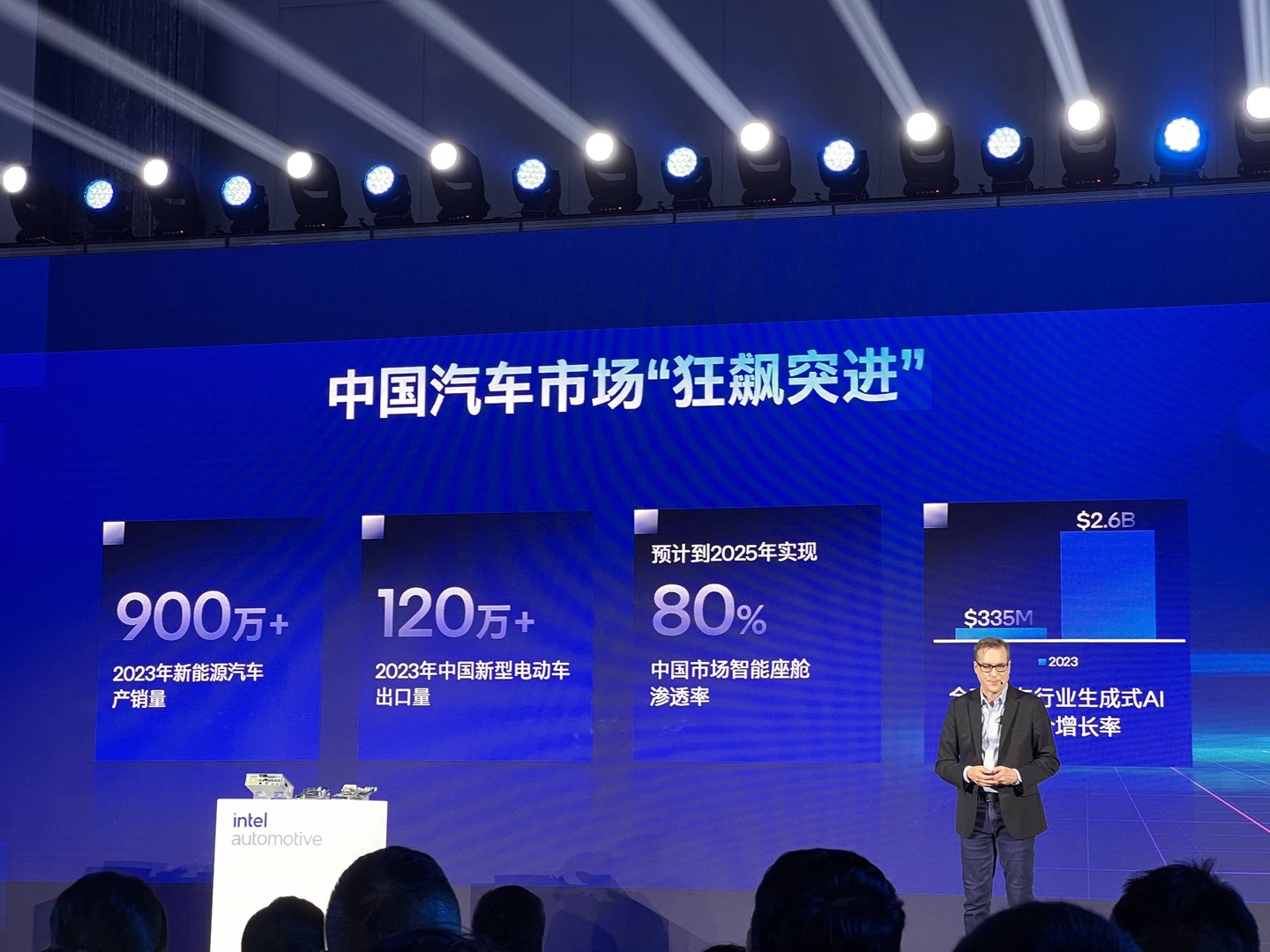
Especially as Chinese car companies are rapidly advancing towards the application and implementation of large language models, Intel has also shown strategic inclinations. The Chinese market has become an important market for Intel's automotive business that cannot be overlooked.

One detail is that Intel's automotive business headquarters is established in China, and the General Manager of its Automotive Division, Jack Weast, has also come to work in China. Jack Weast stated at a press conference that Intel currently has over 2500 engineers conducting research and development work in China.

Whether Intel's re-entry will stir up a storm in the industry remains to be seen, but what can be confirmed is that with Intel's accelerated entry, Qualcomm is no longer the sole preferred choice for automakers